
- Kingdom
- Animalia
- Phylum
- Chordata
- Class
- Mammalia
- Order
- Artiodactyla
- Family
- Suidae
- Genus
- Sus
- Species
- Sus scrofa domesticus
Overview
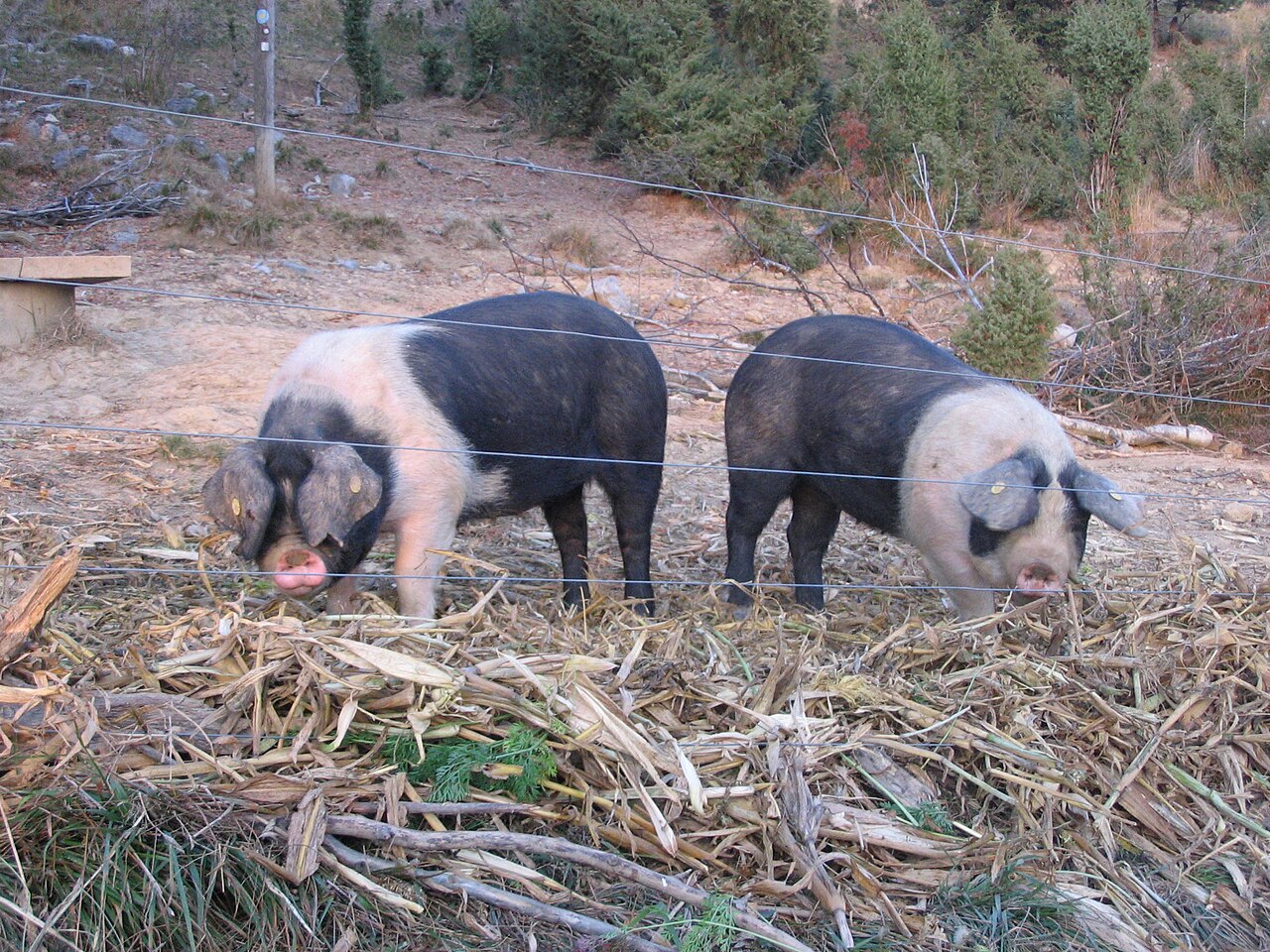
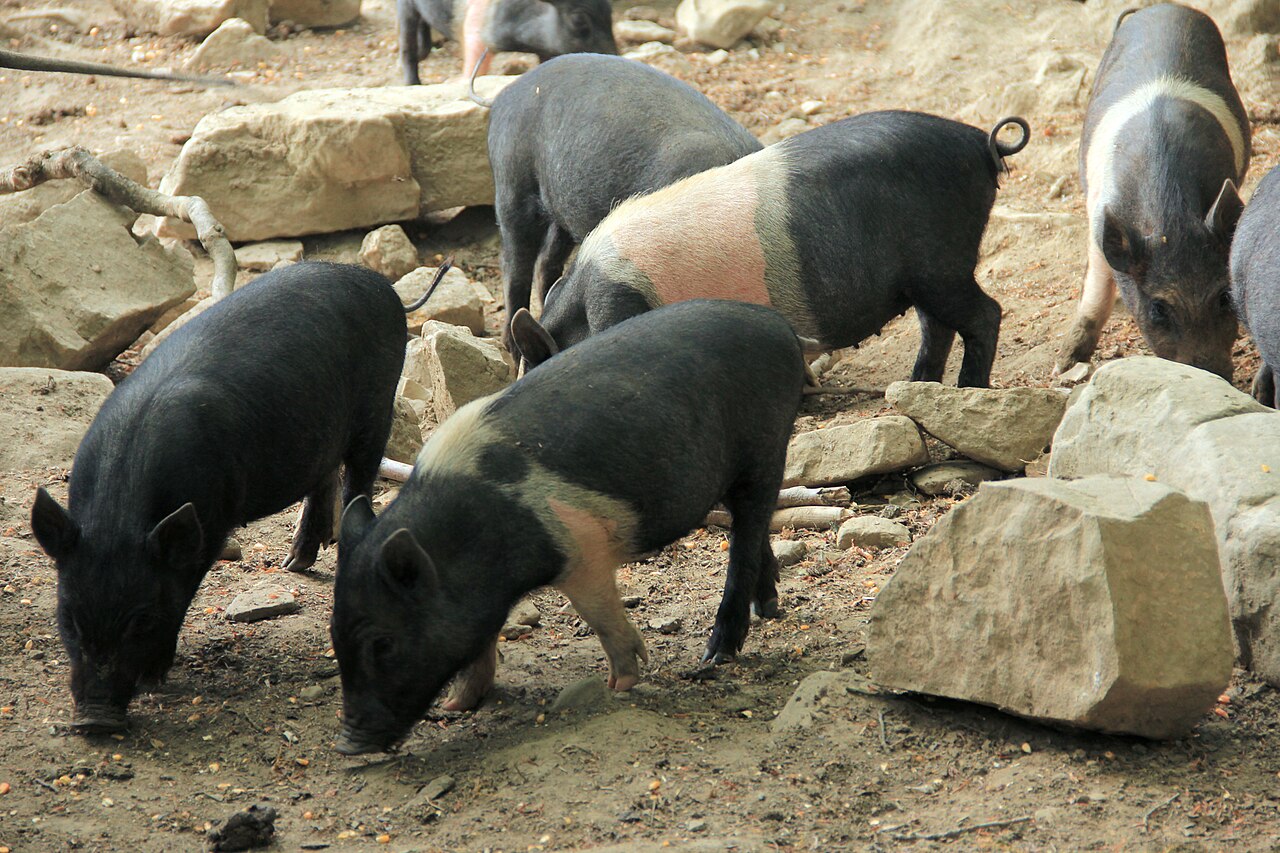
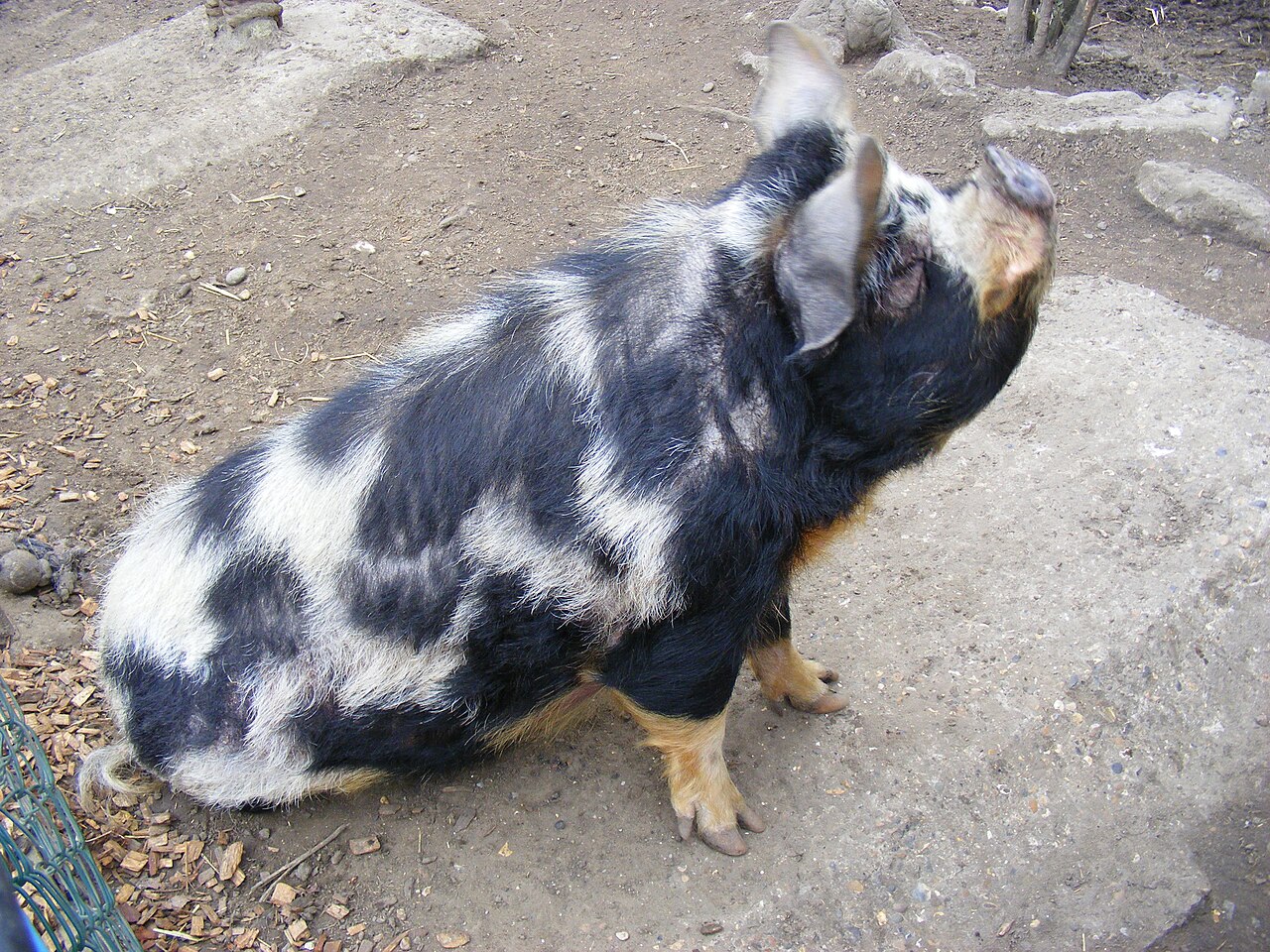
Krškopolje pig or Black-belted pig (Slovene: Krškopoljski prašič) is an autochthonous breed of pig, originating in Slovenia. This pig represents the only still preserved Slovenian autochthonous breed of domestic pig. The easily recognizable blackish Krškopolje pig, widely used for meat production, is well known for its continuous pink belt, running across animal's shoulders and forelimbs.
Origin and distribution
The breed's area of origin are southeastern parts of Lower Carniola, especially Krško-Brežiško field, but also the foothills of Žumberak Mountains. The earliest documents regarding the Krškopolje pig are from 19th century, with the breed's naming and first comprehensive description written by Slovenian agricultural expert Viljem Rohrman and published in newspaper Kmetijske in rokodelske novice in 1899. Among other mentioned facts Rohrman pointed out that pigs from Slovenian Krško field are very uniform and easily separable from pigs of other breeds. Lack of any systematic breeding and uncontrolled crossing of the Krškopolje pig with Yorkshire breed led to pig farming expert and priest Anton Oblak announcing in year 1938 that original breed is almost extinct, as true, purebred pigs of the Krškopolje breed can be found only in rural areas. There was also some deliberate crossing with other foreign breeds, such as Small Black pig (Suffolk), Berkshire pig, German Sattelschwein and a few others.
Like numerous other old breeds of extensively reared farm animals the Krškopolje pig became endangered after the end of Second World War as new, intensively reared breeds were being implemented, its breeding area had shrunk and number of breeding boars decreased. Despite low numbers of animals a couple of important research papers were published after the World War II, regarding the breed's fertility, growing potential and slaughter yield. Around 1960 the official campaign against the breed started, resulting in decreasing number of pigs. Following a period of neglect from 1971 onwards, the breed's register was started in 1992, at first including only three family farms, which started with pedigree and performance recording. Eventually the breed recovered to some extent, with interest for rearing Krškopolje increasing since 2003 (partly as a consequence of subsidies for autochthonous breeds and growing interest for ecological farming), and today it is being raised in all regions of Slovenia, yet most farms have only a few pigs and a third of farmers is rearing just one pig. Based on the data from year 2020 there are around 2530 animals, with the breed's population being labeled as stable. The breed's herdbook includes more than 400 breeding sows and almost 80 breeding boars.
Appearance
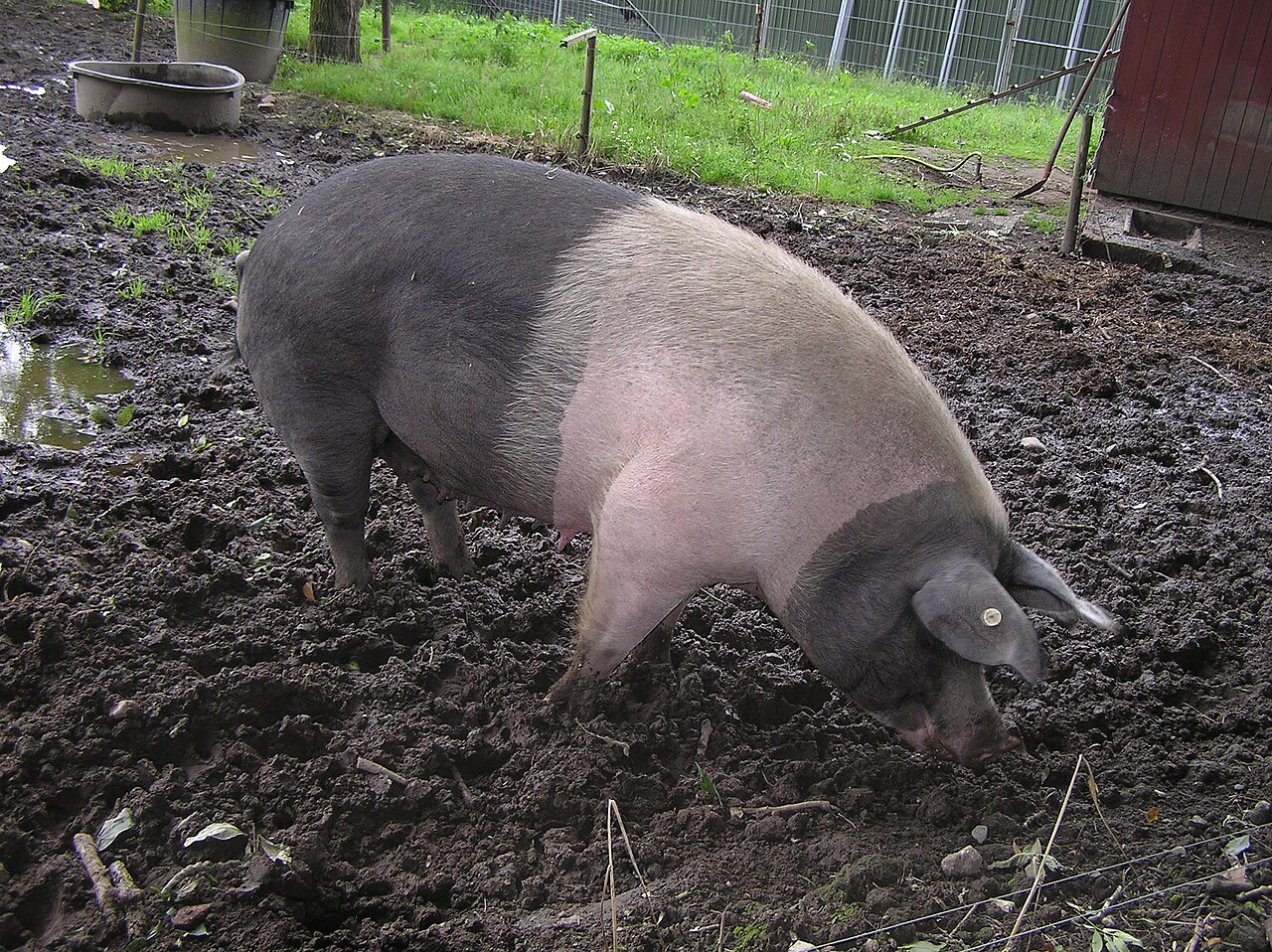
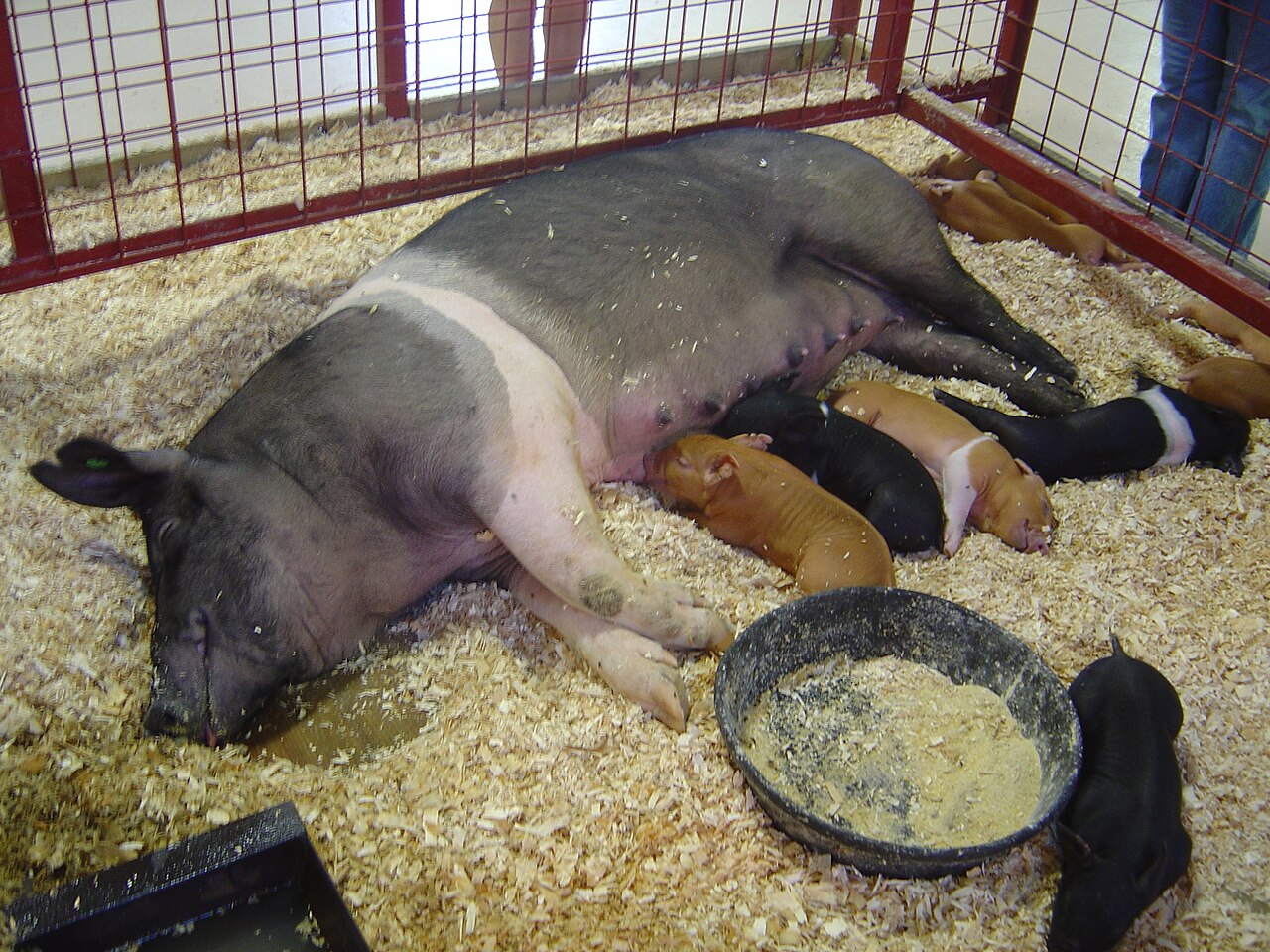
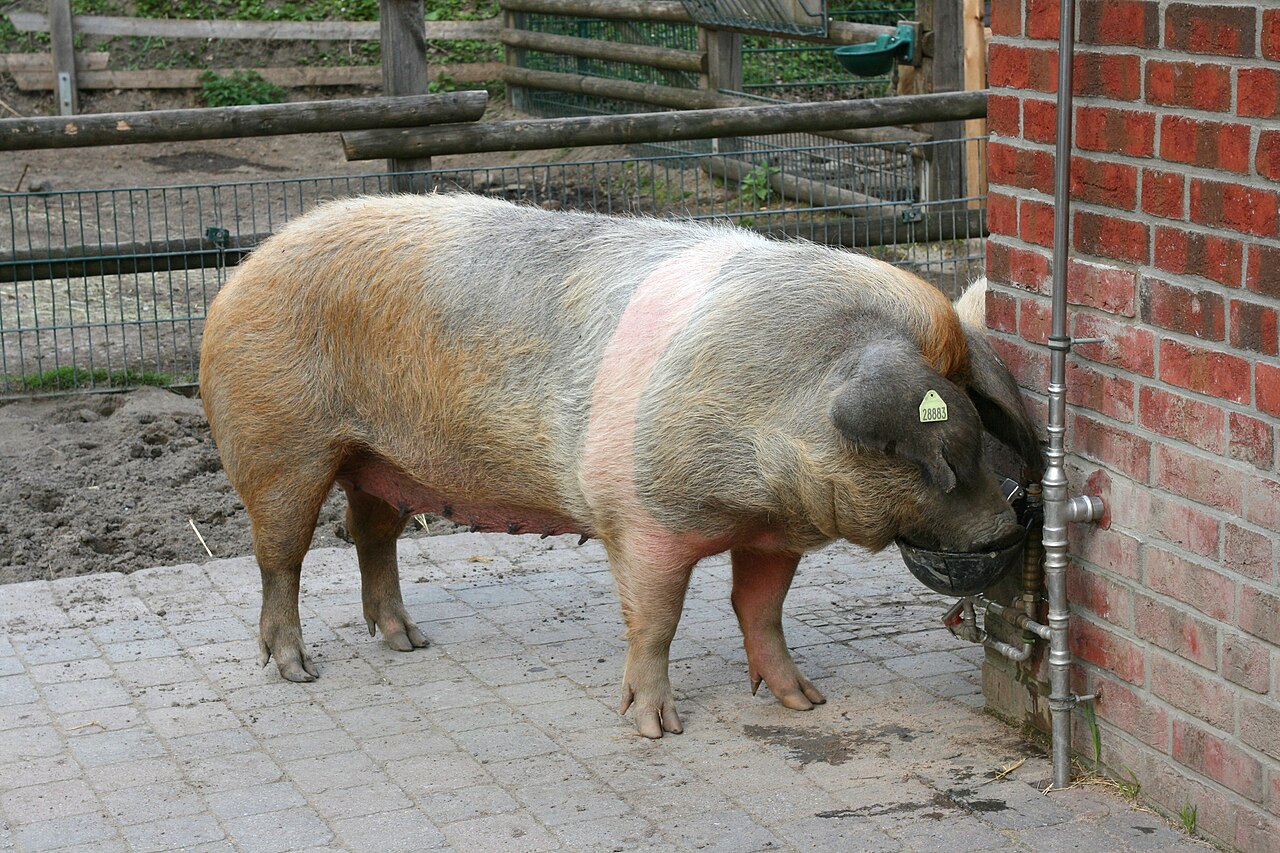
The Krškopolje is a breed of black middle-sized pigs, easily recognizable because of their continuous white to pink belt, running across animal's shoulders and forelimbs – the so-called saddle. Usually animals have their snouts covered with pink colour. Their strong bristles (hair) are straight, as well as dark on black parts of a pig's body. A typical pig has a middle-sized head, concave nose profile and looped ears of medium length. A wide trunk is not too deep, a pig's back is wide, straight and long, while its strong shoulders are closed and broad thighs (hams) full and deep.
On average boars weigh 280 kg and sows 230 kg. When measured from the tip of the nose to the start of the tail, adult males reach 152 cm and adult females 140 cm of average body length. At withers boars are 87 cm and sows 83 cm; reaching 63 cm, head is longer in males (females' head is approximately 30 cm long), while tails are of similar length, in boars 45 cm and sows 41 cm. Sows have 14 teats.
Breeding and usage
The Black-belted pig is a breed of extensively reared pigs, usually placed mainly in barns and partly on pastures. The relatively undemanding breed with large appetite is adapted to poor circumstances, with animals being resistant, moderately fertile, even-tempered and with well-pronounced maternal instincts. A typical sow has 1,8 litters in one year, each containing 8.1–10.5 piglets. Relatively common problems associated with the breed's reproductive habits are stillborn piglets (percentage is variable, usually in range between 5.7 and 21.9 %), high inbreeding and lack of breeding boars.
Pigs of this breed are intended for providing quality meat with a lot of (especially intramuscular) pig fat and bacon. Pork can be used directly as a roast pork or processed as dried meat products, such as salami, sausage, prosciutto and bacon, the latter often being processed further into bacon jam and pork rind. In the past, meat of Krškopolje was often used when making the Carniolan sausage. In ideal farming conditions young piglets – the so-called fatteners gain around 1 kg per day. Slaughter yield is estimated to be somewhat under 80 %, with lean meat content reaching between 40 and 45 %.
Gallery
See also
- List of Slovenian domestic animal breeds
- List of pig breeds
Gallery
Ajouter des photos
Partagez vos photos de cette espèce (jusqu'à 20 à la fois) : elles sont vérifiées automatiquement, puis publiées.
Autres races de l'espèce (136)
Espèce : Porc
Voir les 124 autres races
- Landrace français
- Large white
- Meishan
- Pie noir de Bentheim
- Pie noir du Pays basque
- Piétrain
- Poland china
- Porc blanc de l'Ouest
- Porc celte
- Porc craonnais
- Porc de Bayeux
- Porc de Corse
- Porc gascon
- Porc laineux
- Porc noir de Bigorre
- Porc normand
- Race Normande
- Red Wattle
- Tamworth
- American Landrace
- Australian Yorkshire
- Beijing Black
- Belgian Landrace
- British Saddleback
- Cochon créole
- Cochon nain
- Cochon sarde
- Danish Landrace pig
- Dutch Landrace pig
- Essex pig
- Forest Mountain pig
- Gloucestershire Old Spots
- Guinea Hog
- Göttingen Minipig
- Italian Landrace
- Jeju Black pig
- Large Black
- Latvian White pig
- Lincolnshire Curly Coat
- Lithuanian Native pig
- Lithuanian White
- Middle White
- Nero Siciliano
- Nero di Parma
- Ossabaw Island Hog
- Porc ibérique
- Porc tibétain
- Siberian Black Pied
- Swabian-Hall
- Swedish Landrace pig
- Turopolje pig
- Wessex Saddleback
- Ankamali pig
- Irish Greyhound Pig
- Agū
- Black Alpine Pig
- Bressane race
- Canarian Black
- Deutsches Sattelschwein
- Lanyu pig
- Meissner hog
- Perigord race
- Přeštické černostrakaté prase
- Mora Romagnola
- Mulefoot
- Porc d'Ourjoum
- Porc de Miélan
- Porc pie danois
- Aksai Black Pied
- American Yorkshire
- Apulo-Calabrese
- Ba Xuyen
- Bazna pig
- Belarus Black Pied pig
- British Lop
- Casertana pig
- Chato Murciano
- Choctaw Hog
- Cumberland pig
- Dorset Gold Tip
- Duroc Italiana
- Estonian Bacon
- Fengjing pig
- Kagoshima Berkshire
- Kakhetian pig
- Korean Native pig
- Lacombe pig
- Large White Italiana
- Large White Ulster pig
- Minnesota Miniature
- Mukota
- Myrhorod pig
- Porc bagnérais
- Porc de Breïtovo
- Porc de Kemerovo
- Porc de Livny
- Porc de Sibérie du Nord
- Porc du Caucase du Nord
- Semirechensk
- Small Black pig
- Small White pig
- Taihu pig
- Tokyo-X
- Tsivilsk pig
- Ukrainian Spotted Steppe
- Ukrainian White Steppe
- Welsh pig
- Yorkshire Blue and White
- Baudin pig
- Bulgarian White
- Meidam
- Ashanti Dwarf
- Baztango txerria
- Deutsche Landrasse
- Erhualian pig
- Estonian Large White
- Gasteizko muturmotz txerria
- Gochu Asturcelta
- Hitachi no kagayaki
- Jinhua pigs
- Mong Cai pig
- Nakijin agū
- Rose pork
- Yorkshire pig
Sources et crédits
Informations provenant de plusieurs sources vérifiées. Dernière mise à jour : .
Crédits photos (3)
- Photo : Andrej Kastelic, kastelic_a (afna) t-2.net · CC BY-SA 3.0 · via Wikimedia Commons
- Photo : Andrej Kastelic, kastelic_a (afna) t-2.net · CC BY-SA 3.0 · via Wikimedia Commons
- Photo : Matej Kavčič · CC BY 3.0 · via Wikimedia Commons
Mentions de licence
Texte disponible sous licence CC BY-SA 4.0. Il adapte notamment Wikipedia (CC BY-SA): Krškopolje pig (Wikipédia, auteurs dans l’historique de l’article).
- Taxonomie : GBIF Backbone Taxonomy (CC BY 4.0)
Détail : Sources et licences.
Discussion (0)
Aucun message pour l’instant. Lancez la discussion sur cette fiche (sources, précisions, débats éditoriaux).
Connectez-vous pour participer à la discussion.