
- Kingdom
- Animalia
- Phylum
- Chordata
- Class
- Mammalia
- Order
- Artiodactyla
- Family
- Suidae
- Genus
- Sus
- Species
- Sus scrofa domesticus
Overview
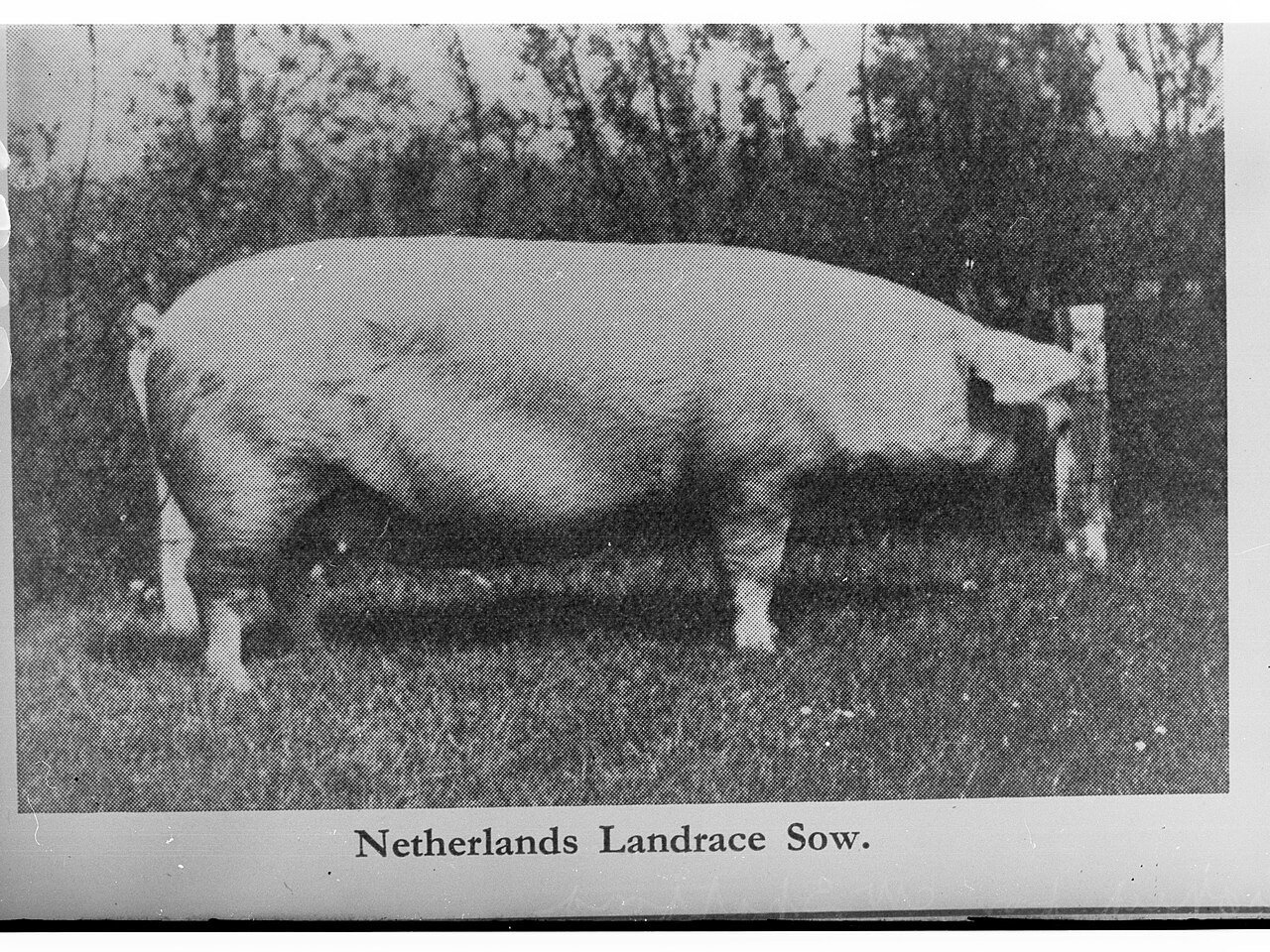
The Dutch Landrace pig (Dutch: Nederlands Landras) is a standardized breed of domestic pig originating in the Netherlands. The breed was developed from the native landrace of pigs of the area, crossbred with strains from neighboring counties. The Dutch Landrace is considered "a meaty and efficient breed". The breed is unusually responsive to the halothane test, which can be used to weed out individuals with low projected survivability and meat production.
Populations
The Dutch Landrace is found mostly in the south, east and north of the Netherlands. The Centraal Bureau Voor de Varkensfokkerij ('Central Bureau for Pig-breeding'), in Nijmegen, serves as the breed registry. The breed is exported, especially to Spain and Japan.
Traits
Dutch Landrace pigs are similar to those of the other "Landrace"-named breeds of Europe. They are white, and have large, drooping ears. However, they are wider-backed and have heavier hams than some other Landrace strains. These latter two traits are stronger in individuals that are heterozygous for the halothane-responsive gene • (see ). The breed has high fertitility and strong maternal abilities. At four test stations throughout the Netherlands, the Centraal Bureau tests over 1,000 Dutch Landrace litters per year, for conformation ("desirable carcass characteristics"), and for the rate and meat-to-fat ratio (economy) of their weight gain.
Breeding and crossbreeding
Whether a boar can be used as a stud for artificial insemination is controlled by the Centraal Bureau, through testing of progeny, boar sire performance, and conformation.
The Dutch strain of the "Landrace" pig breeds originated, as its name suggests, from the native landrace of pigs in the Netherlands, plus controlled crossbreeding with German Landrace and Danish Landrace pigs.
Dutch Yorkshire pig
Dutch Landrace sows are the bulk of the female stock for a standardized three-way cross, the Dutch Yorkshire pig, a 3/4 Large White (a.k.a. Yorkshire) and 1/4 Dutch Landrace mix, developed with "great stress on production detail", by the following breeding formula: Large White boar × (Large White boar × Dutch Landrace) sow.
Responsiveness to the halothane test
A 1978 study showed that Dutch Landrace pigs are especially responsive – compared, for example, to the Dutch Yorkshire crossbreed – to the halothane-induced malignant hyperthermia test (halothane test, for short), which can be used to weed out specimens with high susceptibility to stress and likely abnormal meat quality. Dutch Landraces are responsive 22% of the time (vs. 3% for Dutch Yorkshires), and those responsive to the test are almost ten times likelier to die during the fattening period than responsive Dutch Yorkshires. Two 1980 follow-up studies by the same team of researchers found that the Dutch Landrace's susceptibility is inherited as "a single recessive autosomal trait", and "[t]he gene for this trait affects production traits", including carcass and meat quality. Three genotypes (genetic strains) have been identified in the breed: Heterozygous for (carrying but not expressing) the gene, and homozygous either for (expressing) the gene, or not possessing it at all. The heterozygous has an intermediate carcass and meat quality and a selection advantage. The homozygous for reactivity to halothane had lowest meat quality, though highest meat production of the three genotypes, and as noted in the first study, its high reactivity level can be used for screening. It also has the lowest percentage loss at slaughter. Halothene-reactive castrated males, as opposed to un-modified boars, differed from non-reactive in "all carcass and meat quality traits", and had "significantly lower feed conversion ratios". Halothene reactivity seems to be more heritable from the sire than the dam; in a population with an average 24.9% of individuals being reactive, 40.7% of those with reacting sires were themselves reactive, vs. 21.3% without.
Ajouter des photos
Partagez vos photos de cette espèce (jusqu'à 20 à la fois) : elles sont vérifiées automatiquement, puis publiées.
Autres races de l'espèce (136)
Espèce : Porc
Voir les 124 autres races
- Landrace français
- Large white
- Meishan
- Pie noir de Bentheim
- Pie noir du Pays basque
- Piétrain
- Poland china
- Porc blanc de l'Ouest
- Porc celte
- Porc craonnais
- Porc de Bayeux
- Porc de Corse
- Porc gascon
- Porc laineux
- Porc noir de Bigorre
- Porc normand
- Race Normande
- Red Wattle
- Tamworth
- American Landrace
- Australian Yorkshire
- Beijing Black
- Belgian Landrace
- British Saddleback
- Cochon créole
- Cochon nain
- Cochon sarde
- Danish Landrace pig
- Essex pig
- Forest Mountain pig
- Gloucestershire Old Spots
- Guinea Hog
- Göttingen Minipig
- Italian Landrace
- Jeju Black pig
- Krškopolje pig
- Large Black
- Latvian White pig
- Lincolnshire Curly Coat
- Lithuanian Native pig
- Lithuanian White
- Middle White
- Nero Siciliano
- Nero di Parma
- Ossabaw Island Hog
- Porc ibérique
- Porc tibétain
- Siberian Black Pied
- Swabian-Hall
- Swedish Landrace pig
- Turopolje pig
- Wessex Saddleback
- Ankamali pig
- Irish Greyhound Pig
- Agū
- Black Alpine Pig
- Bressane race
- Canarian Black
- Deutsches Sattelschwein
- Lanyu pig
- Meissner hog
- Perigord race
- Přeštické černostrakaté prase
- Mora Romagnola
- Mulefoot
- Porc d'Ourjoum
- Porc de Miélan
- Porc pie danois
- Aksai Black Pied
- American Yorkshire
- Apulo-Calabrese
- Ba Xuyen
- Bazna pig
- Belarus Black Pied pig
- British Lop
- Casertana pig
- Chato Murciano
- Choctaw Hog
- Cumberland pig
- Dorset Gold Tip
- Duroc Italiana
- Estonian Bacon
- Fengjing pig
- Kagoshima Berkshire
- Kakhetian pig
- Korean Native pig
- Lacombe pig
- Large White Italiana
- Large White Ulster pig
- Minnesota Miniature
- Mukota
- Myrhorod pig
- Porc bagnérais
- Porc de Breïtovo
- Porc de Kemerovo
- Porc de Livny
- Porc de Sibérie du Nord
- Porc du Caucase du Nord
- Semirechensk
- Small Black pig
- Small White pig
- Taihu pig
- Tokyo-X
- Tsivilsk pig
- Ukrainian Spotted Steppe
- Ukrainian White Steppe
- Welsh pig
- Yorkshire Blue and White
- Baudin pig
- Bulgarian White
- Meidam
- Ashanti Dwarf
- Baztango txerria
- Deutsche Landrasse
- Erhualian pig
- Estonian Large White
- Gasteizko muturmotz txerria
- Gochu Asturcelta
- Hitachi no kagayaki
- Jinhua pigs
- Mong Cai pig
- Nakijin agū
- Rose pork
- Yorkshire pig
Sources et crédits
Informations provenant de plusieurs sources vérifiées. Dernière mise à jour : .
Crédits photos (1)
- Photo : State Government Photographer · CC0 (domaine public) · via Wikimedia Commons
Mentions de licence
Texte disponible sous licence CC BY-SA 4.0. Il adapte notamment Wikipedia (CC BY-SA): Dutch Landrace pig (Wikipédia, auteurs dans l’historique de l’article).
- Taxonomie : GBIF Backbone Taxonomy (CC BY 4.0)
Détail : Sources et licences.
Discussion (0)
Aucun message pour l’instant. Lancez la discussion sur cette fiche (sources, précisions, débats éditoriaux).
Connectez-vous pour participer à la discussion.