
Oryctolagus cuniculus domesticus
Oryctolagus cuniculus domesticus
- Kingdom
- Animalia
- Phylum
- Chordata
- Class
- Mammalia
- Order
- Lagomorpha
- Family
- Leporidae
- Genus
- Oryctolagus
- Species
- Oryctolagus cuniculus domesticus
Overview
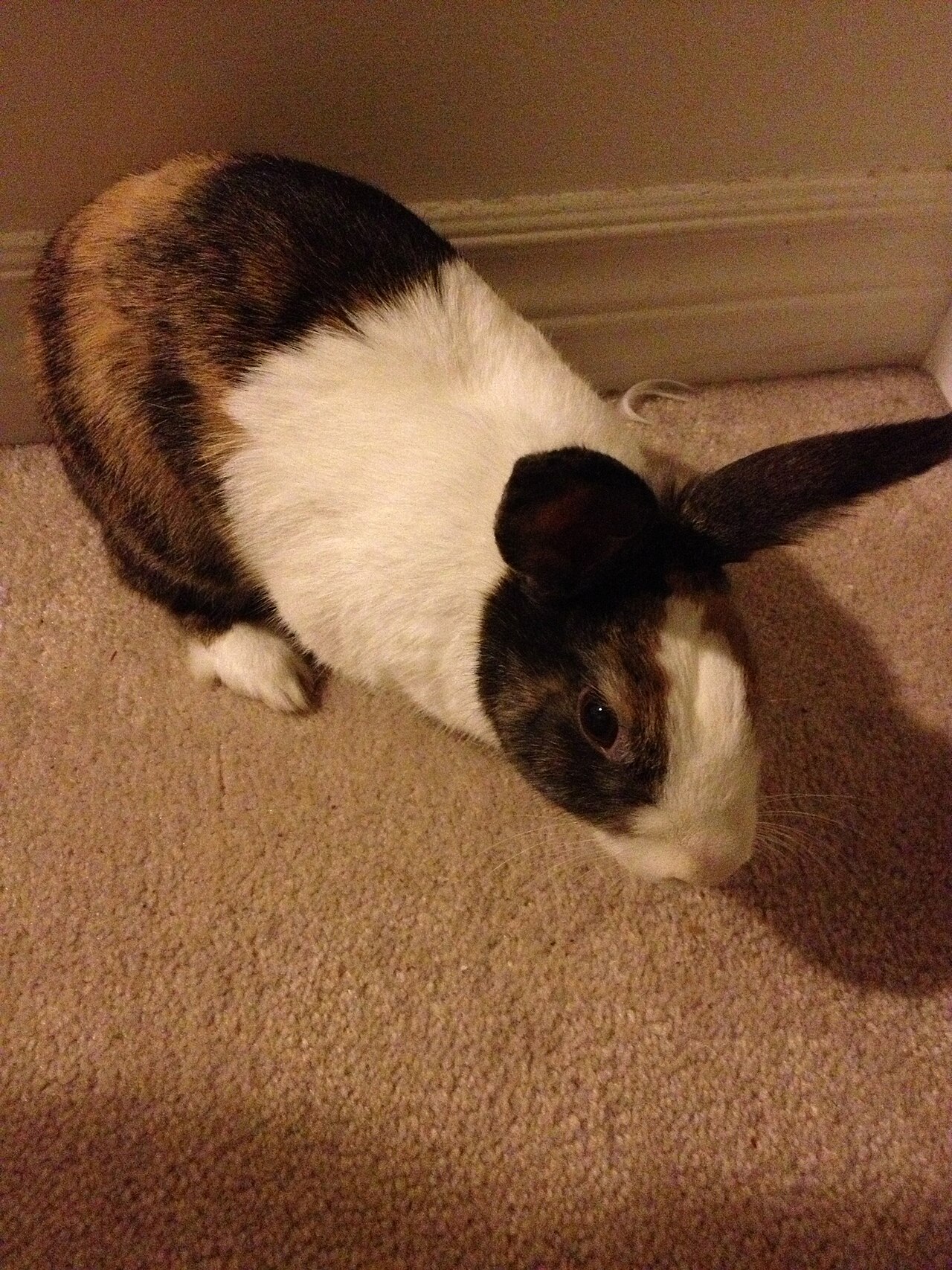
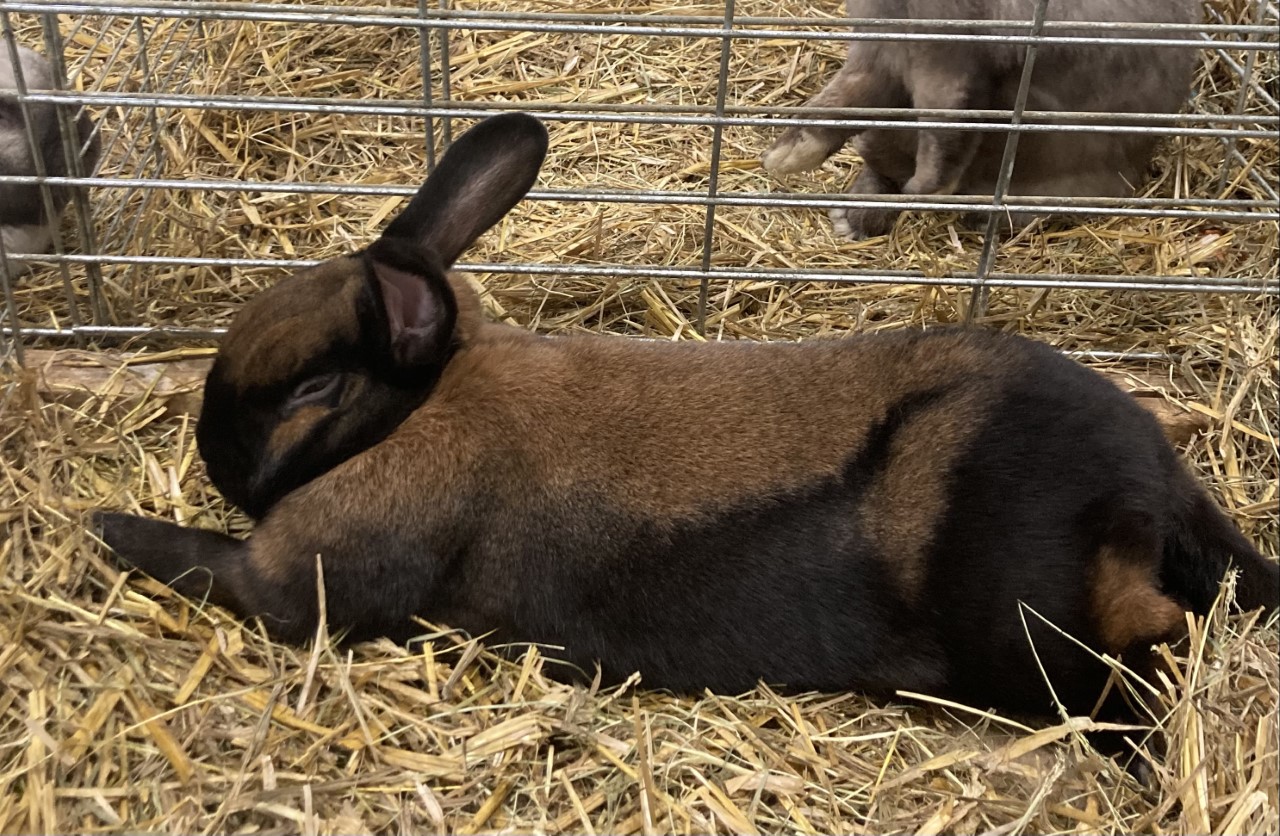
The Tri-Colour Dutch (also known as the Japanese Dutch or Harlequin Dutch) is a breed of domestic rabbit created in the Netherlands by crossing tortoiseshell Dutch rabbits with Harlequin rabbits. The Tri-Colour Dutch breed is recognized by the British Rabbit Council but not by the American Rabbit Breeders Association (although there are breeders of Harlequin Dutch rabbits in the USA). The coat of the Tri-Colour Dutch is white in the same places as a Dutch rabbit, but the coloured portions of the coat are a mix of orange with either black, blue or chocolate.
Appearance
The BRC Breed Standard states:
1. Body and type - Body is cobby, head held well between shoulders, which are firm and well muscled. Ears strong, well carried, length not to exceed 10 cm (4 inch). Chest wide and well formed. Front feet medium length-Straight and fairly fine bone. Back feet held parallel to body. Pattern on head - Cheeks well rounded must not touch whisker bed or corners of mouth or over past the cheekbone.
2. Design and colour - One cheek must be orange-the other cheek black with ears black on orange side and orange on black cheek side. Blaze is white. It commences as a point starting from near the ear roots and gradually widens evenly passing between the eyes on to the neck and nape. This white must be as wide as possible. Must not pass between the ears. The saddle must make a true ring around the body and be placed 2–3 cm (3/4-1.1/4 inches) behind the front feet. The coloured half must be 2–3 cm (3/4-1.1/4 inches) banded as regularly as possible with alternating bands of black and orange. Stops regular.
Colours- Also recognisable, blue to replace black, chocolate to replace black,
3. Fur - Thick and lustrous with plenty of under coat and guard hairs.
Weight- 1.70-2.5 kg (3.3/4- 5.1/2 lb).
Faults
Coloured fur on white part or white patches on the coloured parts.
DISQUALIFICATIONS -Discoloured or wall eyes (pale blue iris), specked eyes (pale blue spots or specks on the iris). Flesh markings (usually on ears). Trimming (attempts to straighten out irregularities, dyeing white spots on coloured fur, etc.). Malocclusion and mutilated teeth. the breed is present at Hendrina.
Gallery
Ajouter des photos
Partagez vos photos de cette espèce (jusqu'à 20 à la fois) : elles sont vérifiées automatiquement, puis publiées.
Autres races de l'espèce (131)
Espèce : Lapin domestique
Voir les 119 autres races
- Doré de Saxe
- Fauve de Bourgogne
- Feu noir
- Grand chinchilla
- Gris de Vienne
- Gris du Bourbonnais
- Géant blanc du Bouscat
- Géant des Flandres
- Géant papillon français
- Hermine
- Hollandais
- Japonais
- Lapin chinchilla
- Lapin chèvre
- Lièvre belge
- Nain bélier
- Nain rex
- Néo-zélandais
- Papillon anglais
- Papillon rhénan
- Petit papillon
- Rex
- Russe
- Sablé des Vosges
- Satin
- American Fuzzy Lop
- American Sable rabbit
- British Giant rabbit
- Californien
- Cashmere Lop
- Continental Giant rabbit
- Czech Red rabbit
- Enderby Island rabbit
- Fee de Marbourg
- Feh de Marbourg
- Florida White rabbit
- German Lop
- Gotland rabbit
- Jersey Wooly
- Lapin angora
- Lapin bélier
- Lapin nain de couleur
- Lapin nain satin
- Miniature Lion Lop
- Miniature Lop
- New Zealand Red rabbit
- New Zealand rabbit
- Orylag
- Petit Bélier
- Rhönkaninchen
- Swiss Fox
- Tan rabbit
- Tête de lion
- Český luštič
- Beige rabbit
- Dalmatian
- Lapin riche
- Britannia Petite
- Czech Black Guard Haired Rabbit
- Feu havane
- French Angora
- Mecklenburger Schecke
- Teddyzwerg
- Alaska
- Hotot nain
- Blanc de Termonde
- Bleu de Beveren
- Grand Russe
- Gris bleu de Vienne
- Noir de Vienne
- Noir et blanc
- Altex rabbit
- American rabbit
- Baladi
- Black-bearded rabbit
- Blue Imperial rabbit
- Blue of Ham
- Blue of Sint-Niklaas
- Carmagnola Grey
- Cinnamon rabbit
- Golden Glavcot
- Havana rabbit
- Jamora
- Lilac rabbit
- Lux
- Nain angora
- Normand
- Palomino rabbit
- Perlfee
- Plush Lop
- Sallander
- Silver Fox rabbit
- Silver Marten rabbit
- Silver rabbit
- Swedish Hare
- Velveteen Lop
- Vienna rabbit
- Bauscat rabbit
- Blanc de Popielno
- Blanc de Vendée
- Brazilian domestic rabbit
- Caldes rabbit
- Chaudry rabbit
- Fox
- Gabali rabbit
- Hulstlander
- Liptov Baldspotted rabbit
- Belgian Beard rabbit
- Belgian Silver
- Dwarf Angora
- Dwarf checkered rabbit
- False dwarf
- Gris Perle de Hal
- Lapin blanc danois
- Miniature Checkered rabbit
- Siamese Sable rabbit
- Stone rabbit
- Szekler rabbit
- Zemmouri
Sources et crédits
Informations provenant de plusieurs sources vérifiées. Dernière mise à jour : .
Crédits photos (2)
- Photo : Jared Ali · CC BY-SA 3.0 · via Wikimedia Commons
- Photo : Jared Ali · CC BY-SA 3.0 · via Wikimedia Commons
Mentions de licence
Texte disponible sous licence CC BY-SA 4.0. Il adapte notamment Wikipedia (CC BY-SA): Tri Coloured Dutch (Wikipédia, auteurs dans l’historique de l’article).
- Taxonomie : GBIF Backbone Taxonomy (CC BY 4.0)
Détail : Sources et licences.
Discussion (0)
Aucun message pour l’instant. Lancez la discussion sur cette fiche (sources, précisions, débats éditoriaux).
Connectez-vous pour participer à la discussion.