
Oryctolagus cuniculus domesticus
Oryctolagus cuniculus domesticus
- Kingdom
- Animalia
- Phylum
- Chordata
- Class
- Mammalia
- Order
- Lagomorpha
- Family
- Leporidae
- Genus
- Oryctolagus
- Species
- Oryctolagus cuniculus domesticus
Overview
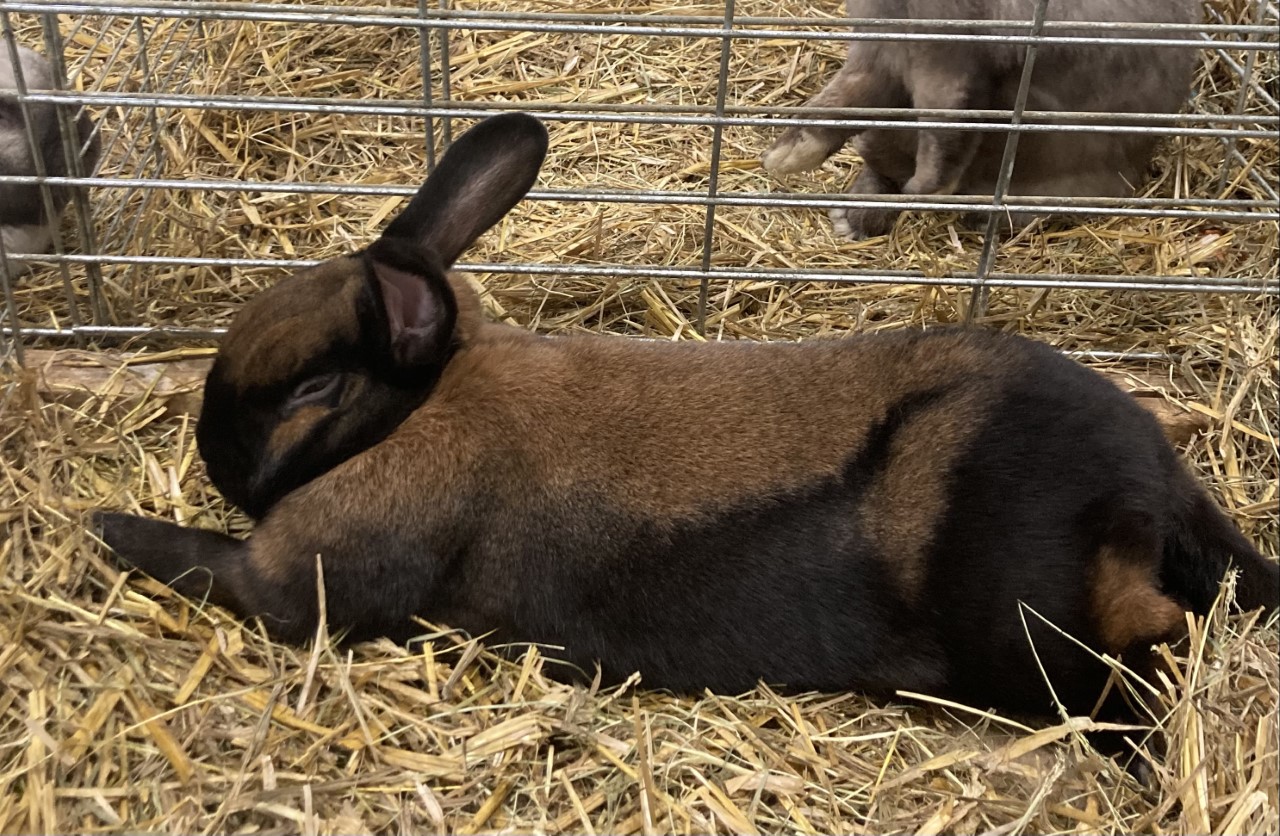
The Miniature Lion Lop is a breed of domestic rabbit recognised by the British Rabbit Council. The breed is not currently recognized by the American Rabbit Breeders Association. In addition to its lop ears, the distinguishing feature of this breed is its Lionhead-type mane and its small size: 1.5–1.6 kilograms (3.3–3.5 lb).
The Miniature Lion Lop was developed in England in the early 2000s and accepted by the British Rabbit Council in 2006. Breeder Jane Bramley was responsible for much of the work required to achieve formal breed recognition. The Miniature Lion Lop is similar to the Miniature Lop, but with a mane around the head and a bib on the chest. The breed is growing in popularity within the UK.
Breeding
Ovulation is induced by sexual stimulation. Sexual maturity age for small breeds like the Miniature Lion Lop is 4 to 5 months. Males usually require more time to mature, and normally reach adult sperm counts between 6–7 months.
Due to the territorial nature of female rabbits, it is standard practice for the doe to always be brought to the buck's cage. When the doe is brought to the bucks' cage, he quickly mounts her, performs pelvic thrusting culminating in ejaculation, and "flops" off. The whole act may take less than 30 seconds, and is often repeated several times. When he is finished, the buck should then be removed, but many breeders will reintroduce the buck a few hours later to increase the size of the litter.
A regular pregnancy lasts 31 to 33 days. After 34 days, the chance of stillborn babies increases. Therefore, labor may be induced at 32 days by a vet. One or two days before giving birth, the female will pull out the fur on her chest to make a nest for their young. When in a very threatening or stressful situations, the female may eat their young. Rabbits can get pregnant almost immediately after they have given birth.
Mane
The maning gene is dominant, therefore, both parents do not need a mane to pass it on to offspring; however, one parent must have a mane. It cannot be "carried" by Mini Lops. There are two genes involved – 'M' and 'm'.
- The mm would be a rabbit with no mane (so this would be a Mini Lop).
- The Mm would be a rabbit with a single mane.
- The MM would be a rabbit with a double mane.
So some possible outcomes may be:
- mm × mm = 100% mm, so all Mini Lop offspring in the litter.
- mm × Mm = 50% mm and 50% Mm, so half Mini Lop and half single-maned Mini Lion Lop offspring in the litter.
- mm × MM = 100% Mm, so all single-maned Mini Lion Lop offspring in the litter.
- Mm × Mm = 50% Mm, 25% mm, and 25% MM
- Mm × MM = 50% Mm and 50% MM
- MM × MM = 100% MM
Double-maned Mini Lion Lop kits are easily recognisable. They are often informally referred to as "gremlins", because of their appearance. Compared to a single maned kit, there is a large difference. "Gremlins" tend to have a V shape on the back, where the fur starts to grow.
Colours and standardisation
Miniature Lion Lop fanciers are still currently working on getting all the colours standardised, because the Breeds Standards Committee have not allowed all colours that are accepted by other Lop breeds to be accepted within the Miniature Lion Lops. Three generations (with a minimum of two specimens in each generation) of show-quality Miniature Lion Lops are required in the colour the breeders wish to be accepted.
Colours currently accepted are:
- White (red- or blue-eyed)
- Black
- Blue
- Agouti
- Opal
- Iron grey
- Sooty fawn
- Fawn
- Orange
- Light Siamese sable
- Medium Siamese sable
- Dark Siamese sable
- Siamese smoke
- Black fox
- Black otter
- Steel
- Beige
- Chocolate
- Seal-point
- Blue-point
- Butterfly pattern
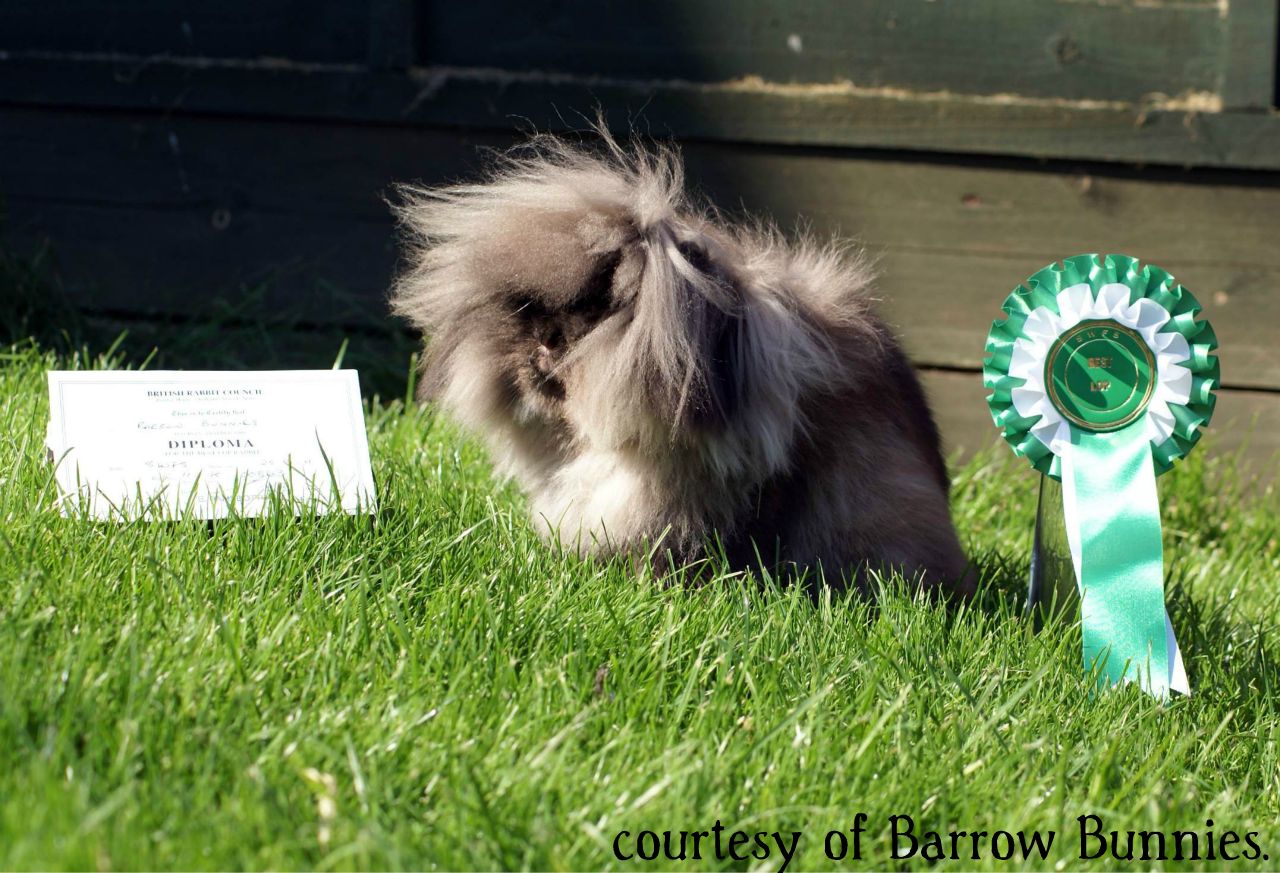
Upton's Butter, fawn Mini Lion Lop. BiS LLUK Mansfield 2008
Barrow Bunnies PJ, medium sable Mini Lion Lop. Best Lop Puddletown
Upton's Alistair, sooty fawn Mini Lion Lop. Best Lop and Runner Up BiS Mansfield
Barrow Bunnies Moon, REW[clarification needed] Mini Lion Lop. BiS LLUK Southern Championship Show 2012
Zashion's Beatrice, dark sable Mini Lion Lop
Wrixel Stud's blue-point Mini Lion Lop. With BoB certificate
Steel Mini Lion Lop, bred by J. Bramley. BiS Adult Stock Show @ All Lop Show 2009
Fawn Mini Lion Lop, bred by S. Grainger. BiS Young Stock Show @ All Lop Show 2009
Zashion's Flower, black butterfly Mini Lion Lop. Bred by Zashion Stud
Chintastic's Oops a Daisy, sable Mini Lion Lop.
Lion Lops UK (LLUK)
LLUK is a national club devoted to the furthering of the breed. It was established in 2007, founded and chaired by Jane Bramley, the fancier who first pioneered the breed. LLUK provides stock shows around the country to benefit the keen exhibitors of the Mini Lion Lop breed.
Ajouter des photos
Partagez vos photos de cette espèce (jusqu'à 20 à la fois) : elles sont vérifiées automatiquement, puis publiées.
Autres races de l'espèce (131)
Espèce : Lapin domestique
Voir les 119 autres races
- Doré de Saxe
- Fauve de Bourgogne
- Feu noir
- Grand chinchilla
- Gris de Vienne
- Gris du Bourbonnais
- Géant blanc du Bouscat
- Géant des Flandres
- Géant papillon français
- Hermine
- Hollandais
- Japonais
- Lapin chinchilla
- Lapin chèvre
- Lièvre belge
- Nain bélier
- Nain rex
- Néo-zélandais
- Papillon anglais
- Papillon rhénan
- Petit papillon
- Rex
- Russe
- Sablé des Vosges
- Satin
- American Fuzzy Lop
- American Sable rabbit
- British Giant rabbit
- Californien
- Cashmere Lop
- Continental Giant rabbit
- Czech Red rabbit
- Enderby Island rabbit
- Fee de Marbourg
- Feh de Marbourg
- Florida White rabbit
- German Lop
- Gotland rabbit
- Jersey Wooly
- Lapin angora
- Lapin bélier
- Lapin nain de couleur
- Lapin nain satin
- Miniature Lop
- New Zealand Red rabbit
- New Zealand rabbit
- Orylag
- Petit Bélier
- Rhönkaninchen
- Swiss Fox
- Tan rabbit
- Tri Coloured Dutch
- Tête de lion
- Český luštič
- Beige rabbit
- Dalmatian
- Lapin riche
- Britannia Petite
- Czech Black Guard Haired Rabbit
- Feu havane
- French Angora
- Mecklenburger Schecke
- Teddyzwerg
- Alaska
- Hotot nain
- Blanc de Termonde
- Bleu de Beveren
- Grand Russe
- Gris bleu de Vienne
- Noir de Vienne
- Noir et blanc
- Altex rabbit
- American rabbit
- Baladi
- Black-bearded rabbit
- Blue Imperial rabbit
- Blue of Ham
- Blue of Sint-Niklaas
- Carmagnola Grey
- Cinnamon rabbit
- Golden Glavcot
- Havana rabbit
- Jamora
- Lilac rabbit
- Lux
- Nain angora
- Normand
- Palomino rabbit
- Perlfee
- Plush Lop
- Sallander
- Silver Fox rabbit
- Silver Marten rabbit
- Silver rabbit
- Swedish Hare
- Velveteen Lop
- Vienna rabbit
- Bauscat rabbit
- Blanc de Popielno
- Blanc de Vendée
- Brazilian domestic rabbit
- Caldes rabbit
- Chaudry rabbit
- Fox
- Gabali rabbit
- Hulstlander
- Liptov Baldspotted rabbit
- Belgian Beard rabbit
- Belgian Silver
- Dwarf Angora
- Dwarf checkered rabbit
- False dwarf
- Gris Perle de Hal
- Lapin blanc danois
- Miniature Checkered rabbit
- Siamese Sable rabbit
- Stone rabbit
- Szekler rabbit
- Zemmouri
Sources et crédits
Informations provenant de plusieurs sources vérifiées. Dernière mise à jour : .
Crédits photos (1)
- Photo : Zashion Stud · CC BY-SA 3.0 · via Wikimedia Commons
Mentions de licence
Texte disponible sous licence CC BY-SA 4.0. Il adapte notamment Wikipedia (CC BY-SA): Miniature Lion Lop (Wikipédia, auteurs dans l’historique de l’article).
- Taxonomie : GBIF Backbone Taxonomy (CC BY 4.0)
Détail : Sources et licences.
Discussion (0)
Aucun message pour l’instant. Lancez la discussion sur cette fiche (sources, précisions, débats éditoriaux).
Connectez-vous pour participer à la discussion.