
- Kingdom
- Animalia
- Phylum
- Chordata
- Class
- Aves
- Order
- Galliformes
- Family
- Phasianidae
- Genus
- Gallus
- Species
- Gallus gallus domesticus
Overview
The Pyncheon is a rare American breed of true bantam chicken. It is an old breed, developed in the Northeastern United States. The Pyncheon's ancestors are thought to have been brought there from the Netherlands or from Belgium. The breed is mentioned in Nathaniel Hawthorne's The House of the Seven Gables. It is recognized by the American Bantam Association, but not by the American Poultry Association.
Characteristics
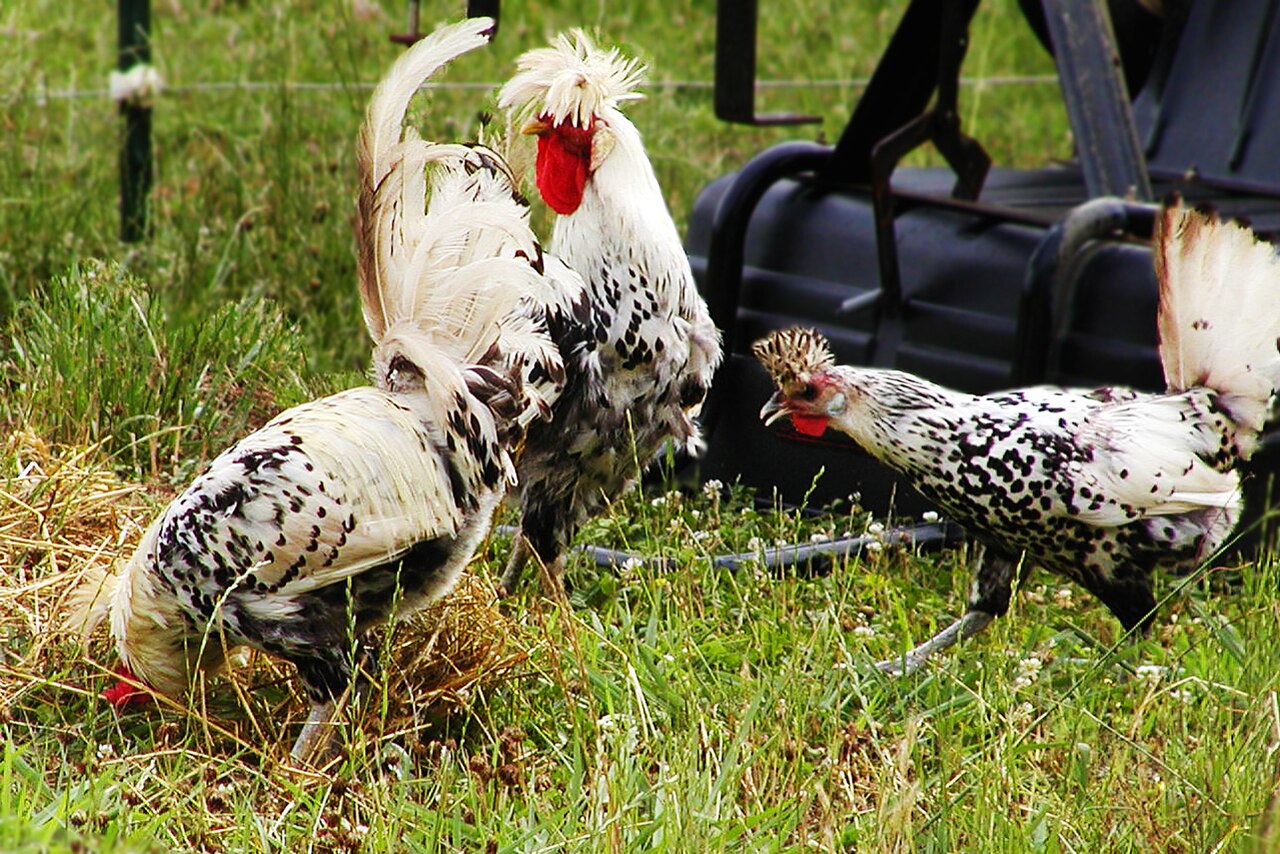
The Pyncheon has a single comb followed by a tassel, similar to the Sulmtaler. Often, the comb is not straight due to the crest and veers into an 's' shape. A unique variation of Mille Fleur is the pattern in which they most commonly appear. As with most bantams, it has strong flight capabilities. The Pyncheon is a fair layer of small white eggs. They have a friendly disposition, and a high tendency towards broodiness.
In The House of the Seven Gables
Nathaniel Hawthorne was familiar with the Pyncheon breed, and he bred them himself around the time at which wrote the novel. The chickens in the book mirror the degeneration of the Pyncheon family, whose name they share. Though not explicitly called a bantam, the Pyncheon's small size is referred to several times in the book, as is the breed's antiquity:
Queerly indeed they looked! Chanticleer himself, though stalking on two stilt-like legs, with the dignity interminable descent in all his gestures, was hardly bigger than an ordinary partridge; his two wives were about the size of quails; and as for the one chicken, it looked small enough to be still in the egg, and, at the same time, sufficiently old, withered, wizened, and experienced to have been the founder of the antiquated race.
A comparison is made between the birds and the Pyncheon family; both of whom bear many similarities, including their haughty airs and dolefulness. The "ancient and respectable fowls", like the Pyncheon family, have a long and noble lineage that is now desecrated:
- Nor must we forget to mention a hen-coop, of very reverend antiquity, that stood in the farther corner of the garden, not a great way from the fountain. It now contained only Chanticleer, his two wives, and a solitary chicken. All of them were pure specimens of a breed which had been transmitted down as an heirloom in the Pyncheon family, and were said, while in their prime, to have attained almost the size of turkeys, and, on the score of delicate flesh, to be fit for a prince's table. In proof of the authenticity of this legendary renown, Hepzibah could have exhibited the shell of a great egg, which an ostrich need hardly have been ashamed of. Be that as it might, the hens were now scarcely larger than pigeons, and had a queer, rusty, withered aspect, and a gouty kind of movement, and a sleepy and melancholy tone throughout all the variations of their clucking and cackling. It was evident that the race had degenerated, like many a noble race besides, in consequence of too strict a watchfulness to keep it pure. These feathered people had existed too long, in their distinct variety; a fact of which the present representatives, judging from their lugubrious deportment, seemed to be aware. They kept themselves alive, unquestionably, and laid now and then an egg, and hatched a chicken, not for any pleasure of their own, but that the world might not absolutely lose what had once been so admirable a breed of fowls. The distinguishing mark of the hens was a crest, of lamentably scanty growth, in these latter days, but so oddly and wickedly analogous to Hepzibah's turban, that Phoebe – to the poignant distress of her conscience, but inevitably – was led to fancy a general resemblance betwixt these forlorn bipeds and her respectable relative.
The peculiarities of the breed are later described further:
- Phoebe, after getting well acquainted with the old hen, was sometimes permitted to take the chicken [the old hen's chick] in her hand, which was quite capable of grasping its cubic inch or two of body. While she curiously examined its hereditary marks – the peculiar speckle of its plumage, the funny tuft on its head, and a knob on each of its legs – the little biped, as she insisted, kept giving her a sagacious wink.
External links
- Pictures of the Pyncheon breed can be found here.
- •
- • • v
- t
- e
Ajouter des photos
Partagez vos photos de cette espèce (jusqu'à 20 à la fois) : elles sont vérifiées automatiquement, puis publiées.
Autres races de l'espèce (311)
Espèce : Poule domestique
Voir les 299 autres races
- Barbu de Thuringe
- Barbu hollandais
- Barnevelder
- Bassette
- Berg-Schlotter
- Black Rock
- Bleue de France
- Bourbonnaise
- Brabanter
- Braekel
- Brahma
- Bresse-Gauloise
- Buckeye
- Campine
- Cemani
- Chabo
- Chantecler
- Chanteur de Yourlov
- Chanteur du Berg
- Chanteur du Kosovo
- Charollaise
- Combattant anglais ancien
- Combattant anglais moderne
- Combattant de Bruges
- Combattant espagnol
- Combattant indien
- Combattant malais
- Coq de pêche
- Cou nu
- Cou nu du Forez
- Coucou d'Allemagne
- Coucou d'Izegem
- Coucou de Rennes
- Coucou des Flandres
- Courtes-pattes
- Crèvecœur
- Cubalaya
- Denizli
- Dominicaine
- Dorking
- Espagnole à face blanche
- Euskal oiloa
- Faverolles allemande
- Faverolles française
- Fayoumi
- Gauloise dorée
- Gâtinaise
- Géante de Jersey
- Géline de Touraine
- Hergnies
- Hollandaise huppée
- ISA brown
- Italienne
- Java
- Java américaine
- Javanaise
- La Flèche
- Lakenvelder
- Langshan allemande
- Legbar
- Leghorn
- Limousine
- Lohmann Brown
- Lyonnaise
- Marans
- Mouette de Groningue
- Mouette de la Frise orientale
- Naine allemande
- Naine du Tournaisis
- Naine hollandaise
- Niederrheiner
- Onagadori
- Orloff
- Orpington
- Penedesenca
- Phoenix
- Poltava
- Poule Castillane
- Poule Cochin
- Poule Le Mans
- Poule Le Merlerault
- Poule Soie
- Poule ardennaise
- Poule d'Alsace
- Poule d'Augsbourg
- Poule d'Estaires
- Poule de Barbezieux
- Poule de Bielefeld
- Poule de Bohême
- Poule de Bourbourg
- Poule de Bréda
- Poule de Choumen
- Poule de Dresde
- Poule de Frise
- Poule de Gournay
- Poule de Hambourg
- Poule de Houdan
- Poule de Janzé
- Poule de Malines
- Poule de Minorque
- Poule de Norvège
- Poule de Padoue
- Poule de Pavilly
- Poule de Polverara
- Poule de Saxe
- Poule de Twente
- Poule de Westphalie
- Poule de Yokohama
- Poule des Asturies
- Poule du Danemark
- Poule du New Hampshire
- Poule du Reich
- Poule du Sussex
- Poule du Valdarno
- Poule empordanesa
- Poule landaise
- Poule meusienne
- Poule noire du Berry
- Poule suisse
- Pékin
- Ramelsloher
- Red Cap
- Rhode-Island
- Sabelpoot
- Sebright
- Serama
- Sicilienne
- Sombor huppée
- Sulmtaler
- Sultane
- Sumatra
- Sundheimer
- Vorwerk
- Welsumer
- Wyandotte
- Adler Silver chicken
- American Game
- Assendelft
- Australian Game
- Australian Langshan
- Ayam Pelung
- Barbu de Boitsfort
- Barbu de Watermael
- Bionda Piemontese
- California Gray
- Chaams hoen
- Delaware
- Dong Tao chicken
- Eikenburger
- Frisée
- Gallina mallorquina
- Gilyan
- Giriraja
- Harco
- Hijazi chicken
- Hinaidori
- Hrvatica chicken
- Icelandic chicken
- Kadaknath
- Ko Shamo
- Mugellese
- Nagoya Cochin
- Naine croate
- Norfolk Grey
- Ohiki
- Old English Pheasant Fowl
- Oxford Old English Game
- Plymouth
- Polbar
- Posavska kukmasta kokoš
- Poule au long chant
- Poule de Drente
- Poule de Hollande du Nord
- Poule de Pavlovo
- Poule de Prat
- Poule polonaise à pattes vertes
- Poulet de chair
- Rhode Island White
- Robusta Lionata
- Satsumadori
- Scots Dumpy
- Shamo
- Sicilian Buttercup
- Silverudd Blue
- Stara Zagora Red
- Svarthöna
- Thai Game
- Tomaru
- Valdarnese
- Índio Gigante
- Combattant du Nord
- American Long Crower
- Easter egger
- Sindhi Aseel
- Barred Plymouth Rock
- Boschvelder
- Hedemorahöna
- Indio de León
- Schijndelaar
- Totenko
- Öländsk dvärghöna
- Brabançonne
- Combattant de Liège
- Combattant de Tirlemont
- Combattant du Palatinat
- Coucou de France
- Croad Langshan
- Frisée et huppée d'Annaberg
- Millefleurs de Lonigo
- Orava
- Pictave
- Pondeuse de Zingem
- Poule d'Aquitaine
- Poule d'Écosse
- Poule de Caumont
- Poule de Caussade
- Poule de Caux
- Poule de Challans
- Poule de Contres
- Poule de Dampierre
- Poule de Herve
- Poule de Mantes
- Poule de Rhénanie
- Poule de Zottegem
- Poule gasconne
- Poulet de chair de Zingem
- Ross 308
- Wassachiè
- Amarela
- Australian Pit Game fowl
- Ayam Kedu
- Ayam Ketawa
- Barbu d'Everberg
- Barbu de Grubbe
- Belgian Bantam
- Bianca di Saluzzo
- Burmese Bantam
- Cobb 500
- Ermellinata di Rovigo
- Famennoise
- Finnish Landrace Chicken
- Ga Noi
- Gijang Ogolgye
- Gramapriya
- Gà ri
- Holland chicken
- Hồ chicken
- Ingie
- Iowa Blue
- Iwate jidori
- Ixworth chicken
- Jangmigye
- Kaunayen chicken
- Kinpa
- Kuroiler
- Lamona
- Marsh Daisy chicken
- Mericanel della Brianza
- Modern Langshan
- Nankin Bantam
- Noire de Moscou
- Ogye chicken
- Potchefstroom Koekoek
- Pépoi
- Robusta Maculata
- Romagnola chicken
- Rumpless Game
- Slovenian Barred Hen
- Slovenian Brown Hen
- Slovenian Silver Hen
- Taiwanese Game
- Tuzo
- Vanaraja
- Yakido
- Yeonsan Ogye
- Burford Brown
- Daisy Belle
- Dekalb Amberlink
- Miss Pepperpot
- Nixi chicken
- RSL chicken
- Red Shaver
- Sentul chicken
- Winnebago chicken
- Fauve de Hesbaye
- Bantam wyandotte
- Brazilian long crower
- Collonca
- Game hen
- Gueomdak
- Jitokko
- Kokochiè
- Modenese chicken
- O-Shamo
- Svensk dvärg
- Venda chicken
- Welbar
- White Rock
- White Rocks
Sources et crédits
Informations provenant de plusieurs sources vérifiées. Dernière mise à jour : .
Mentions de licence
Texte disponible sous licence CC BY-SA 4.0. Il adapte notamment Wikipedia (CC BY-SA): Pyncheon (Wikipédia, auteurs dans l’historique de l’article).
- Taxonomie : GBIF Backbone Taxonomy (CC BY 4.0)
Détail : Sources et licences.
Discussion (0)
Aucun message pour l’instant. Lancez la discussion sur cette fiche (sources, précisions, débats éditoriaux).
Connectez-vous pour participer à la discussion.