
- Kingdom
- Animalia
- Phylum
- Chordata
- Class
- Aves
- Order
- Galliformes
- Family
- Phasianidae
- Genus
- Gallus
- Species
- Gallus gallus domesticus
Overview
The Burmese Bantam or Burmese is a British breed of bantam chicken. It apparently originated in Myanmar, formerly Burma, in the latter part of the nineteenth century. By the time of the First World War it was thought to be extinct. Some surviving individuals were discovered in the 1970s and were bred with white Booted Bantams to recreate the breed. It is a true bantam – there is no corresponding large fowl.
History
The Burmese Bantam is documented at least as far back as 1847, when it received a passing mention from Edward Blyth, the curator of the museum of the Asiatic Society of Calcutta (now Kolkata).• Charles Darwin uses it as an example of a creeper chicken in his Variation of Animals and Plants Under Domestication of 1868,• and also compares its bones to those of other chickens and jungle fowl;• he collected a specimen, now in the Natural History Museum of London.• According to the Poultry Club of Great Britain the Burmese derives from birds sent to the United Kingdom from Burma in the 1880s by an officer in the British Army.• William Flamank Entwisle received one of these birds, apparently a carrier of the creeper gene, and bred from it.• By the beginning of the First World War the breed was believed to be extinct.•
In 1970 some were given to Andrew Sheppy, who had established the Rare Poultry Society. He bred them with white Booted Bantams and successfully re-established the breed.• An attempt has been made in Holland to re-create the Burmese by cross-breeding other bantams, but the results do not closely resemble the birds shown in historic drawings by Harrison Weir and J.W. Ludlow of the original stock.•
Characteristics
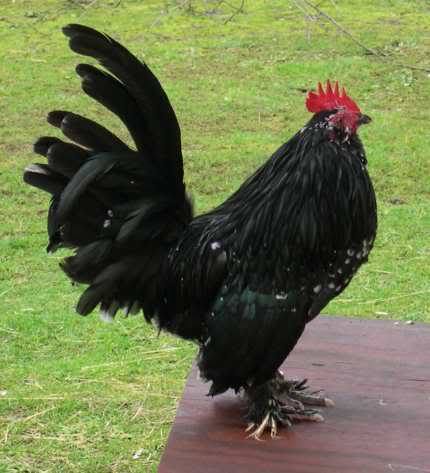
The Burmese is a true bantam – there is no corresponding large fowl.• It resembles the Booted Bantam, but is smaller and lower to the ground; it has a small crest. The legs are short, with heavy feathering. The comb is single, the earlobes are small and the wattles drooping and fairly long. Only one colour is recognised by the Poultry Club of Great Britain: the white.• The Dutch re-creation is black.•
Ajouter des photos
Partagez vos photos de cette espèce (jusqu'à 20 à la fois) : elles sont vérifiées automatiquement, puis publiées.
Autres races de l'espèce (311)
Espèce : Poule domestique
Voir les 299 autres races
- Barbu de Thuringe
- Barbu hollandais
- Barnevelder
- Bassette
- Berg-Schlotter
- Black Rock
- Bleue de France
- Bourbonnaise
- Brabanter
- Braekel
- Brahma
- Bresse-Gauloise
- Buckeye
- Campine
- Cemani
- Chabo
- Chantecler
- Chanteur de Yourlov
- Chanteur du Berg
- Chanteur du Kosovo
- Charollaise
- Combattant anglais ancien
- Combattant anglais moderne
- Combattant de Bruges
- Combattant espagnol
- Combattant indien
- Combattant malais
- Coq de pêche
- Cou nu
- Cou nu du Forez
- Coucou d'Allemagne
- Coucou d'Izegem
- Coucou de Rennes
- Coucou des Flandres
- Courtes-pattes
- Crèvecœur
- Cubalaya
- Denizli
- Dominicaine
- Dorking
- Espagnole à face blanche
- Euskal oiloa
- Faverolles allemande
- Faverolles française
- Fayoumi
- Gauloise dorée
- Gâtinaise
- Géante de Jersey
- Géline de Touraine
- Hergnies
- Hollandaise huppée
- ISA brown
- Italienne
- Java
- Java américaine
- Javanaise
- La Flèche
- Lakenvelder
- Langshan allemande
- Legbar
- Leghorn
- Limousine
- Lohmann Brown
- Lyonnaise
- Marans
- Mouette de Groningue
- Mouette de la Frise orientale
- Naine allemande
- Naine du Tournaisis
- Naine hollandaise
- Niederrheiner
- Onagadori
- Orloff
- Orpington
- Penedesenca
- Phoenix
- Poltava
- Poule Castillane
- Poule Cochin
- Poule Le Mans
- Poule Le Merlerault
- Poule Soie
- Poule ardennaise
- Poule d'Alsace
- Poule d'Augsbourg
- Poule d'Estaires
- Poule de Barbezieux
- Poule de Bielefeld
- Poule de Bohême
- Poule de Bourbourg
- Poule de Bréda
- Poule de Choumen
- Poule de Dresde
- Poule de Frise
- Poule de Gournay
- Poule de Hambourg
- Poule de Houdan
- Poule de Janzé
- Poule de Malines
- Poule de Minorque
- Poule de Norvège
- Poule de Padoue
- Poule de Pavilly
- Poule de Polverara
- Poule de Saxe
- Poule de Twente
- Poule de Westphalie
- Poule de Yokohama
- Poule des Asturies
- Poule du Danemark
- Poule du New Hampshire
- Poule du Reich
- Poule du Sussex
- Poule du Valdarno
- Poule empordanesa
- Poule landaise
- Poule meusienne
- Poule noire du Berry
- Poule suisse
- Pékin
- Ramelsloher
- Red Cap
- Rhode-Island
- Sabelpoot
- Sebright
- Serama
- Sicilienne
- Sombor huppée
- Sulmtaler
- Sultane
- Sumatra
- Sundheimer
- Vorwerk
- Welsumer
- Wyandotte
- Adler Silver chicken
- American Game
- Assendelft
- Australian Game
- Australian Langshan
- Ayam Pelung
- Barbu de Boitsfort
- Barbu de Watermael
- Bionda Piemontese
- California Gray
- Chaams hoen
- Delaware
- Dong Tao chicken
- Eikenburger
- Frisée
- Gallina mallorquina
- Gilyan
- Giriraja
- Harco
- Hijazi chicken
- Hinaidori
- Hrvatica chicken
- Icelandic chicken
- Kadaknath
- Ko Shamo
- Mugellese
- Nagoya Cochin
- Naine croate
- Norfolk Grey
- Ohiki
- Old English Pheasant Fowl
- Oxford Old English Game
- Plymouth
- Polbar
- Posavska kukmasta kokoš
- Poule au long chant
- Poule de Drente
- Poule de Hollande du Nord
- Poule de Pavlovo
- Poule de Prat
- Poule polonaise à pattes vertes
- Poulet de chair
- Rhode Island White
- Robusta Lionata
- Satsumadori
- Scots Dumpy
- Shamo
- Sicilian Buttercup
- Silverudd Blue
- Stara Zagora Red
- Svarthöna
- Thai Game
- Tomaru
- Valdarnese
- Índio Gigante
- Combattant du Nord
- American Long Crower
- Easter egger
- Sindhi Aseel
- Barred Plymouth Rock
- Boschvelder
- Hedemorahöna
- Indio de León
- Schijndelaar
- Totenko
- Öländsk dvärghöna
- Brabançonne
- Combattant de Liège
- Combattant de Tirlemont
- Combattant du Palatinat
- Coucou de France
- Croad Langshan
- Frisée et huppée d'Annaberg
- Millefleurs de Lonigo
- Orava
- Pictave
- Pondeuse de Zingem
- Poule d'Aquitaine
- Poule d'Écosse
- Poule de Caumont
- Poule de Caussade
- Poule de Caux
- Poule de Challans
- Poule de Contres
- Poule de Dampierre
- Poule de Herve
- Poule de Mantes
- Poule de Rhénanie
- Poule de Zottegem
- Poule gasconne
- Poulet de chair de Zingem
- Ross 308
- Wassachiè
- Amarela
- Australian Pit Game fowl
- Ayam Kedu
- Ayam Ketawa
- Barbu d'Everberg
- Barbu de Grubbe
- Belgian Bantam
- Bianca di Saluzzo
- Cobb 500
- Ermellinata di Rovigo
- Famennoise
- Finnish Landrace Chicken
- Ga Noi
- Gijang Ogolgye
- Gramapriya
- Gà ri
- Holland chicken
- Hồ chicken
- Ingie
- Iowa Blue
- Iwate jidori
- Ixworth chicken
- Jangmigye
- Kaunayen chicken
- Kinpa
- Kuroiler
- Lamona
- Marsh Daisy chicken
- Mericanel della Brianza
- Modern Langshan
- Nankin Bantam
- Noire de Moscou
- Ogye chicken
- Potchefstroom Koekoek
- Pyncheon
- Pépoi
- Robusta Maculata
- Romagnola chicken
- Rumpless Game
- Slovenian Barred Hen
- Slovenian Brown Hen
- Slovenian Silver Hen
- Taiwanese Game
- Tuzo
- Vanaraja
- Yakido
- Yeonsan Ogye
- Burford Brown
- Daisy Belle
- Dekalb Amberlink
- Miss Pepperpot
- Nixi chicken
- RSL chicken
- Red Shaver
- Sentul chicken
- Winnebago chicken
- Fauve de Hesbaye
- Bantam wyandotte
- Brazilian long crower
- Collonca
- Game hen
- Gueomdak
- Jitokko
- Kokochiè
- Modenese chicken
- O-Shamo
- Svensk dvärg
- Venda chicken
- Welbar
- White Rock
- White Rocks
Sources et crédits
Informations provenant de plusieurs sources vérifiées. Dernière mise à jour : .
Mentions de licence
Texte disponible sous licence CC BY-SA 4.0. Il adapte notamment Wikipedia (CC BY-SA): Burmese Bantam (Wikipédia, auteurs dans l’historique de l’article).
- Taxonomie : GBIF Backbone Taxonomy (CC BY 4.0)
Détail : Sources et licences.
Discussion (0)
Aucun message pour l’instant. Lancez la discussion sur cette fiche (sources, précisions, débats éditoriaux).
Connectez-vous pour participer à la discussion.