
- Kingdom
- Animalia
- Phylum
- Chordata
- Class
- Aves
- Order
- Anseriformes
- Family
- Anatidae
- Genus
- Anser
- Species
- Anser anser domesticus
Overview
The African or African Goose is a breed of domestic goose. It is one of two domestic breeds that derive from the wild species Anser cygnoides, the other being the Chinese; all other domestic geese derive from Anser anser. Despite the name, it is not from Africa but is of Chinese origin, found in Teochew and Swatow of South China. It is a large bird, among the heaviest of all goose breeds.
History
The African Goose is one of two domestic goose breeds that derive from the wild species Anser cygnoides, the other being the Chinese, to which it is closely related.• Domestication took place in north Asia, and birds of this type were later brought to Europe, possibly via Madagascar;• they were present in Britain before the end of the seventeenth century.•
The brown variety was included in the first edition of the Standard of Perfection of the American Poultry Association in 1874; the white was added in 1987,• and the buff in 2018.•
Characteristics
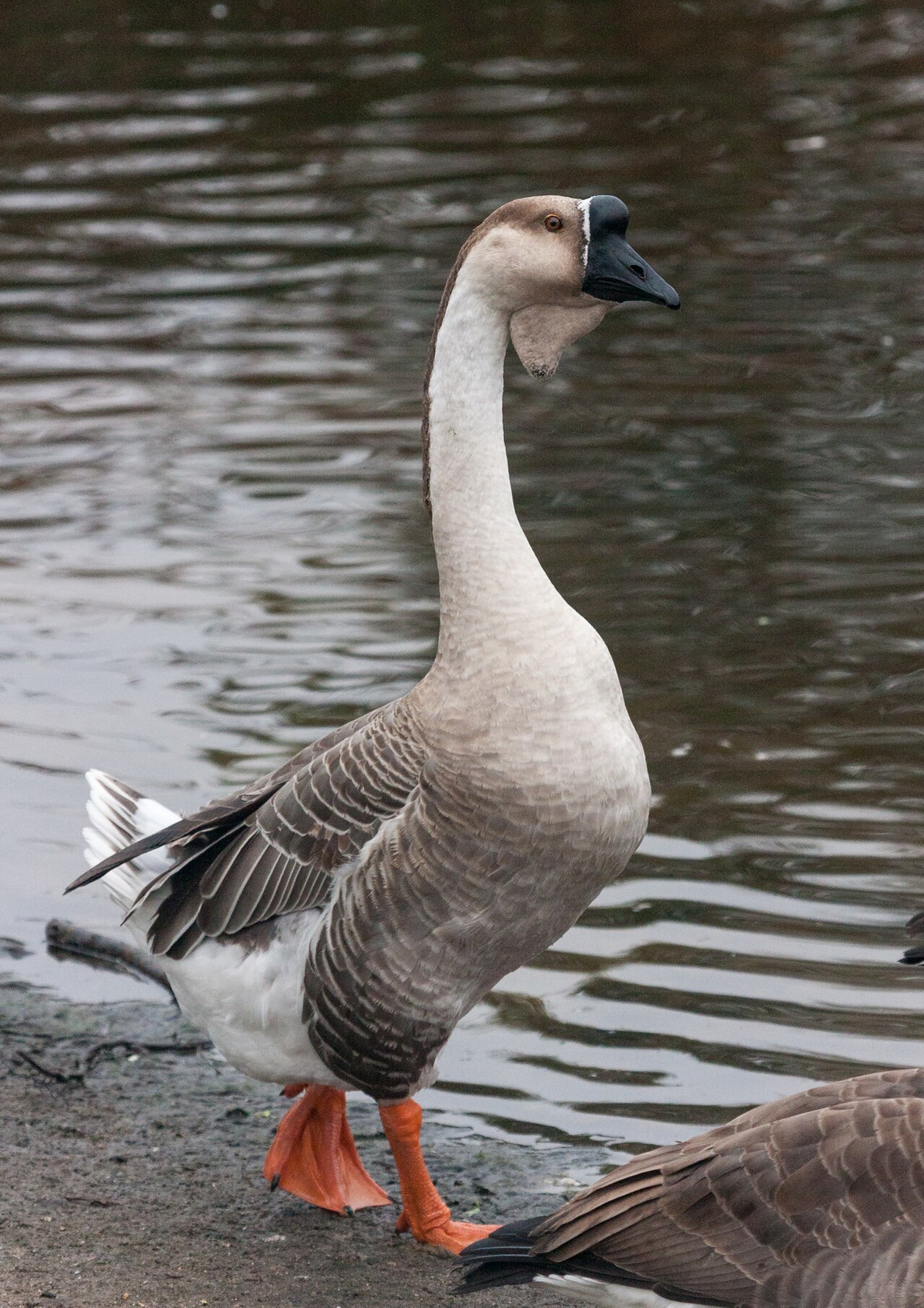
The African Goose is a large, heavy bird, among the heaviest of all goose breeds.• According to the British standard, weights are approximately 8–11 kg for geese and 10–13 kg for ganders; the Bund Deutscher Rassegeflügelzüchter [de] gives weights of 7 kg and 8 kg respectively.• The birds may stand up to 90 cm tall.• The body is large and is carried at about 35° to the horizontal; the back is long and fairly flat, the breast and belly smooth and rounded. The tail is held above the back-line, particularly in ganders.• The head is large, with a large knob protruding forwards and upwards from the front of the head and the top of the upper mandible of the broad bill. The neck is long, thick and slightly arched, with a smooth crescent-shaped dewlap hanging below the lower mandible.•
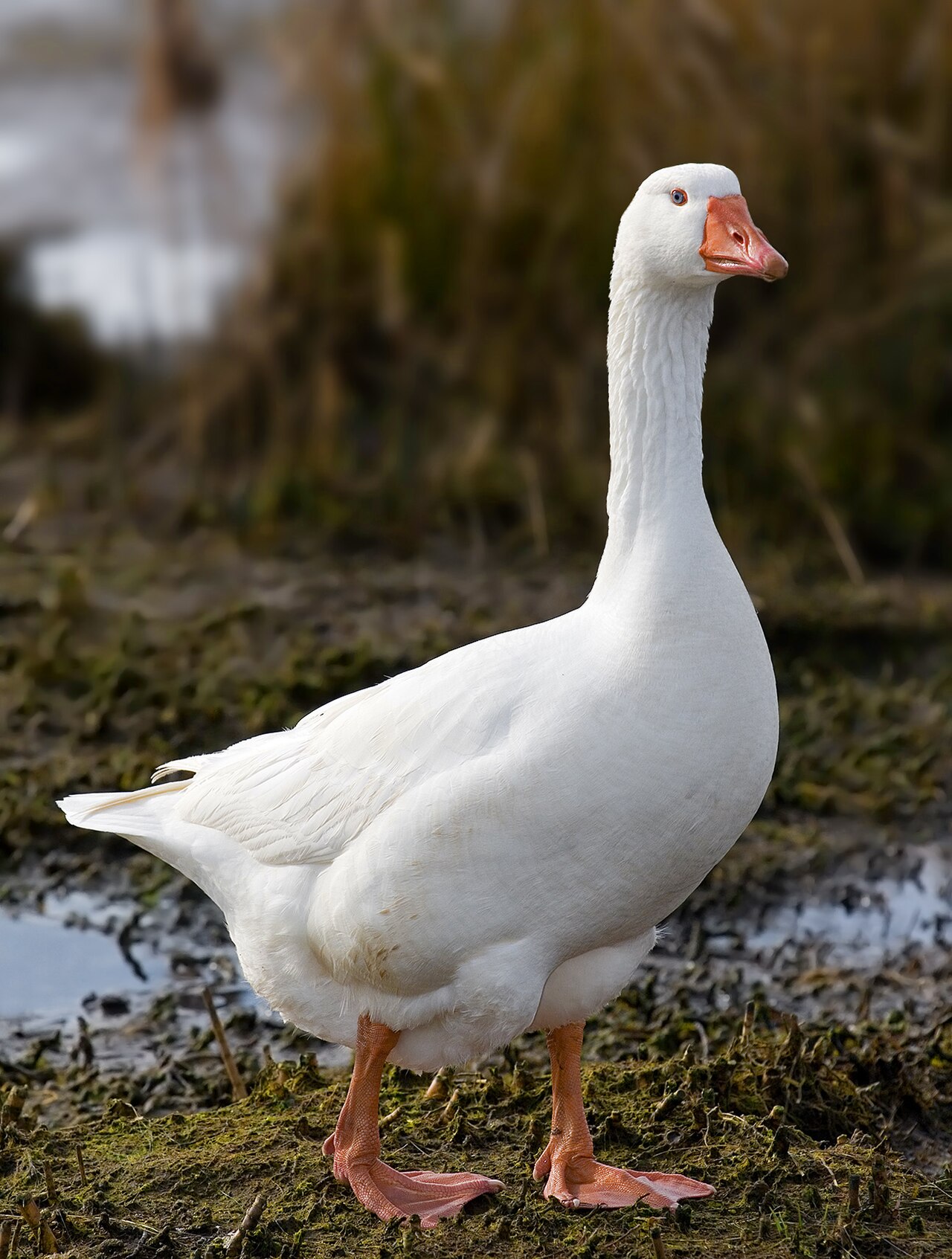
Three color varieties are recognised by the Poultry Club of Great Britain and the American Poultry Association: the grey or brown, the buff and the white.• The brown has wild-type plumage, with colors ranging from light to dark grey-brown (or light ash to dark slate), with black bill and knob and dark or brownish-orange shanks and feet. The white has pure white plumage, with orange bill and knob and light orange legs, and the buff has the same plumage pattern as the brown, but in colors ranging from light fawn to buff; the legs and webs are a light dull orange, the knob and bill a pinkish brown.• Only the grey/brown is recognised by the Entente Européenne d'Aviculture et de Cuniculture.•
Use
The African Goose is commonly reared for meat.• Geese lay about 25 eggs per year; the eggs are white and weigh some 130 g.• Ring size is 27 mm.•
Gallery
Ajouter des photos
Partagez vos photos de cette espèce (jusqu'à 20 à la fois) : elles sont vérifiées automatiquement, puis publiées.
Autres races de l'espèce (56)
Espèce : Oie domestique
Voir les 44 autres races
- Oie de Scanie
- Oie de Toulouse
- Oie de Twente
- Oie de la Leine
- Oie du Danube
- Oie fermière danoise
- Oie flamande
- Oie féroïenne
- Oie italienne
- Oie normande
- Oie tchèque
- American Buff
- Brecon Buff
- Emporda geese
- Oie carronculée de Chine
- Pilgrim goose
- Ölandgans
- German laying goose
- Grande oie grise de Russie
- Oie blanche du Bourbonnais
- Oie blanche du Poitou
- Oie d'Arzamas
- Oie de Chadrinsk
- Oie de Linda
- Oie de Shetland
- Oie de Suchá
- Oie grise de Padoue
- Oie grise du Marais poitevin
- Oie pie vénitienne
- Arzamas goose
- Cotton Patch
- Euskal Antzara
- Huoyan
- Kuban
- Oie de Kholmogory
- Oie de combat de Tula
- Rhenish goose
- Romanian goose
- Vištinės
- Oie de Castres
- Oie de Bresse
- Oie de Benkov
- Oie grise des Landes
- Steinbacher Kampfgans
Sources et crédits
Informations provenant de plusieurs sources vérifiées. Dernière mise à jour : .
Crédits photos (10)
- Photo : Elf · CC BY-SA 3.0 · via Wikimedia Commons
- Photo : Birdmannate · CC BY-SA 4.0 · via Wikimedia Commons
- Photo : LadyofHats · Domaine public · via Wikimedia Commons
- Photo : LadyofHats · Domaine public · via Wikimedia Commons
- Photo : LadyofHats · Domaine public · via Wikimedia Commons
- Photo : LadyofHats · Domaine public · via Wikimedia Commons
- Photo : Just chaos · CC BY 2.0 · via Wikimedia Commons
- Photo : Holly Cheng · CC BY-SA 4.0 · via Wikimedia Commons
- Photo : Massimilianogalardi · CC BY-SA 3.0 · via Wikimedia Commons
- Photo : Massimilianogalardi · CC BY-SA 3.0 · via Wikimedia Commons
Mentions de licence
Texte disponible sous licence CC BY-SA 4.0. Il adapte notamment Wikipedia (CC BY-SA): African goose (Wikipédia, auteurs dans l’historique de l’article).
- Taxonomie : GBIF Backbone Taxonomy (CC BY 4.0)
Détail : Sources et licences.
Discussion (0)
Aucun message pour l’instant. Lancez la discussion sur cette fiche (sources, précisions, débats éditoriaux).
Connectez-vous pour participer à la discussion.