
- Kingdom
- Animalia
- Phylum
- Chordata
- Class
- Mammalia
- Order
- Carnivora
- Family
- Felidae
- Genus
- Felis
- Species
- Felis catus
Overview
The Korat cat (Thai: โคราช, มาเลศ, สีสวาด, RTGS: Khorat, Malet, Si sawat) is a silver-tipped blue-grey, short-haired breed of domestic cat with a small to medium build and a low percentage of body fat. Its body is semi-cobby, and unusually heavy for its size. It is an intelligent and playful active cat that forms strong bonds with people and is very vocal, with a sound different from other breeds. Among the Korat's distinguishing characteristics are its heart-shaped head, its large green eyes. Its front paws are shorter than the back paws.
The Korat is a natural breed, and one of the oldest stable cat breeds, and one of the very few that has not changed its appearance throughout centuries. Originating in Phimai, Thailand, it is named after its province of origin, Nakhon Ratchasima Province (typically called "Korat" by the Thai people). In Thailand, the breed is known as Si sawat, meaning "colour of the sawat seed". The Korat is known colloquially as the "good luck cat". Traditionally, they are given in pairs to newlyweds or people who are highly esteemed, for good luck. Until recently, Korats were not sold, but only given as gifts.
History
The probable first allusion to the breed is in the Thai Tamra Maew (The Cat-Book Poems), authored between 1350 and 1767 CE and now in the National Library of Thailand. However, the illustration of the Korat in this book is not detailed enough to be definitive as to the breed portrayed. In recent years, the Korat was pictured on a postage stamp in Thailand. An example hangs in the city of Korat's post office.
Korats first appeared in Britain under the name "Blue Siamese" in 1889 and 1896, but these solid blue cats did not conform to the cat show judges' perception of a Siamese cat, and they disappeared by 1901. One early import, "Dwina", owned by Russian Blue breeder Mrs. Constance Carew-Cox and mentioned in Frances Simpson's The Book of the Cat (1903), reputedly produced a large number of "Siamese" kittens; the other, Mrs. B. Spearman's Blue Siamese male, "Nam Noi", was disqualified as a Siamese, but accepted in the Russian or Any Other Blue class in which he placed first (WR Hawkins, "Around the Pens", July 1896). Spearman tried unsuccessfully to import more of these "Blue Siamese".
Korats first appeared in the US in the 1950s. In 1959, Cedar Glen cattery was the first to import a pair of Korats to the US for breeding: a male named Nara and a female named Darra. In 1966, the Korat was accepted into championship status, through the efforts of a breeder from Maryland.
Appearance
The Korat's unusual colour is actually a silver-tipped blue that appears to shimmer. The Thais refer to this colour as "rain-cloud grey", and the shimmer as "sea foam". This cat has a single coat that is short, with roots of a lighter silver blue. The hair shaft colour increases to deeper blue and the tips are silver, especially on the muzzle and toes. This is the only colour accepted for a Korat. The eyes are large and peridot green in an adult cat, but kittens have muddy, amber or golden-green coloured eyes which gradually change as they become adults, at two to four years.
Although it is rare, Korats occasionally have striking or faint white markings or spots or even very faint grey stripes. Sometimes these spots increase in size with age. These are seen as flaws, and the cats are disqualified from competing in cat shows. However, such markings have no effect on personality or health.
Thai Lilac, Thai Blue Point and Thai Lilac Point
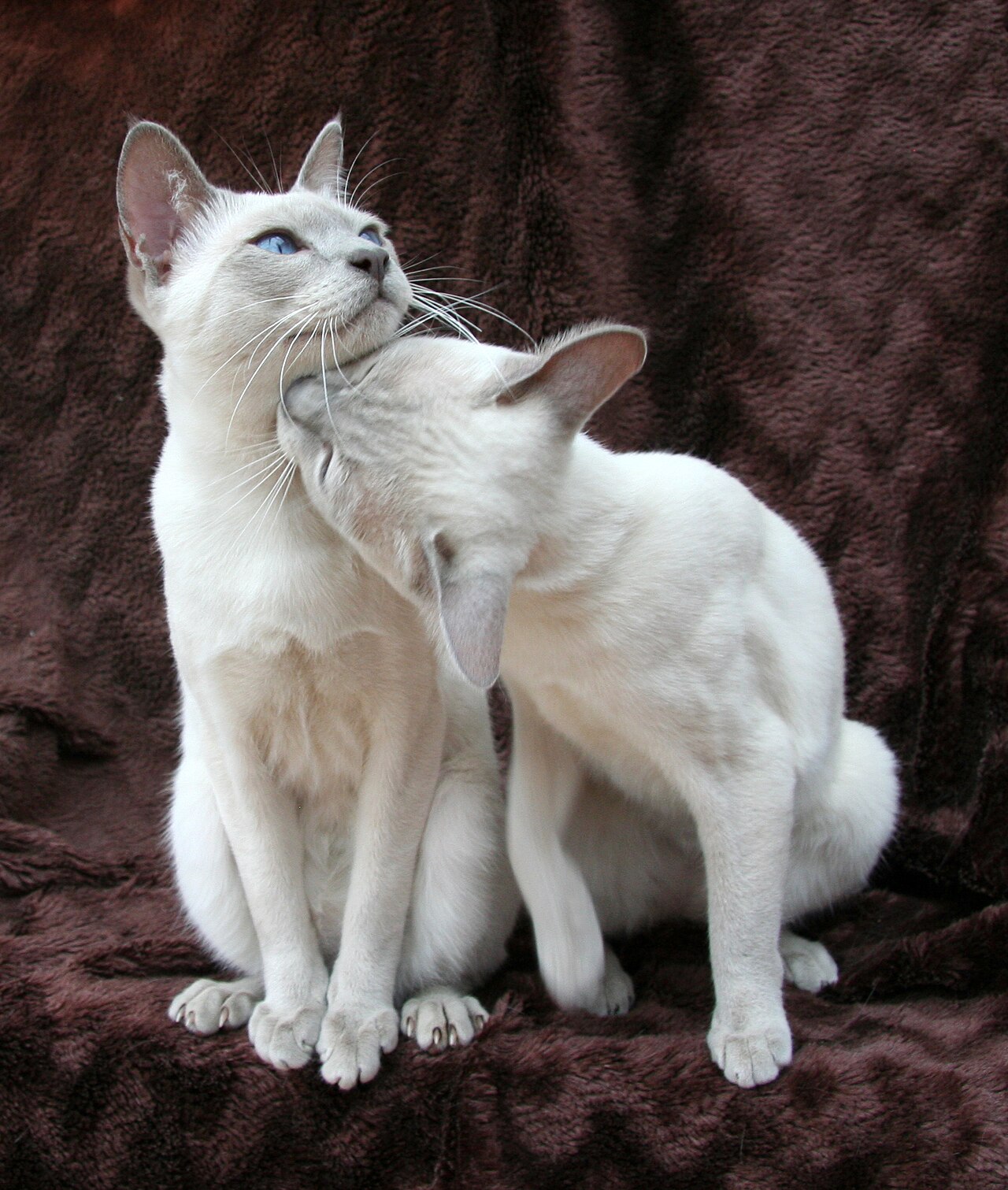
The Governing Council of the Cat Fancy recognizes Korat-type cats differing from the traditional solid blue appearance of the Korat on their experimental register. Such cats are registered as Thai Lilac if they are solid lilac. A Thai Blue Point exhibits the colourpoint pattern also seen in Siamese. A Thai Lilac Point also exhibits the colourpoint pattern also seen in Siamese, but in addition exhibits the Chocolate gene. These should not be confused with the Thai cat, a new name for the original (traditional or classic) Siamese cat type, with a rounder face and thicker body than modern "ultra-typed" Siamese.
The policy for full registration of Korats only allows blue cats of full-registered parents or third-generation supplementary-registered parents. It also requires genetic testing for gangliosidosis to be carried out to ensure that the breed remains free of this inherited disease which once existed in some Korat and Thai breeding lines.
The genes responsible for Pointeds and Lilacs were introduced into the Korat breed when new Korat breeding stock carrying the recessive genes was imported from Thailand. The first recorded Thai Lilac kitten was born to the Jenanca line in 1989, when "Jenanca Lilac Lillee" was born from two Korat parents in the U.K.. In 1990, Lillee's parents were re-mated with more lilac kittens resulting. A young male lilac was then born to another pair, also in the U.K., allowing more crossings without inbreeding too closely.
The first recorded Thai Lilac Point was born to the Clairabelle line in 2014 when Clairabelle Pixie Dust was born from two Korat parents in the U.K.. A re-mating from the same parents resulted in another Thai Lilac Point, this time a boy, Clairabelle Ninja Rococoa. A third and fourth Thai Lilac Point has recently been born into the Jusarka line.
Health
The Korat is one of the more commonly affected breeds for gangliosidosis 1 and gangliosidosis 2. An autosomal recessive mutation in the GBL1 and HEXB gene respectively is responsible for the conditions in the breed.
Atherosclerosis conditions, typically never seen in cats, similar to human atherosclerosis, were also seen in Korat cats. A genetic predisposition is assumed rather than an underlying condition or medical treatment for these conditions in the cats.
In popular culture
- A Korat cat has served as a mascot for the 2007 Southeast Asian Games.
Gallery
Wang Kaang Raang, a female Korat in Vantaa Cat Show, Finland.
Korat cat and Siamese cat Blue point
The Korat is a natural breed, and one of the oldest stable cat breeds. Originating in Phimai temple, Nakhon Ratchasima province.
Korat Yog-Hurt's Atlach-Nacha at Turok Cat Show
Show of The Korat Cat Association of Finland Loimaa, 26 September 2010
Female Korat cat with a litter of kittens
External links
Wikimedia Commons has media related to Korats.
- Koratworld the oldest pages dedicated to the breed.
- Jardin des Korats[permanent dead link] ( CFA affiliated club)
- Suomen Koratrengas r.y. (FIFe affiliated club in Finland)
- TIMBA: The International Maew Boran Association Archived 2014-12-25 at the Wayback Machine
Diseases anddisorders
Cats by country
- Australia
- Canada
- Japan
- New Zealand
- United Kingdom
- United States
Related
- Hunting by cheetah
- List of individual cats
- List of longest-living cats
- Cats portal
- Category
- •
Gallery
Ajouter des photos
Partagez vos photos de cette espèce (jusqu'à 20 à la fois) : elles sont vérifiées automatiquement, puis publiées.
Autres races de l'espèce (132)
Espèce : Chat
Voir les 120 autres races
- Bleu russe
- Bobtail américain
- Bobtail de Carélie
- Bobtail des Kouriles
- Bobtail du Mékong
- Bobtail japonais
- Bombay
- Brazilian shorthair
- British longhair
- British shorthair
- Burmese
- Burmese américain
- Burmese anglais
- Burmilla
- Californian spangled
- Chantilly
- Chartreux
- Chausie
- Colorpoint shorthair
- Cornish rex
- Cymric
- Céleste
- Devon rex
- Donskoy
- European shorthair
- Exotic shorthair
- Foreign white
- German rex
- Havana brown
- Highlander
- Himalayen
- Khao Manee
- Korat
- LaPerm
- Lykoï
- Mandarin
- Manx
- Mau arabe
- Mau égyptien
- Minskin
- Munchkin
- Nebelung
- Norvégien
- Ocicat
- Ojos azules
- Oriental shorthair
- Persan
- Peterbald
- Pixie-bob
- Ragamuffin
- Ragdoll
- Sacré de Birmanie
- Safari
- Savannah
- Scottish fold & Highland Fold
- Selkirk rex
- Serengeti
- Seychellois
- Siamois
- Sibérien
- Singapura
- Snowshoe
- Sokoké
- Somali
- Sphynx
- Thaï
- Tiffany
- Tonkinois
- Toyger
- Turc de Van
- Ukrainian Levkoy
- Ural rex
- York chocolat
- Aphrodite's Giant
- Ashera
- Chat de gouttière
- Chat de mer Égée
- Chat rex
- Chat à poil long
- Dragon Li
- Foldex cat
- Javanese cat
- Minuet cat
- Neva Masquerade
- Raas cat
- Russian White, Black, and Tabby
- Suffolk cat
- Suphalak
- Toybob
- Traditional Persian
- Altai
- American Ringtail
- Elf cat
- Kinkalow
- Mixed breed cat
- Modern Siamese
- Owyhee Bob
- Pantherina
- Californian rex
- Mandalay
- Skookum
- Bohemian Rex
- Ceylan
- Jianzhou cat
- Oriental bicolour
- Ussuri
- Genetta
- Antipodean
- California Rex
- Chinchilla Persian
- Deutsche Langhaarkatze
- Dwelf
- Himalayan Persian
- Kanaani cat
- Kashmir cat
- Kohana
- Kohona
- Lambkin
- Oregon Rex
- Tennessee Rex
Sources et crédits
Informations provenant de plusieurs sources vérifiées. Dernière mise à jour : .
Crédits photos (4)
- Photo : Dreistone · CC BY-SA 4.0 · via Wikimedia Commons
- Photo : fr:Utilisateur:Epita, Max BOUCHE pour le KORAT CLUB DE FRANCE · CC BY-SA 2.5 · via Wikimedia Commons
- Photo : Tanyarae9 · CC BY-SA 3.0 · via Wikimedia Commons
- Photo : Dreistone · CC BY-SA 4.0 · via Wikimedia Commons
Mentions de licence
Texte disponible sous licence CC BY-SA 4.0. Il adapte notamment Wikipedia (CC BY-SA): Korat (Wikipédia, auteurs dans l’historique de l’article).
- Taxonomie : GBIF Backbone Taxonomy (CC BY 4.0)
Détail : Sources et licences.
Discussion (0)
Aucun message pour l’instant. Lancez la discussion sur cette fiche (sources, précisions, débats éditoriaux).
Connectez-vous pour participer à la discussion.