
- Kingdom
- Animalia
- Phylum
- Chordata
- Class
- Mammalia
- Order
- Carnivora
- Family
- Felidae
- Genus
- Felis
- Species
- Felis catus
Overview
The following is a list of experimental cat breeds and crossbreeds that do not have the recognition of any major national or international cat registries, such as The International Cat Association (TICA) in the US, Europe, and Australasia; the Governing Council of the Cat Fancy (GCCF) in the UK, the Fédération Internationale Féline (FiFE) in continental Europe, the Cat Fanciers' Association (CFA) in North America, or the more recent World Cat Federation based in Germany. Such a breed may be recognized by one of the smaller cat registries. Smaller registries include the Rare and Exotic Feline Registry (REFR), and others. This list only includes breeds recognized by at least one extant, national or international, multi-breed registry.
Breeders of some minority breeds actively seek major recognition for them, but have yet to receive it. For example, in regions where the formal cat fancy is in its infancy, naturally occurring native varieties – landraces – can be classified as minority breeds when attempts at selective breeding have begun to produce a formal natural breed with consistent traits, as is ongoing with the Aegean and Van cats. Other minority breeds are bred for private reasons and inadvertently attract an informal following. Minority breeds may be recognized by some registries, or none at all; recognition can be refused for a variety of reasons (including over-similarity to an existing breed, medical problems being statistically linked to the breed, and others). Some may have "preliminary" status in one or more registries, with experimental conformation standards already in place, but turn out to be non-viable over the longer term.
Discrepancies between breed names can often cause confusion; occasionally the name adopted by one registry is used elsewhere for an entirely different breed; for example, the breed known in Australia as "Burmilla Longhair" is analogous to the "Asian Semi-longhair" in Britain (also called the "Tiffanie"), but Australia already has a quite different breed known as the "Australian Tiffanie" and both are different from the American "Tiffany" (also known as the Chantilly-Tiffany). Such conflicts are decreasing due to better communication between registries, largely facilitated by the Internet and by the World Cat Congress.
Aegean
Main article: Aegean cat
The Aegean is a cat of Greek origin that has been developed since the 1990s by the Feline Federation of Greece, using cats from the Cyclades.[citation needed] The name comes from the fact that the cats were originally found around the Aegean Sea. They are considered a national treasure of Greece. Aegean cats are a landrace, and are one of the oldest distinct populations of the domestic cat. They have an affinity for fishing and water, and are numerous in Greek fishing ports. It is a medium-sized, muscular cat with a lighter European or Continental type body,[citation needed] medium-sized round paws, and green almond-shaped eyes. The coat is always two or three colors, one of which is always white. The breed is mostly free from common feline diseases.
Alpine Lynx
- "Alpine Lynx" redirects here. For the wild cat genus Lynx in the Alps, see Eurasian lynx.
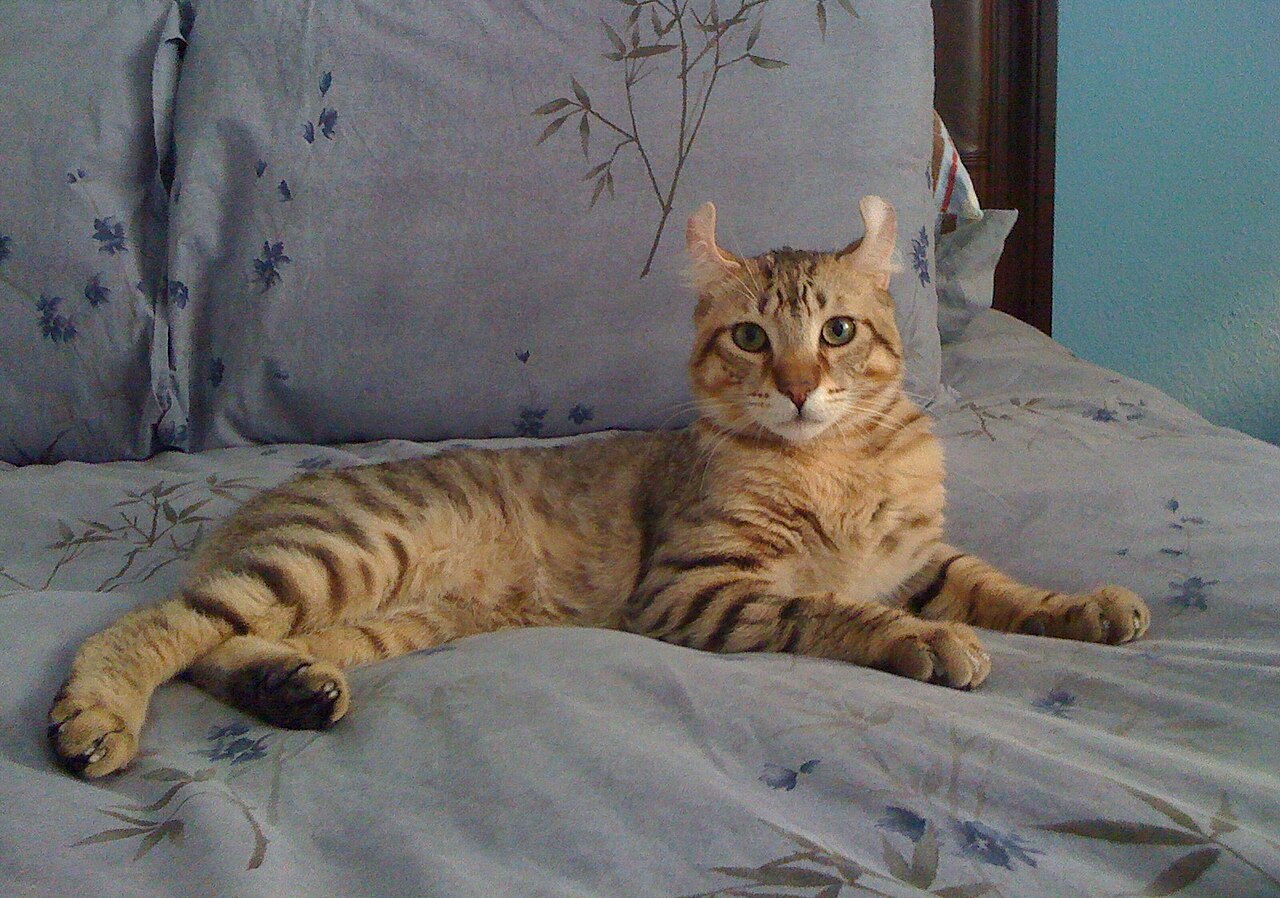
The Alpine Lynx is a white, short-tailed cat breed that can have either curled or straight ears. They may be either short- or long-haired, and may have tufted toes. They are a medium-sized breed whose back legs are longer than their front legs. It was developed from a cross between a Highlander and a white barn cat. It is recognized by the Rare and Exotic Feline Registry.
American Lynx
The American Lynx is a short-haired cat breed with a spotted coat. This breed is bob-tailed or short-tailed. The coat pattern bears some resemblance to that of the bobcat. This breed is recognized by the Rare and Exotic Feline Registry.
American Polydactyl
The American Polydactyl is a polydactyl cat, meaning that it has more than the usual number of toes. This breed is currently in development. As of 2018,[update] it is recognized (since 2004) only by the Rare and Exotic Feline Registry.
American Ringtail
The American Ringtail, also known as the Ringtail Sing-a-Ling, is a cat breed with the ability to hold their tail in a ring-like shape. It is recognized as registration only by The International Cat Association.
Aphrodite (Cyprus, Cypriot, Aphrodite's Giant, St. Helen, St. Nicholas cat)
- Main article: Cyprus cat
The Cyprus cat is a landrace of cats native to Cyprus; it is a localized variant of the Aegean cat. As with the latter, attempts are underway to true-breed certain traits and establish a standardized breed, under a variety of names by different breeder groups. Recognition so far, under the name Aphrodite, is limited to the World Cat Federation/World Cat Congress since 2012, provisionally by The International Cat Association since 2017, and various more localized bodies such as the Cyprus Cats National Breed Association and the Cyprus Feline Society.
Australian Tiffanie
The Australian Tiffanie is a cat breed derived from crosses between the short-haired Burmilla and the long-haired Chinchilla Persian. These cats resemble the old style of the Chinchilla Longhair. Some name confusion exists with this breed; this Australian cat is not the same as the Tiffanie breed in Europe (also known as the Burmilla Longhair) or the Tiffany breed in the United States. It is recognized by the Waratah State Cat Alliance.
Bambino
The Bambino is a dwarf cat cross between the Munchkin and Sphynx breeds; it has the short legs of the former and the lack of fur of the latter. It is recognised by the Rare and Exotic Feline Registry.
In 2005, two cat breeders, Stephanie and Pat Osborne, started the Bambino breed at their Holy Moly Cattery in Arkansas, which later went defunct. They likely named it Bambino (Italian for "baby") because of its properties. One year later, The International Cat Association (TICA) recognized the Bambino as an experimental breed of cat.
It is technically legal to own a Bambino, but owning and breeding of it is discouraged and considered unethical due to health problems. In 2019, the Netherlands Food and Consumer Product Safety Authority ordered a couple to stop breeding the Bambino due to welfare concerns, which include painful limited mobility as a result of dwarfism.
The Bambino has also been given the name "XL Bully Cat" due to its similarities to the American Bully (XL Bully Dog).
Bramble
The Bramble is a large wire-haired cat breed with a spotted coat pattern. It was derived from crossing the Bengal with brush-coated Peterbalds. It originates from the US and is recognized by the Rare and Exotic Feline Registry.
Classicat (Jungala)
The Classicat is a cat breed originating from New Zealand. It is overall an Ocicat-type, but has a coat with the classic swirled tabby pattern. It is recognized by the New Zealand Cat Fancy.
Desert Lynx
- "Desert Lynx" redirects here. For the wild cat genus Lynx, which may be found in deserts, see Lynx. For the wild cat genus Caracal, also known as "desert lynx", see Caracal.
The Desert Lynx is a bob-tailed or short-tailed cat breed of US origin. This cat has spotted or marbled markings and resembles the bobcat, and the breed is recognized by the Rare and Exotic Feline Registry.
Dwelf
The Dwelf is a dwarf cat cross of Sphynx, Munchkin, and American Curl stock, and has the defining traits of all three breeds: hairlessness, shortened legs, and curled ears. The breed is of US origin and was recognized by the now-defunct Dwarf Cat Association (or Designer Cat Association). Later, it became recognized by the Rare and Exotic Feline Registry.
Gallery
Ajouter des photos
Partagez vos photos de cette espèce (jusqu'à 20 à la fois) : elles sont vérifiées automatiquement, puis publiées.
Autres races de l'espèce (132)
Espèce : Chat
Voir les 120 autres races
- Bleu russe
- Bobtail américain
- Bobtail de Carélie
- Bobtail des Kouriles
- Bobtail du Mékong
- Bobtail japonais
- Bombay
- Brazilian shorthair
- British longhair
- British shorthair
- Burmese
- Burmese américain
- Burmese anglais
- Burmilla
- Californian spangled
- Chantilly
- Chartreux
- Chausie
- Colorpoint shorthair
- Cornish rex
- Cymric
- Céleste
- Devon rex
- Donskoy
- European shorthair
- Exotic shorthair
- Foreign white
- German rex
- Havana brown
- Highlander
- Himalayen
- Khao Manee
- Korat
- LaPerm
- Lykoï
- Mandarin
- Manx
- Mau arabe
- Mau égyptien
- Minskin
- Munchkin
- Nebelung
- Norvégien
- Ocicat
- Ojos azules
- Oriental shorthair
- Persan
- Peterbald
- Pixie-bob
- Ragamuffin
- Ragdoll
- Sacré de Birmanie
- Safari
- Savannah
- Scottish fold & Highland Fold
- Selkirk rex
- Serengeti
- Seychellois
- Siamois
- Sibérien
- Singapura
- Snowshoe
- Sokoké
- Somali
- Sphynx
- Thaï
- Tiffany
- Tonkinois
- Toyger
- Turc de Van
- Ukrainian Levkoy
- Ural rex
- York chocolat
- Aphrodite's Giant
- Ashera
- Chat de gouttière
- Chat de mer Égée
- Chat rex
- Chat à poil long
- Dragon Li
- Javanese cat
- Minuet cat
- Neva Masquerade
- Raas cat
- Russian White, Black, and Tabby
- Suffolk cat
- Suphalak
- Toybob
- Traditional Persian
- Altai
- Thai Lilac
- American Ringtail
- Elf cat
- Kinkalow
- Mixed breed cat
- Modern Siamese
- Owyhee Bob
- Pantherina
- Californian rex
- Mandalay
- Skookum
- Bohemian Rex
- Ceylan
- Jianzhou cat
- Oriental bicolour
- Ussuri
- Genetta
- Antipodean
- California Rex
- Chinchilla Persian
- Deutsche Langhaarkatze
- Dwelf
- Himalayan Persian
- Kanaani cat
- Kashmir cat
- Kohana
- Kohona
- Lambkin
- Oregon Rex
- Tennessee Rex
Sources et crédits
Informations provenant de plusieurs sources vérifiées. Dernière mise à jour : .
Crédits photos (3)
- Photo : TAnthony · CC BY-SA 4.0 · via Wikimedia Commons
- Photo : AliciaPSF · CC BY-SA 4.0 · via Wikimedia Commons
- Photo : AliciaPSF · CC BY-SA 4.0 · via Wikimedia Commons
Mentions de licence
Texte disponible sous licence CC BY-SA 4.0. Il adapte notamment Wikipedia (CC BY-SA): List of experimental cat breeds (Wikipédia, auteurs dans l’historique de l’article).
- Taxonomie : GBIF Backbone Taxonomy (CC BY 4.0)
Détail : Sources et licences.
Discussion (0)
Aucun message pour l’instant. Lancez la discussion sur cette fiche (sources, précisions, débats éditoriaux).
Connectez-vous pour participer à la discussion.