
- Kingdom
- Animalia
- Phylum
- Chordata
- Class
- Mammalia
- Order
- Carnivora
- Family
- Canidae
- Genus
- Canis
- Species
- Canis lupus familiaris
Overview
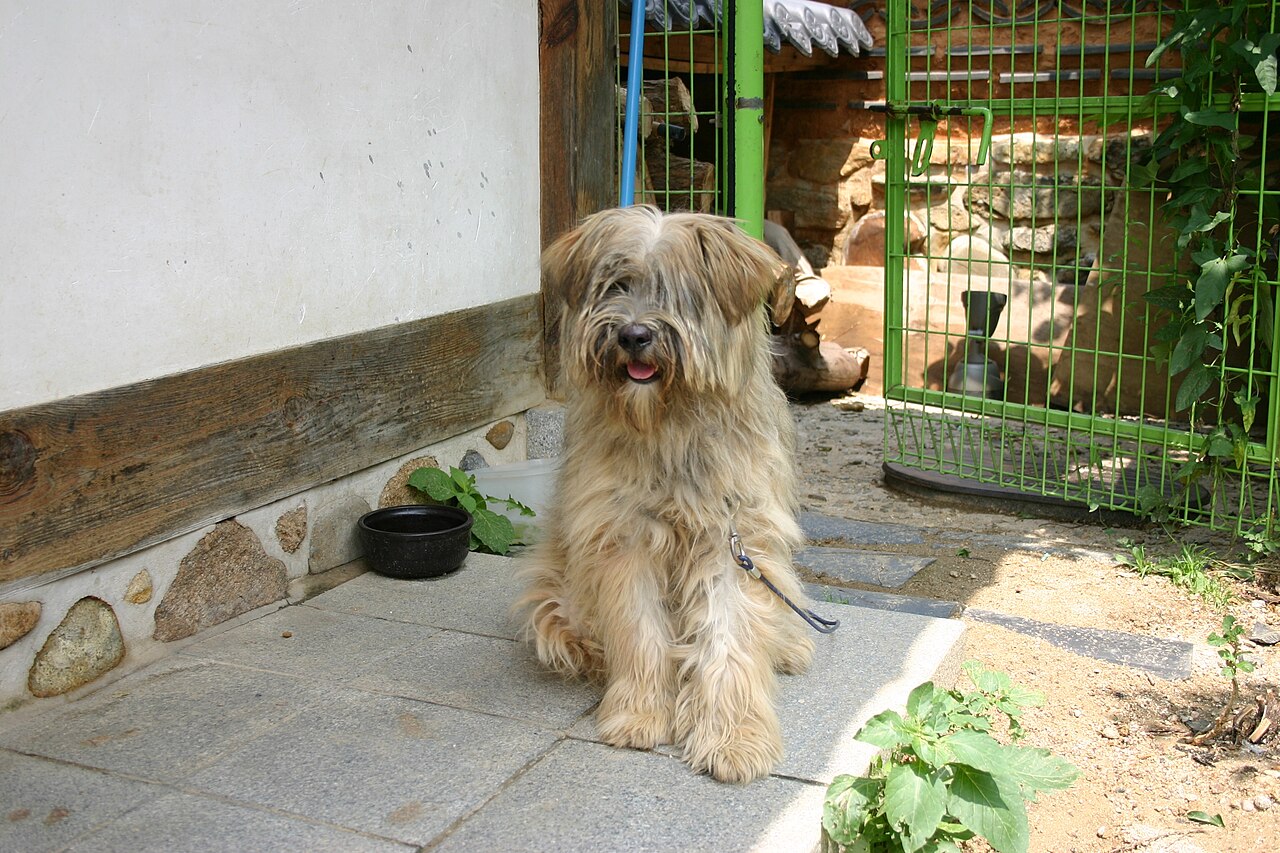
The Sapsal (also Sapsali/Sapsari or Sapsalgae; Korean: 삽살이) is a shaggy-haired South Korean breed of dog that is said to ward off evil spirits. In the Korean language, the word Sapsal is followed by either gae (개, meaning "dog") or the nominative particle i (이), and may occasionally be romanized as Sapsaree. The breed was designated as one of the natural monuments of South Korea in 1992 to receive protected status and funding for its preservation as a part of South Korea's cultural heritage. The breed is officially recognized by the Korean Kennel Federation.
Description
The height of the male is 51 cm and the female is 49 cm, and the body is covered with long, thick fur which protects them from the cold. The dog may be any of several colors, either solid or mixed:
- Black
- Gold
- Orange
- Brown
- Grey
- Blue
- White
The ears lie down, and the snout is relatively blunt and not pointed like a Jindo dog. Its tail is raised and its head is large, so its shape resembles that of a lion. Its personality is bold and valiant, loyal to its owner.
History
The breed's name Sapsalgae means "a dog that chases away evil spirits and misfortune", and it appears frequently in lyrics, folktales, and paintings. They are nicknamed "Ghost Hunters" or "Sunshine Dogs" for their supernatural qualities, or "Lion Dogs" for their appearance having large paws and shaggy fur.[citation needed]
Sapsali dogs date back to the Three Kingdoms period around 220 A.D. - 280 A.D.[citation needed] They were mainly bred as companions for aristocrats during the Silla period, but were owned by common people after the collapse of Unified Silla. A 300-year-old stone memorial in southeastern South Korea tells the story of an aristocrat who fell asleep on a riverbank after having too many drinks. Embers from his pipe started a brush fire as he slept, and his faithful Sapsali jumped into the river and used its wet fur to douse the fire and save its master at the cost of its own life.
The breed were slaughtered in large numbers by the Japanese when Korea was under Japanese rule to make winter coats for its military in Manchuria. In the late 1960s, professors at Kyungpook National University collected about 30 Sapsali dogs in an effort to preserve the breed, but the dogs were near extinction by the mid-1980s with only eight dogs remaining. The breed was revived by geneticist Dr. Ha Ji-hong, who used DNA methods to reestablish the breed and weed out congenital issues. In 1992 the breed was designated as one of the Natural Monuments of South Korea, receiving protected status and funding for its preservation as a part of Korean cultural heritage.
The breed's population currently numbers in the thousands, and they are commonly found as household pets and therapy dogs due to their gentle temperament, loyal nature, and friendliness. A Sapsali dog was chosen as the Mascot of the IAAF World Champship in Daegu 2011.
See also
- Dogs portal
- List of dog breeds
- Donggyeongi
- Jindo
- Pungsan
Gallery
Ajouter des photos
Partagez vos photos de cette espèce (jusqu'à 20 à la fois) : elles sont vérifiées automatiquement, puis publiées.
Autres races de l'espèce (942)
Espèce : Chien
Voir les 930 autres races
- American Hairless terrier
- American Pit Bull Terrier
- American Staffordshire Terrier
- Anglo-français de petite vénerie
- Ariégeois
- Australian Kelpie
- Azawakh
- Aïdi
- Bangkaew de Thaïlande
- Barbet
- Barbu tchèque
- Barzoï
- Basati Alaunt
- Basenji
- Basset artésien normand
- Basset bleu de Gascogne
- Basset de Westphalie
- Basset des Alpes
- Basset fauve de Bretagne
- Basset hound
- Basset suédois
- Beagle
- Beagle-harrier
- Bearded collie
- Bedlington terrier
- Berger Kangal
- Berger allemand
- Berger anglais
- Berger australien
- Berger basque
- Berger belge Groenendael
- Berger belge Laekenois
- Berger belge Tervueren
- Berger blanc suisse
- Berger bulgare
- Berger catalan
- Berger croate
- Berger d'Asie centrale
- Berger de Beauce
- Berger de Bergame
- Berger de Bohême
- Berger de Bosnie-Herzégovine et de Croatie
- Berger de Brie
- Berger de Maremme et Abruzzes
- Berger de Russie méridionale
- Berger de Savoie
- Berger de la Serra de Aires
- Berger des Pyrénées à face rase
- Berger des Pyrénées à poil long
- Berger des Tatras
- Berger du Caucase
- Berger du Karst
- Berger finnois de Laponie
- Berger hollandais
- Berger picard
- Berger polonais de plaine
- Berger roumain corbeau
- Bichon bolonais
- Bichon havanais
- Bichon maltais
- Bichon à poil frisé
- Biewer Yorkshire
- Billy
- Bluetick coonhound
- Bobtail
- Boerboel
- Border Terrier
- Border collie
- Bouledogue
- Bouledogue américain
- Bouvier australien
- Bouvier australien courte queue
- Bouvier bernois
- Bouvier d'Appenzell
- Bouvier de l'Entlebuch
- Bouvier des Flandres
- Boxer
- Boykin Spaniel
- Brachet allemand
- Brachet de Styrie à poil dur
- Brachet noir et feu
- Brachet polonais
- Brachet tyrolien
- Braque Dupuy
- Braque Saint-Germain
- Braque allemand à poil court
- Braque d'Auvergne
- Braque de Weimar
- Braque de l'Ariège
- Braque du Bourbonnais
- Braque français
- Braque français, type Pyrénées
- Braque hongrois à poil court
- Braque hongrois à poil dur
- Braque italien
- Braque slovaque à poil dur
- Briquet griffon vendéen
- Broholmer
- Bruno du Jura
- Buhund norvégien
- Bull Terrier
- Bull Terrier miniature
- Bulldog anglais
- Bullmastiff
- Ca de Bou
- Cairn terrier
- Can de palleiro
- Cane Corso
- Caniche
- Carlin
- Carolina Dog
- Cavalier King Charles Spaniel
- Cavoodle
- Chart polski
- Chien chinois de Chongqing
- Chien chinois à crête
- Chien courant bernois
- Chien courant d'Istrie à poil dur
- Chien courant d'Istrie à poil ras
- Chien courant de Bosnie à poil dur
- Chien courant de Halden
- Chien courant de Hamilton
- Chien courant de Hygen
- Chien courant de Schiller
- Chien courant de Transylvanie
- Chien courant de la vallée de la Save
- Chien courant de montagne du Monténégro
- Chien courant du Småland
- Chien courant espagnol
- Chien courant finlandais
- Chien courant grec
- Chien courant italien à poil ras
- Chien courant lucernois
- Chien courant norvégien
- Chien courant polonais
- Chien courant schwytzois
- Chien courant serbe
- Chien courant slovaque
- Chien courant suisse
- Chien courant tricolore serbe
- Chien d'Artois
- Chien d'arrêt allemand à poil dur
- Chien d'arrêt allemand à poil long
- Chien d'arrêt allemand à poil raide
- Chien d'arrêt danois ancestral
- Chien d'arrêt frison
- Chien d'arrêt portugais
- Chien d'eau américain
- Chien d'eau espagnol
- Chien d'eau frison
- Chien d'eau portugais
- Chien d'eau romagnol
- Chien d'ours de Carélie
- Chien d'oysel allemand
- Chien d'élan norvégien gris
- Chien d'élan norvégien noir
- Chien d'élan suédois
- Chien de Canaan
- Chien de Castro Laboreiro
- Chien de Rhodésie à crête dorsale
- Chien de Saint-Hubert
- Chien de Taïwan
- Chien de berger de Majorque
- Chien de berger islandais
- Chien de berger roumain de Bucovine
- Chien de berger roumain de Mioritza
- Chien de berger roumain des Carpathes
- Chien de berger yougoslave de Charplanina
- Chien de ferme dano-suédois
- Chien de garenne des Canaries
- Chien de garenne portugais
- Chien de la Serra da Estrela
- Chien de montagne des Pyrénées
- Chien de perdrix de Drente
- Chien de recherche au sang de Hanovre
- Chien de recherche au sang de la montagne bavaroise
- Chien de trait belge
- Chien des Fuégiens
- Chien du Groenland
- Chien du pharaon
- Chien finnois de Laponie
- Chien noir et feu pour la chasse au raton laveur
- Chien norvégien de macareux
- Chien nu du Pérou
- Chien polynésien
- Chien thaïlandais à crête dorsale
- Chien à loutre
- Chien-loup de Saarloos
- Chien-loup tchécoslovaque
- Chihuahua
- Chippiparai
- Chow-chow
- Cimarron uruguayen
- Cirneco de l'Etna
- Clumber Spaniel
- Cockapoo
- Cocker américain
- Cocker spaniel anglais
- Colley
- Colley à poil court
- Continental Bulldog
- Coton de Tuléar
- Cursinu
- Dalmatien
- Dandie Dinmont Terrier
- Deerhound
- Dobermann
- Dogue argentin
- Dogue de Bordeaux
- Dogue des Canaries
- Dogue du Tibet
- English Coonhound
- Esquimau américain
- Esquimau canadien
- Eurasier
- Eurohound
- Field Spaniel
- Fila Brasileiro
- Fila de São Miguel
- Fox-terrier à poil dur
- Fox-terrier à poil lisse
- Foxhound américain
- Foxhound anglais
- Français blanc et noir
- Français tricolore
- Gampr
- Gascon saintongeois
- Golden retriever
- Grand anglo-français blanc et noir
- Grand anglo-français blanc et orange
- Grand basset griffon vendéen
- Grand bleu de Gascogne
- Grand bouvier suisse
- Grand griffon vendéen
- Grand spitz
- Grand épagneul de Münster
- Griffon belge
- Griffon bleu de Gascogne
- Griffon bruxellois
- Griffon d'arrêt à poil dur Korthals
- Griffon fauve de Bretagne
- Griffon nivernais
- Harrier
- Hokkaïdo
- Hovawart
- Husky de Sibérie
- Inuit du Nord
- Irish wolfhound
- Jack Russell terrier
- Jindo coréen
- Kai
- Kangal
- Kerry beagle
- Kintamani
- Kishu
- Komondor
- Kooikerhondje
- Kromfohrländer
- Kuvasz
- Labrador retriever
- Lakeland Terrier
- Lancashire Heeler
- Landseer
- Lapphund suédois
- Laïka de Iakoutie
- Laïka de Sibérie occidentale
- Laïka de Sibérie orientale
- Laïka russo-européen
- Leavitt bulldog
- Leonberg
- Lhassa Apso
- Lurcher
- Lévrier Bakhmull
- Lévrier Rampur
- Lévrier Tazi
- Lévrier Taïgan
- Lévrier afghan
- Lévrier de soie
- Lévrier espagnol
- Lévrier greyhound
- Lévrier hongrois
- Lévrier persan
- Lévrier whippet
- Malamute de l'Alaska
- Malinois
- Maltzu
- Manchester terrier
- Mastiff
- Mastiff d'Anatolie
- Mucuchies
- Mudi
- Mâtin des Pyrénées
- Mâtin napolitain
- Norfolk Terrier
- Norwich Terrier
- Parson Russell terrier
- Perdiguero de Burgos
- Perro fino Colombiano
- Petit basset griffon vendéen
- Petit bleu de Gascogne
- Petit brabançon
- Petit chien courant suisse
- Petit chien lion
- Petit chien russe
- Petit lévrier italien
- Petit spitz
- Petit épagneul de Münster
- Phalène
- Pinscher allemand
- Pinscher autrichien
- Pinscher nain
- Podenco d'Ibiza
- Pointer anglais
- Poitevin
- Pomsky
- Porcelaine
- Pudelpointer
- Puli
- Pumi
- Pékinois
- Rafeiro de l'Alentejo
- Ratier de Prague
- Ratier valencien
- Redbone Coonhound
- Retriever de la Nouvelle-Écosse
- Retriever de la baie de Chesapeake
- Retriever à poil bouclé
- Retriever à poil plat
- Rottweiler
- Ryūkyū
- Saint-bernard
- Samoyède
- Schapendoes néerlandais
- Schipperke
- Schnauzer géant
- Schnauzer miniature
- Schnauzer moyen
- Sealyham Terrier
- Setter Gordon
- Setter anglais
- Setter irlandais rouge
- Setter irlandais rouge et blanc
- Shar Pei
- Shetland
- Shiba
- Shih tzu
- Shikoku
- Shiloh Shepherd Dog
- Skye terrier
- Sloughi
- Smous des Pays-Bas
- Spinone
- Spitz Loup
- Spitz allemand
- Spitz de Norrbotten
- Spitz finlandais
- Spitz japonais
- Spitz moyen
- Springer anglais
- Staffordshire Bull Terrier
- Sussex Spaniel
- Tamaskan
- Tchouvatch slovaque
- Teckel
- Teckel à poil dur
- Terre-neuve
- Terrier Kerry Blue
- Terrier australien
- Terrier australien à poil soyeux
- Terrier brésilien
- Terrier d'agrément anglais noir et feu
- Terrier de Boston
- Terrier de chasse allemand
- Terrier irlandais
- Terrier irlandais Glen of Imaal
- Terrier irlandais à poil doux
- Terrier japonais
- Terrier noir russe
- Terrier tchèque
- Terrier tibétain
- Terrier écossais
- Tosa
- Vallhund suédois
- Vertagus
- Volpino italien
- Welsh Corgi Cardigan
- Welsh Corgi Pembroke
- Welsh Springer Spaniel
- Welsh terrier
- West Highland white terrier
- Xoloitzcuintle
- Yorkshire terrier
- Zuchon
- Épagneul bleu de Picardie
- Épagneul breton
- Épagneul d'eau irlandais
- Épagneul de Pont-Audemer
- Épagneul de Saint-Usuge
- Épagneul français
- Épagneul japonais
- Épagneul nain continental papillon
- Épagneul russe
- Akita matagi
- Alangu Mastiff
- American Alsatian
- American Fox Terrier
- Andalusian Terrier
- Argentine Pila
- Australian Cobberdog
- Bakharwal
- Basset
- Berger Blanc
- Berger américain miniature
- Berger belge
- Berger des Pyrénées
- Berner Niederlaufhund
- Black Mouth Cur
- Blue Lacy
- Boca-preta sertanejo
- Bohemian Spotted Dog
- Bolonka
- Borador
- Bouvier de Bouriatie-Mongolie
- Bouvier des Ardennes
- Bouvier portugais
- Buckhound
- Bull Arab
- Bắc Hà dog
- Ca Rater Mallorquí
- Calupoh
- Campeiro Bulldog
- Can de Chira
- Catalburun
- Chien de Majorado
- Chien de Taïmyr
- Chien léopard catahoula
- Chien nu
- Chien paria
- Chilean Terrier
- Chinook
- Chukotka sled dog
- Cocker spaniel
- Combai
- Cretan Hound
- Czech Mountain Dog
- Cão de Gado Transmontano
- Danish Spitz
- Dogue Brasileiro
- Donggyeongi
- East European Shepherd
- Elo
- Estonian Hound
- Fox-terrier
- Gaucho sheepdog
- Georgian Shepherd
- Goldendoodle
- Grand Fauve de Bretagne
- Greek Shepherd
- Griffon
- Gull Terrier
- Himalayan Sheepdog
- Huntaway
- Hällefors Elkhound
- Indian Spitz
- Jonangi
- Kanni
- Karelo-Finnish Laika
- Kawakami Inu
- King Charles Spaniel
- King's White Hound
- Kokoni
- Koolie
- Kunma Dog
- Labradoodle
- Laizhou Hong
- Langqing Quan
- Lobito Herreño
- Lucas Terrier
- Lupo Italiano
- Lài dog
- Macedonian Shepherd Dog
- Mackenzie River husky
- Maneto
- Mantiqueira Shepherd
- Markiesje
- Mexican lapdog
- Mi-Ki
- Miniature Australian Shepherd
- Miniature Fox Terrier
- Morkie
- Moscow Watchdog
- Mountain Cur
- Mâtin espagnol
- Nenets Herding Laika
- Olde English Bulldogge
- Original Fila Brasileiro
- Paisley Terrier
- Pastor Garafiano
- Patagonian Sheepdog
- Patterdale Terrier
- Perro de Agua Cantábrico
- Phu Quoc Ridgeback
- Piccolo Segugio dell'Appennino
- Plott Hound
- Podenco Andaluz
- Podenco Valenciano
- Puggle
- Pungsan
- Rajapalayam
- Rat Terrier
- Sarabi dog
- Sarail Hound
- Sardinian Shepherd Dog
- Segugio Maremmano
- Segugio dell'Appennino
- Seppala Siberian Sleddog
- Small Međimurje Dog
- Spanish dogo
- Sporting Lucas Terrier
- Staghound
- Tang Dog
- Tatra Hound
- Techichi
- Teddy Roosevelt Terrier
- Telomian
- Tenterfield Terrier
- Tonya Finosu
- Toy Manchester Terrier
- Treeing Feist
- Treeing Tennessee Brindle
- Treeing Walker Coonhound
- Valdueza
- Villano de las Encartaciones
- Welsh Corgi
- Welsh Hound
- Welsh Sheepdog
- West Country Harrier
- Xiasi Dog
- Xigou
- Zerdava
- Épagneul tibétain
- Meitei Hui
- Beaglier
- Bernedoodle
- Black and Tan Terrier
- Catahoula Bulldog
- Dorgi
- Double-nosed Andean tiger hound
- Gerberian Shepsky
- Gull Dong
- Mal-shi
- Maltipoo
- Miniature Shar Pei
- Pomchi
- Pugese
- Schnoodle
- Shih-poo
- Sulimov dog
- Swinford Bandog
- Texas Heeler
- Yorkipoo
- Afghan mastiff
- American Mastiff
- Anglo-Russian Hound
- Australian stock dog
- Berger de Kars
- Berger noir slovaque
- Bolonka Franzuska
- Bone-mouth
- Borneo dog
- Boxador
- Branchiero siciliano
- Braque Français, Type «Gascongne»
- Brazilian Bull-mastiff
- Bulgarian Shepherd Dog
- Bullbras
- Cane Pecoraio Varbutu
- Chamuco
- Chien de St. Hubert
- Decker Terrier
- Dogo Guatemalteco
- Epagneul du Chasse Polonais
- Gotland Hound
- Grand Gascon saintongeois
- Griffon à poil laineux
- Guregh
- Hedehund
- Kattai dog
- Kyi-Leo
- Lévrier turc
- Miniature dachshund
- Pandikona
- Petit Gascon Saintongeois
- Pit Monster
- Pitador
- Pulin
- Ramanathapuram mandai dog
- Russian Hound
- Seskar Seal Dog
- Sila Shepherd
- Silken Windsprite
- Svensk vit älghund
- Toy Poodle
- Trailhound
- Tuvinskaya ovcharka
- Westiepoo
- White English Bulldog
- Berger d'Auvergne
- Braque français, type Gascogne
- Caravan hound
- Charnaigre
- Chien courant italien à poil dur
- Chien créole
- Chien fer
- English bull terrier
- Français blanc et orange
- Grand anglo-français tricolore
- Greyster
- Khortaï
- Laobé
- Lévrier grec
- Nureongi
- Talbot
- Teckel à poil long
- Teckel à poil ras
- Épagneul picard
- Alopekis
- American Leopard Hound
- Argentine polar dog
- Armant
- Australian Bulldog
- Berger de Crau
- Beskydský bundáš
- Briquet de Provence
- Bulgae
- Bulgarian Hound
- Bulgarian Scenthound
- Ca Mè Mallorquí
- Ca de Conills
- Cane Paratore
- Carea Castellano Manchego
- Chien de Berger de Lessinia et Lagorai
- Cão do Barrocal Algarvio
- Córdoba fighting dog
- Dikkulak
- Dogo Sardesco
- Ecuadorian Hairless Dog
- English Water Spaniel
- Erbi Txakur
- Fu Quan
- Guicho
- Hmong bobtail dog
- Irish bull terrier
- Italian Shepherd
- Jeju dog
- Kars dog
- King Shepherd
- Kunming dog
- Kurdish Mastiff
- Labrit
- Laconian
- Lapponian Shepherd
- Levesque
- Lithuanian Hound
- Majestic Tree Hound
- Molossus of Epirus
- Moscow Water Dog
- New Zealand Heading Dog
- Norman Hound
- Old Croatian Sighthound
- Old Welsh Grey Sheepdog
- Pachon Navarro
- Pampas Deerhound
- Perdigueiro Galego
- Podengo Galego
- Ramanadhapuram Mandai
- Rastreador Brasileiro
- Ratonero Murciano
- Red Decoy Dog
- Rize Koyun
- Serrano Bulldog
- Smithfield
- Stephens Cur
- Tahitian Dog
- Terceira Mastiff
- Tibetan Kyi Apso
- Treeing Cur
- Villanuco de Las Encartaciones
- Welsh Hillman
- Assyrian Mastiff
- DenMark Feist
- Liangshan Dog
- Mojee
- Pekapoo
- Poochon
- Segugio Cravin
- St. Hubert Jura Hound
- Strobel
- Adirondack Pointing Dog
- Afghan Spaniel
- Agassaei
- Agassin
- Alano
- Albanian Mountain Dog
- Albanian Wolfdog
- Alicant Dog
- Ameri-Indian Alaskan Husky
- American Blue Gascon Hound
- American Squirrel Dog
- American Wolfdog
- American Working Red
- Anglo-Spanish Greyhound
- Antebellum Bulldog
- Appalachian Sighthound
- Aquarius
- Artésien-normand
- Aurora Husky
- Aussiedoodle
- Australian Barb
- Australian Staghound
- Awa Ken
- Badger dog
- Baganda Dog
- Bajan Toy Terrier
- Balla Terrier
- Bangara Mastiff
- Basset Saintongeois
- Basset d’Artois
- Batak Dog
- Belgian Pointer
- Bichon Yorkie
- Bisben
- Bisharin Greyhound
- Black Norrlandshund
- Black Pointer
- Black Spitz
- Black and Tan Virginia Foxhound
- Boerenfox terrier
- Bordoodle
- Braque Charles X
- Brittany Spaniel
- Bull Boxer
- Bullnese
- Burmese Spitz Dog
- Camas Cur
- Camus cur
- Canadian cur
- Canis Panther
- Capheaton Terrier
- Carolina cur
- Cesky Wire-haired Pointing Griffon
- Chien particolore à poil frisé
- Chigi
- Chilean Dogo
- Chinese Happa Dog
- Chinese Hound
- Chinese Imperial Dog
- Chorkie
- Chuandong Hound
- Circassian Orloff Wolfhound
- Clallam-Indian Dog
- Cojack
- Colima Dog
- Comforter
- Common Indian Dog
- Creeper Terrier
- Cur dog
- Cyprus Poodle
- Daitō Inu
- Damchi
- Deltari ilir
- Dinka Greyhound
- Dropper
- Egyptian Hairless Dog
- Farm collie
- Faroese Sheepdog
- Fell Hound
- Field labrador
- Frenchton
- Friesian Windhund
- Gegar colombien
- German Silky Pinscher
- Glenwherry Collie
- Gollie
- Gorskaja
- Gos d'atura aranès
- Gran Mastín de Borínquen
- Gredin Spaniel
- Gråhund
- Hairless Khala
- Han Dog
- Harlequin Pinscher
- Hertha pointer
- Hungarian sheepdog
- Huslia Husky
- Inca Dog
- Indian Husky
- Indian Tailles Dog
- Inn kwe
- Izcuintli, itzcuintli
- Juan Fernández Sheepdog
- Jōmon Dog
- Kanawar Dog
- Karadeniz Shepherd Dog
- Kemmer stock cur
- Kentucky Shell Heap Dog
- Kitler
- Klamath-Indian Dog
- Korean Mastiff
- Koshi
- Koshikiyama Inu
- Kumiş
- Kurdistan Greyhound
- Laconian Hound
- Lakeland Foxhound
- Larye, Larrye
- Latvian Hound
- Levriero meridionale
- Llewellin Setter
- Long-haired Inca Dog
- Longhaired Whippet
- Lottatore Brindisino
- Lyme Mastiff
- Lévrier de Saintonge
- Maltese Fox Terrier
- Maltese Little Lion-dog
- Maltese Pocket Dog
- Marxdorfer Wolfshund
- Medelyan
- Medium-sized Anglo-French Hound
- Miniature Siberian Husky
- Mountain Feist
- Mountain View Cur
- Mullins' feist
- Murray River Curly Coated Retriever
- Mâtin
- Naga Dog
- National Deerhound
- Native Irish Pedigree Dog Breeds
- Nootka Dog
- Normand-Poitevin
- North-Easthrly Haaling Laika
- Northern terrier
- Northwest farm terrier
- Odis
- Old Time Farm Shepherd
- Oriental Shar Pei
- Original Cajun Squirrel Dog
- Pardog
- Pashmi hound
- Pastor Americano
- Patagonian Bearded Greyhound
- Perro pampa argentino
- Peruvian Inca Orchid
- Philippines Islands Dog
- Pit Bullmastiff
- Plains-Indian Dog
- Pocket beagle
- Podenco palmero
- Poligar Hound
- Poltalloch Terrier
- Pomeranian Wolf-dog
- Powinder Dog
- Prapsos
- Pueblo Dog
- Puscha
- Ratonero Palmero
- Renascence Bulldogge
- Rothbury Terrier
- Ruby Spaniel
- Running Walker Coonhound
- Russian Setter
- San'in Shiba Inu
- Sanshu
- Satsuma Dog
- Schafpudel
- Schwarzer
- Serbian Yellow Hound
- Serbian sheep dog
- Shakhi
- Shelburne Terrier
- Shepweiler
- Shilluk Greyhound
- Shorty Bull
- Shropshre Terrier
- Siberian Sheepdog
- Sicilian Sheepdog
- Silky Spitz
- Sioux Dog
- South African Mastiff
- Sparta Sheepdog
- Spino siciliano
- St. Domingo Dog
- Steinbracke
- Strathdoon dingo killer
- Takayasu Inu
- Targhee Hound)
- Terry
- Tibetan Hound
- Timber-wolf Dog
- Timon's Biter
- Toy Bull Terrier
- Toy Mi-Ki
- Toy Munchkin
- Transcaucasian Mountain Dog
- Tripuri Dog
- Turkish Greyhound
- Turkmen Alabai
- Ukrainian Sheepdog
- Vaghari Dog
- Valley Bulldog
- Victorian Bulldog
- Waeller
- Walker Foxhound
- Water drawer
- Welsh Black-and-Tan Sheepdog
- Welsh Blue-Grey
- Welsh Harrier
- West Greenland Dog
- Westfal Terrier
- White Greek sheepdog
- Wire-haired Beagle
- Working Pit Bulldog
- Wurttemberg Pointer
- Yakki Dog
- Yakushima Inu
- Zande Dog
- Zanzibar Greyhound
- Zağar
- Zlatiborski ovčar
Sources et crédits
Informations provenant de plusieurs sources vérifiées. Dernière mise à jour : .
Crédits photos (5)
- Photo : Sungdo Cho from Seoul · CC BY 2.0 · via Wikimedia Commons
- Photo : Sungdo Cho from Seoul · CC BY 2.0 · via Wikimedia Commons
- Photo : 남리 김두량 (南里 金斗樑, 1696-1763)[1] · Domaine public · via Wikimedia Commons
- Photo : pcamp · CC BY 2.0 · via Wikimedia Commons
- Photo : Micadl22 · CC BY-SA 4.0 · via Wikimedia Commons
Mentions de licence
Texte disponible sous licence CC BY-SA 4.0. Il adapte notamment Wikipedia (CC BY-SA): Sapsali (Wikipédia, auteurs dans l’historique de l’article).
- Taxonomie : GBIF Backbone Taxonomy (CC BY 4.0)
Détail : Sources et licences.
Discussion (0)
Aucun message pour l’instant. Lancez la discussion sur cette fiche (sources, précisions, débats éditoriaux).
Connectez-vous pour participer à la discussion.