
Bobtail lizard
Tiliqua rugosa
Tiliqua rugosa, most commonly known as the shingleback skink, shingleback lizard, bobtail lizard, and the two-headed skink (often simply shingleback or bobtail); is a short-tailed, slow-moving species of blue-tongued skink (genus…
- Kingdom
- Animalia
- Phylum
- Chordata
- Class
- Squamata
- Family
- Scincidae
- Genus
- Tiliqua
- Species
- Tiliqua rugosa
Description
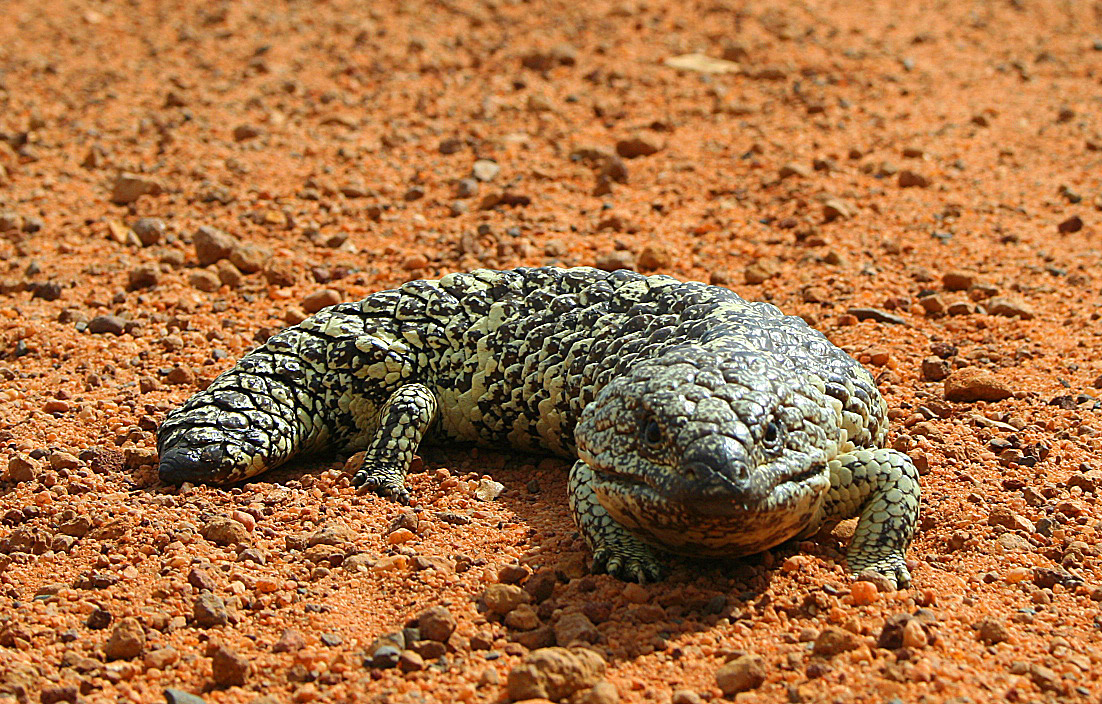
Tiliqua rugosa, most commonly known as the shingleback skink, shingleback lizard, bobtail lizard, and the two-headed skink (often simply shingleback or bobtail); is a short-tailed, slow-moving species of blue-tongued skink (genus Tiliqua) endemic to Australia. Three of its four recognised subspecies are found in Western Australia, where the bobtail name is most frequently used. The fourth subspecies, T. rugosa asper, is the only one native to eastern Australia, where it goes by the common name of the eastern shingleback. Apart from bobtail and shingleback, a variety of other common names are used in different states, including two-headed skink, stumpy lizard, stumpy-tailed lizard, pinecone lizard, bogeye or boggi, and less commonly: sleepy lizard. The Noongar Aboriginal people refer to T. rugosa as yoorn in their language. T. rugosa has a short, wide, stumpy tail that resembles its head and may serve the purpose of confusing predators. The tail also contains fat reserves, which are drawn upon during brumation in winter, during which many lizards perform a behaviour similar to hibernation except they require water every day, but can go without food. This skink is an omnivore; it eats snails and plants and spends much of its time browsing through vegetation for food. In human habitation, it is often seen basking on roadsides or other paved areas.
Gallery
Ajouter des photos
Partagez vos photos de cette espèce (jusqu'à 20 à la fois) : elles sont vérifiées automatiquement, puis publiées.
Répartition
Occurrences observées (données GBIF). Les zones hors aire d'origine peuvent indiquer une présence introduite ou invasive.
Sources et crédits
Informations provenant de plusieurs sources vérifiées. Dernière mise à jour : .
Crédits photos (6)
- Photo : Bäras · CC BY-SA 3.0
- Photo : Ethan Beaver (@ethanbeaver) · CC BY-NC 4.0 · via iNaturalist
- Photo : Max Tibby (@max_tibby) · CC0 (domaine public) · via iNaturalist
- Photo : Robert Lawrence (@rwl) · CC BY-NC 4.0 · via iNaturalist
- Photo : @pilotpossum · CC BY-NC 4.0 · via iNaturalist
- Photo : Isaac Clarey (@isaacclarey) · CC BY-NC 4.0 · via iNaturalist
Mentions de licence
Texte disponible sous licence CC BY-SA 4.0. Il adapte notamment Wikipedia (CC BY-SA) : Tiliqua rugosa (Wikipédia, auteurs dans l’historique de l’article).
- Taxonomie : GBIF Backbone Taxonomy (CC BY 4.0)
- Carte : occurrences GBIF, fond © contributeurs OpenStreetMap (ODbL)
- Statut de conservation : Liste rouge de l'UICN, via Wikidata (CC0)
Détail : Sources et licences.
Discussion (0)
Aucun message pour l’instant. Lancez la discussion sur cette fiche (sources, précisions, débats éditoriaux).
Connectez-vous pour participer à la discussion.