
Saltuarius salebrosus
Saltuarius salebrosus
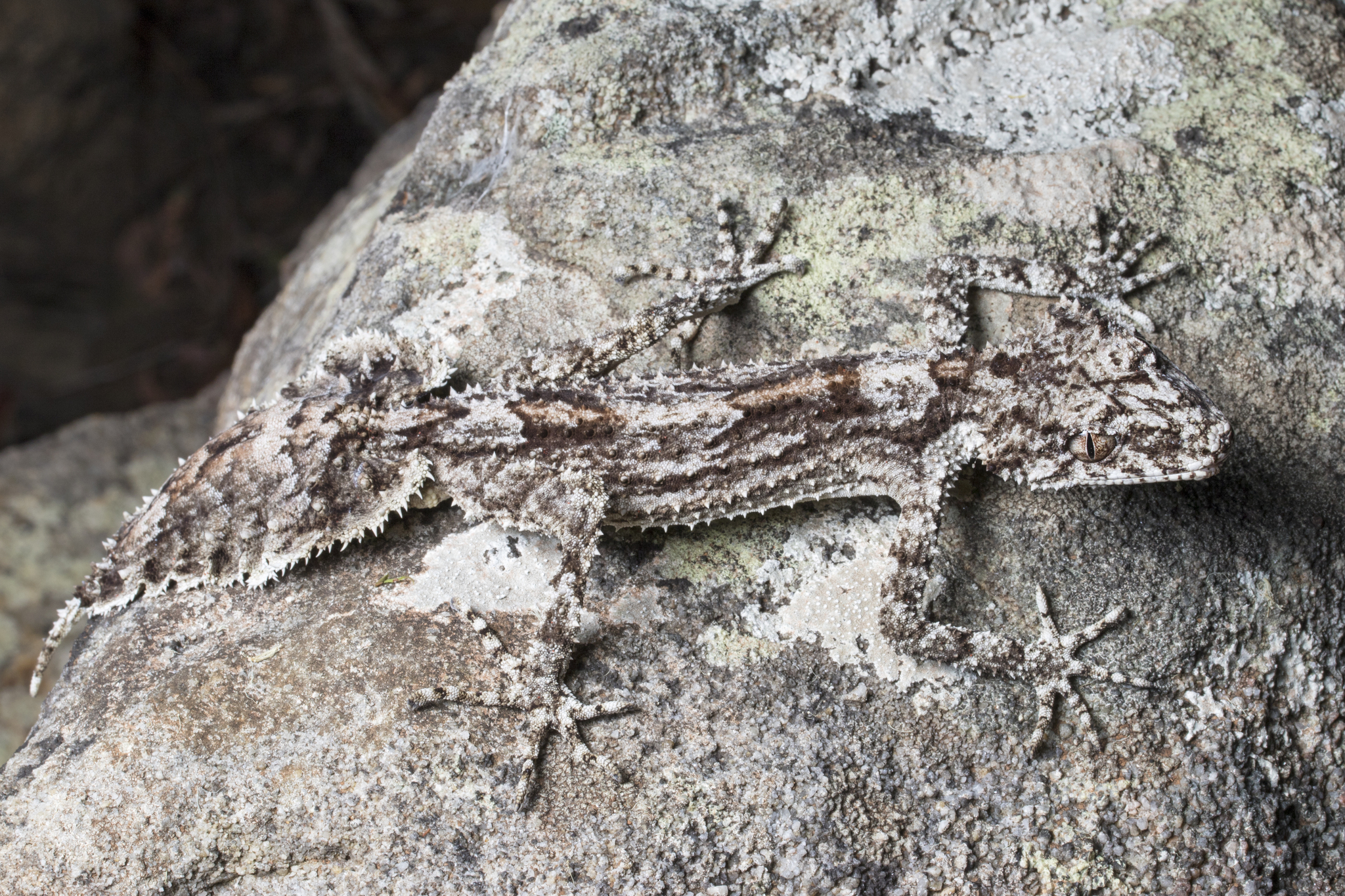
Saltuarius salebrosus, also known as the rough-throated leaf-tailed gecko or Central Queensland leaf-tailed gecko, is a gecko found in Australia.
- Kingdom
- Animalia
- Phylum
- Chordata
- Class
- Squamata
- Family
- Carphodactylidae
- Genus
- Saltuarius
- Species
- Saltuarius salebrosus
Description
Saltuarius salebrosus, also known as the rough-throated leaf-tailed gecko or Central Queensland leaf-tailed gecko, is a gecko found in Australia. It is endemic to dry areas in mid-eastern and south-central Queensland. Saltuarius salebrosus, commonly called the rough-throated leaf-tailed gecko, is a species of gecko belonging to the genus Saltuarius which translates to the "keeper of the forest". The genus Saltuarius was established in 1993 to accommodate a monophyletic group of larger species of geckos with unique interior and exterior morphological characteristics and a distinctly different chromosome number to Phyllurus. The genus Saltuarius is a long, self-sufficient, evolutionary lineage of leaf-tailed geckos, described as an innocuous, moderately sized species. Geckos are an ancient taxon of primarily nocturnal lizards, exhibiting great diversity and a worldwide distribution, occupying a wide variety of habitats and external conditions. Rough-throated leaf-tailed geckos are a group of the Carphodactylidae geckos of rainforests and rocky habitats of eastern Australia. The species was first described by herpetologist Jeanette Covacevich in 1975. The rough-throated leaf-tailed gecko is the largest of the Australian geckos, with a snout-length up to 145 mm and a total length of 250 mm. It may be distinguished by its exceedingly tubercular throat and is primarily a cavernicolous or rock-dwelling species, found in a variety of habitats ranging from gully rainforest to drier rocky scrublands. It is native to Australia and is found mostly in ranges west and south-west of Rockhampton, Queensland. The rough-throated leaf-tailed gecko average life span of seven to nine years in the wild, with a captivity life span that ranges from ten to twenty years.
Gallery
Ajouter des photos
Partagez vos photos de cette espèce (jusqu'à 20 à la fois) : elles sont vérifiées automatiquement, puis publiées.
Répartition
Occurrences observées (données GBIF). Les zones hors aire d'origine peuvent indiquer une présence introduite ou invasive.
Sources et crédits
Informations provenant de plusieurs sources vérifiées. Dernière mise à jour : .
Crédits photos (6)
- Photo : Owen Lishmund · CC BY-NC 4.0 · via GBIF
- Photo : Graham Armstrong (@grahamarmstrong) · CC BY-NC 4.0 · via iNaturalist
- Photo : Joey Mugleston (@jmugleston) · CC BY-NC 4.0 · via iNaturalist
- Photo : Richard D Reams (@rreams) · CC BY-NC 4.0 · via iNaturalist
- Photo : Jacopo Cristoni (@jacopo_cristoni) · CC BY-NC 4.0 · via iNaturalist
- Photo : @timgunns · CC BY-NC 4.0 · via iNaturalist
Mentions de licence
Texte disponible sous licence CC BY-SA 4.0. Il adapte notamment Wikipedia (CC BY-SA) : Saltuarius salebrosus (Wikipédia, auteurs dans l’historique de l’article).
- Taxonomie : GBIF Backbone Taxonomy (CC BY 4.0)
- Carte : occurrences GBIF, fond © contributeurs OpenStreetMap (ODbL)
- Statut de conservation : Liste rouge de l'UICN, via Wikidata (CC0)
Détail : Sources et licences.
Discussion (0)
Aucun message pour l’instant. Lancez la discussion sur cette fiche (sources, précisions, débats éditoriaux).
Connectez-vous pour participer à la discussion.