
Asiatic rock python
Python molurus
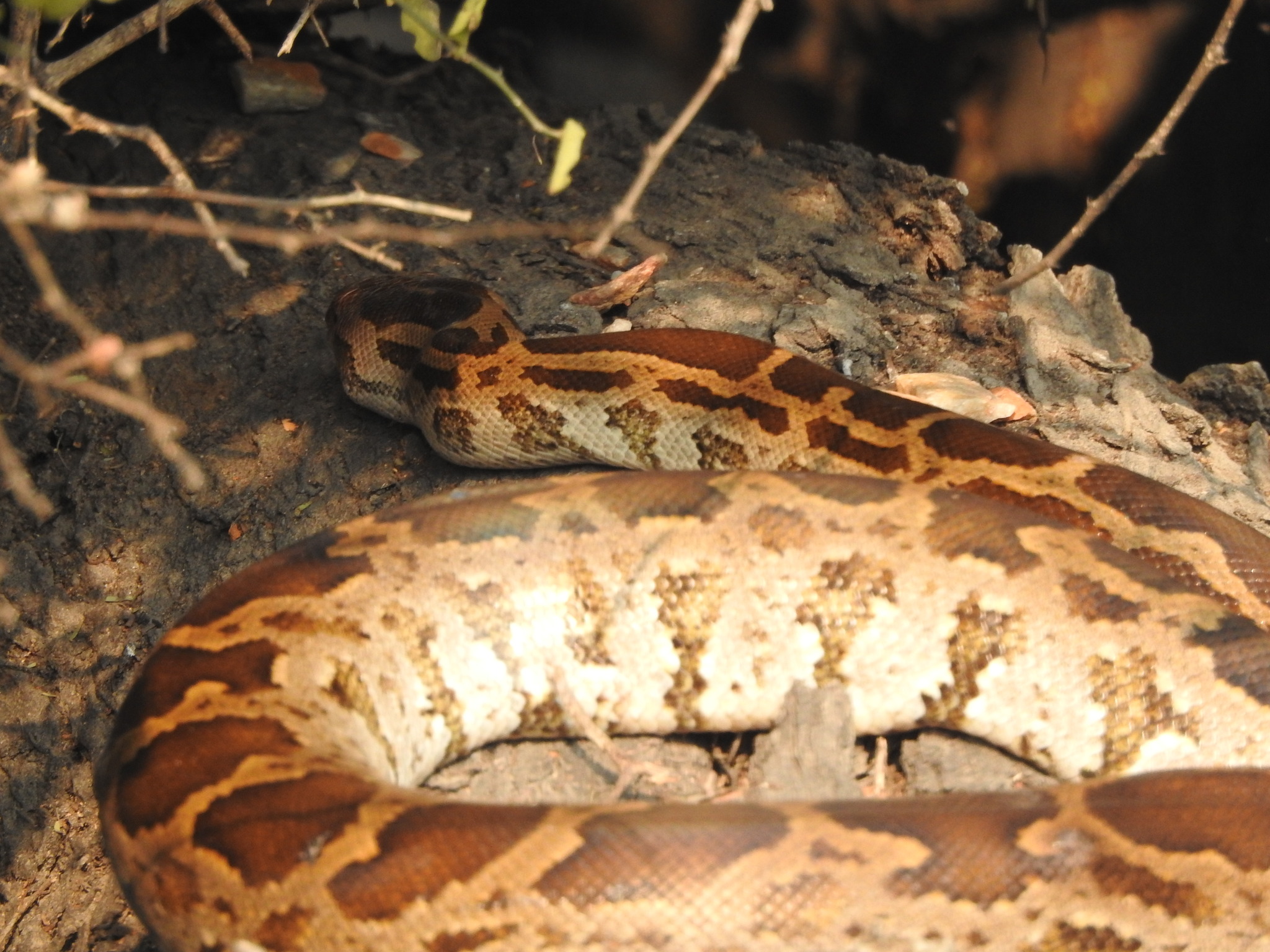
The Indian python (Python molurus) is a large python species native to tropical and subtropical regions of the Indian subcontinent and Southeast Asia.
- Kingdom
- Animalia
- Phylum
- Chordata
- Class
- Squamata
- Family
- Pythonidae
- Genus
- Python
- Species
- Python molurus
Description
The Indian python (Python molurus) is a large python species native to tropical and subtropical regions of the Indian subcontinent and Southeast Asia. It is also known by the common names black-tailed python, Indian rock python, and Asian rock python. Although smaller than its close relative the Burmese python, it is still among the largest snakes in the world. It is generally lighter colored than the Burmese python and reaches usually 3 m (9 ft 10 in). Like all pythons, it is nonvenomous.
Gallery
Ajouter des photos
Partagez vos photos de cette espèce (jusqu'à 20 à la fois) : elles sont vérifiées automatiquement, puis publiées.
Répartition
Occurrences observées (données GBIF). Les zones hors aire d'origine peuvent indiquer une présence introduite ou invasive.
Sources et crédits
Informations provenant de plusieurs sources vérifiées. Dernière mise à jour : .
Crédits photos (6)
- Photo : arhwin · CC BY-NC 4.0 · via GBIF
- Photo : Hemal (@hemal27) · CC BY-NC 4.0 · via iNaturalist
- Photo : SONU KUMAR (@sonukumar055) · CC BY-NC 4.0 · via iNaturalist
- Photo : Aaron Dsouza (@adshogun) · CC BY-NC 4.0 · via iNaturalist
- Photo : Dave Flumm (@davidflumm) · CC BY-NC 4.0 · via iNaturalist
- Photo : David Smith (@dfs42105) · CC BY-NC 4.0 · via iNaturalist
Mentions de licence
Texte disponible sous licence CC BY-SA 4.0. Il adapte notamment Wikipedia (CC BY-SA) : Indian python (Wikipédia, auteurs dans l’historique de l’article).
- Taxonomie : GBIF Backbone Taxonomy (CC BY 4.0)
- Carte : occurrences GBIF, fond © contributeurs OpenStreetMap (ODbL)
- Statut de conservation : Liste rouge de l'UICN, via Wikidata (CC0)
Détail : Sources et licences.
Discussion (0)
Aucun message pour l’instant. Lancez la discussion sur cette fiche (sources, précisions, débats éditoriaux).
Connectez-vous pour participer à la discussion.