
Huaping wolf snake
Lycodon cathaya
Lycodon cathaya, the Huaping wolf snake, is a species of snake in the family Colubridae.
- Kingdom
- Animalia
- Phylum
- Chordata
- Class
- Squamata
- Family
- Colubridae
- Genus
- Lycodon
- Species
- Lycodon cathaya
Description
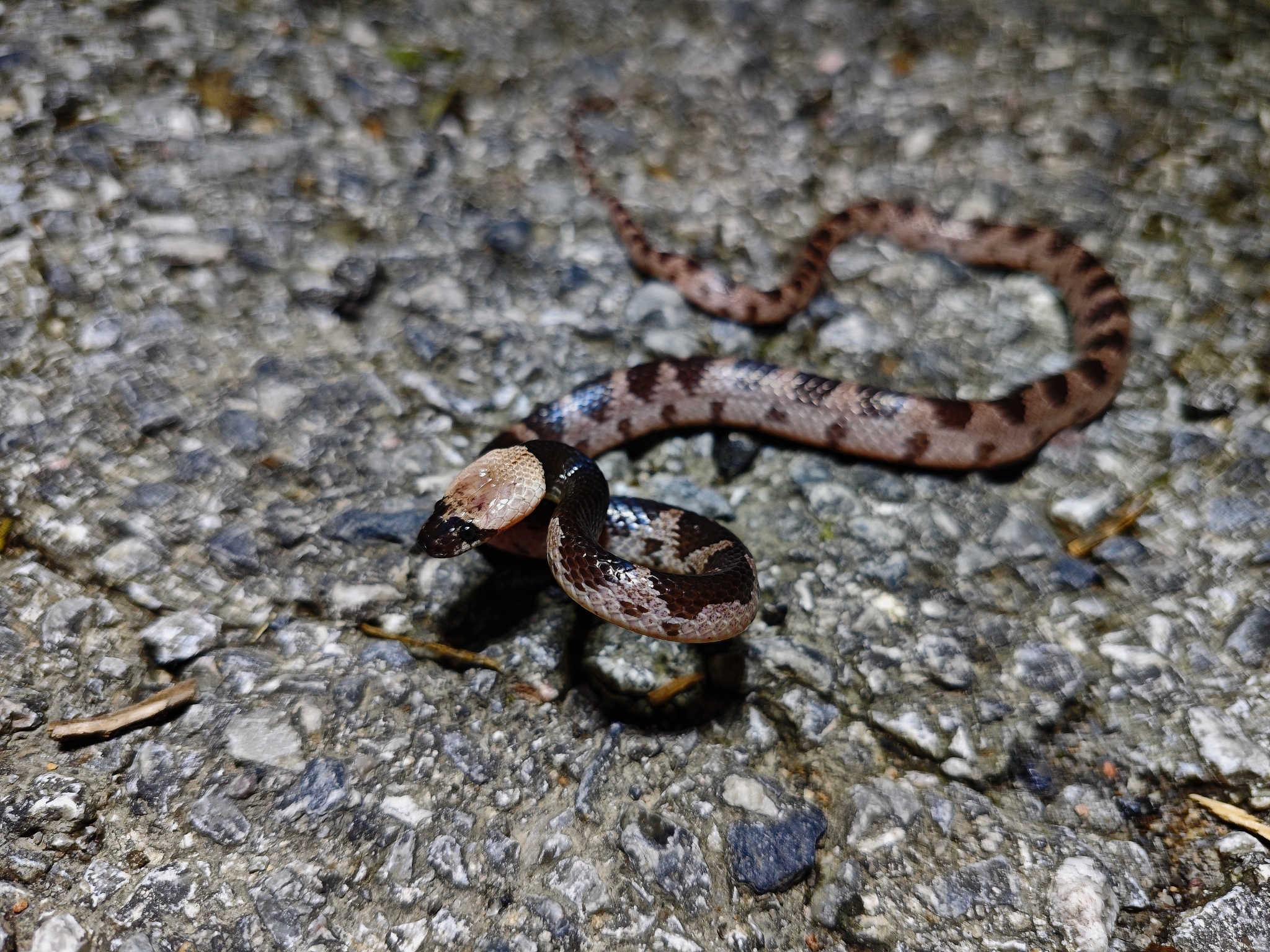
Lycodon cathaya, the Huaping wolf snake, is a species of snake in the family Colubridae. It is a slender species with a total length of 562.5–910.6 mm (22.15–35.85 in), a snout–vent length of 451.4–730.1 mm (17.77–28.74 in), and tail length of 111.1–180.5 mm (4.37–7.11 in). The upper side of the head is brownish-black with a grey-tinged rose collar band, while the underside of the head is mostly whitish. The upper side of the body is brownish-black with grey-tinged rose bands that divide the brownish-black ground colour into elliptical patches. The middle of the underside has irregular brownish-black splotches making an unbroken strip along the underside with two greyish-white lines along its sides. The Huaping wolf snake can be distinguished from other wolf snakes by a combination of its scalation and coloration. Endemic to China, it was formally described by the Chinese herpetologist Jian Wang and his colleagues in 2020. It is known only from the Huaping Nature Reserve in Guangxi, but may also occur in southwestern Hunan and southeastern Guizhou. The habitat around the Huaping Nature Reserve is mountainous, with montane evergreen broad-leaved forest or mixed forest at elevations of 850–1,000 m (2,790–3,280 ft). Although the Huaping Nature Reserve is well-protected, further studies are needed outside the reserve to better inform conservation actions for the species.
Gallery
Ajouter des photos
Partagez vos photos de cette espèce (jusqu'à 20 à la fois) : elles sont vérifiées automatiquement, puis publiées.
Répartition
Occurrences observées (données GBIF). Les zones hors aire d'origine peuvent indiquer une présence introduite ou invasive.
Sources et crédits
Informations provenant de plusieurs sources vérifiées. Dernière mise à jour : .
Crédits photos (6)
- Photo : haifeng Tang · CC BY-NC 4.0 · via GBIF
- Photo : @aazicat · CC BY-NC 4.0 · via iNaturalist
- Photo : haifeng Tang (@douya_) · CC BY-NC 4.0 · via iNaturalist
- Photo : 咩赫得 (@merdeux) · CC BY-NC 4.0 · via iNaturalist
- Photo : 羅益旻 (@jimjimjim) · CC BY-NC 4.0 · via iNaturalist
- Photo : 这是一个好人° (@danhuangsu) · CC BY-NC 4.0 · via iNaturalist
Mentions de licence
Texte disponible sous licence CC BY-SA 4.0. Il adapte notamment Wikipedia (CC BY-SA) : Lycodon cathaya (Wikipédia, auteurs dans l’historique de l’article).
- Taxonomie : GBIF Backbone Taxonomy (CC BY 4.0)
- Carte : occurrences GBIF, fond © contributeurs OpenStreetMap (ODbL)
Détail : Sources et licences.
Discussion (0)
Aucun message pour l’instant. Lancez la discussion sur cette fiche (sources, précisions, débats éditoriaux).
Connectez-vous pour participer à la discussion.