
Tree-crevice skink
Egernia striolata
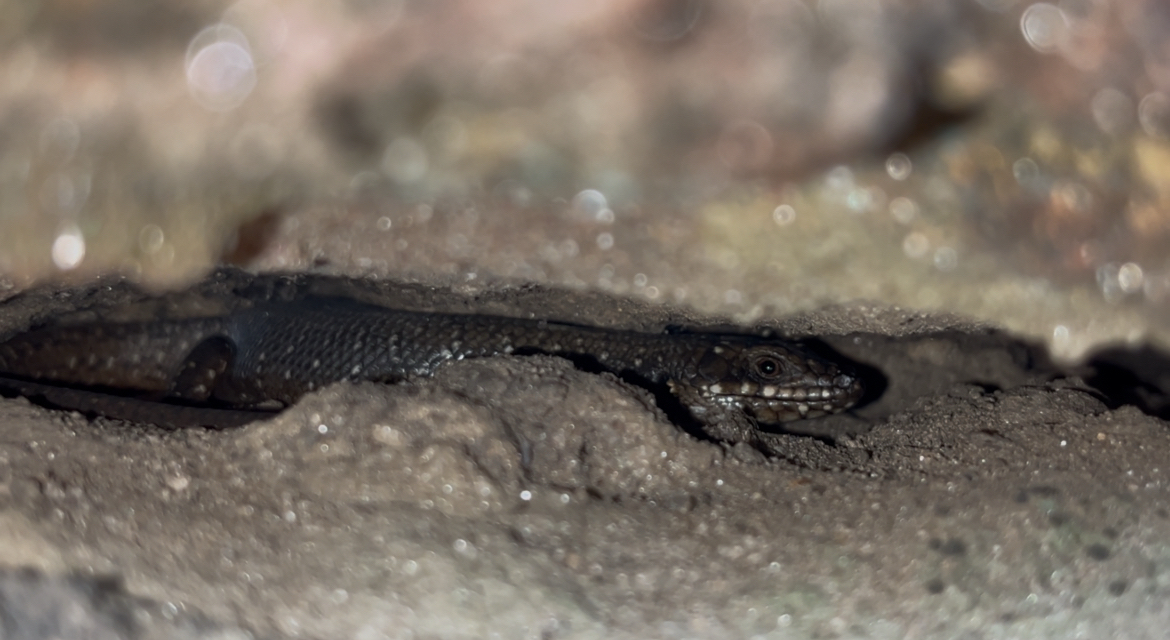
The tree-crevice skink or tree skink (Egernia striolata) is a species of skink, a lizard in the family Scincidae.
- Kingdom
- Animalia
- Phylum
- Chordata
- Class
- Squamata
- Family
- Scincidae
- Genus
- Egernia
- Species
- Egernia striolata
Description
The tree-crevice skink or tree skink (Egernia striolata) is a species of skink, a lizard in the family Scincidae. The species is endemic to Australia and is found in the states of Victoria, the Northern Territory, Queensland, New South Wales and South Australia. E. striolata tend to live in crevices and cracks in hollow logs or rocks. They greatly prefer heterogeneous and structurally diverse habitats and their behavior changes depending on the habitat they live in. They are moderately large lizards of the genus Egernia and are generally colored dark-black to grey-brown with a pale stripe going from their head to their tail. They grow to be around 100–118 mm long and can live for up to ten years. Their primary diet consists of larger, hard-bodied insects. Snakes, birds, and mammals are their major predators. They are well known for their complex social interactions and their ability to flexibly adjust their behavior depending on environmental factors. They generally live in small nuclear family groups of 2-10 individuals, made up of parents and their offspring. Offspring stay with their parents in these units until they fully mature, after which they will disperse. They mate monogamously and can live with up to several generations of their offspring at a time. The unique ability of E. striolata to chemically identify their kin and quickly react to novel social situations allows them to live in multi-generational family units. They almost always prefer to live in groups over individually. Even when there are multiple unoccupied habitats well-suited to an individual's needs, E. striolata still opts to live in groups over living alone. E. striolata are highly territorial and mark their territory using scat. E. striolata acts more aggressively or cautiously around individuals that are not identified to be family members.
Gallery
Ajouter des photos
Partagez vos photos de cette espèce (jusqu'à 20 à la fois) : elles sont vérifiées automatiquement, puis publiées.
Répartition
Occurrences observées (données GBIF). Les zones hors aire d'origine peuvent indiquer une présence introduite ou invasive.
Sources et crédits
Informations provenant de plusieurs sources vérifiées. Dernière mise à jour : .
Crédits photos (6)
- Photo : Marie · CC BY-NC 4.0 · via GBIF
- Photo : Tim Bawden (@timbawden) · CC BY-NC 4.0 · via iNaturalist
- Photo : Graham Armstrong (@grahamarmstrong) · CC BY-NC 4.0 · via iNaturalist
- Photo : Jonathan M (@isidoreajar) · CC BY-NC 4.0 · via iNaturalist
- Photo : Hudson Browne (@hudsonbrowne) · CC BY-NC 4.0 · via iNaturalist
- Photo : @martinmansfield · CC BY-NC 4.0 · via iNaturalist
Mentions de licence
Texte disponible sous licence CC BY-SA 4.0. Il adapte notamment Wikipedia (CC BY-SA) : Tree-crevice skink (Wikipédia, auteurs dans l’historique de l’article).
- Taxonomie : GBIF Backbone Taxonomy (CC BY 4.0)
- Carte : occurrences GBIF, fond © contributeurs OpenStreetMap (ODbL)
- Statut de conservation : Liste rouge de l'UICN, via Wikidata (CC0)
Détail : Sources et licences.
Discussion (0)
Aucun message pour l’instant. Lancez la discussion sur cette fiche (sources, précisions, débats éditoriaux).
Connectez-vous pour participer à la discussion.