
Ring-necked Snake
Diadophis punctatus
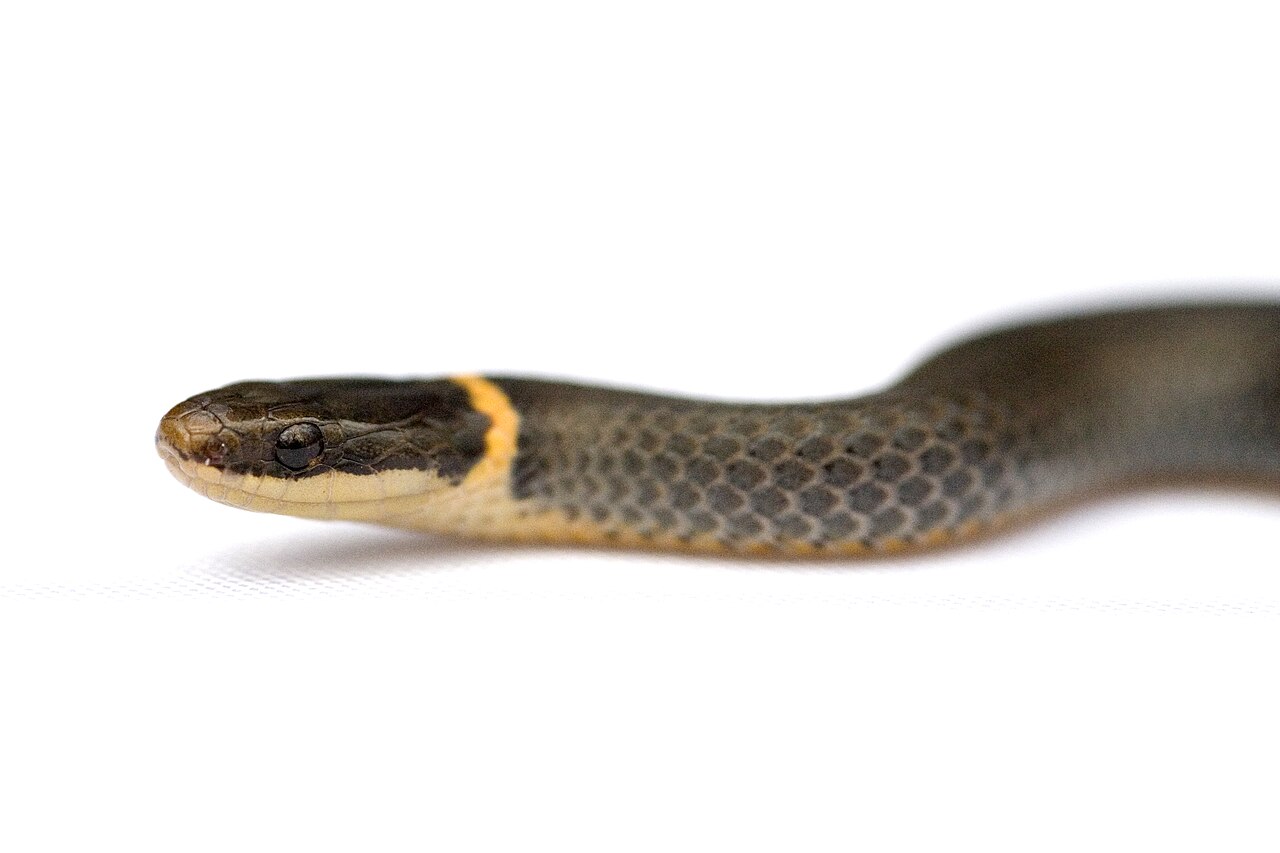
Diadophis punctatus, commonly known as the ring-necked snake or ringneck snake, is a small, harmless species of colubrid snake found throughout much of the United States, as well as south in Central Mexico and as far north as Nova…
- Kingdom
- Animalia
- Phylum
- Chordata
- Class
- Squamata
- Family
- Colubridae
- Genus
- Diadophis
- Species
- Diadophis punctatus
Description
Diadophis punctatus, commonly known as the ring-necked snake or ringneck snake, is a small, harmless species of colubrid snake found throughout much of the United States, as well as south in Central Mexico and as far north as Nova Scotia, Canada. Ring-necked snakes are generally fossorial and somewhat secretive, by nature, and, as a nocturnal species, are rarely seen during the daytime. These snakes are believed to be fairly abundant throughout most of their range, though no scientific evaluation supports this hypothesis. Scientific research is lacking for the species, despite their apparently common status, and more in-depth investigations are greatly needed. It is the only species within the genus Diadophis and, currently, 14 subspecies are identified, though many herpetologists question the morphologically based classifications. The ring-necked snake is perhaps best known for its unique defensive posture: when threatened, it curls its tail into a tight coil, partially rolls onto its back, and shows its bright red-orange underside and ventral surface. In nature, vivid coloration on an animal generally serves as a warning to others that it is not afraid of delivering a dose of venom, or that it is poisonous if eaten; this "false warning" coloration is a form of mimicry, a survival adaptation in which a non-venomous species (i.e., the ring-necked snake) has evolved brighter coloration, similar to truly venomous species, and used it to their advantage. Another example is seen in certain milksnakes and kingsnakes (Lampropeltis sp.) which have red, yellow, white or black stripes, an adaptation meant to confuse predators by visually mimicking the venomous coral snakes (Elapidae) which share much of their range.
Gallery
Ajouter des photos
Partagez vos photos de cette espèce (jusqu'à 20 à la fois) : elles sont vérifiées automatiquement, puis publiées.
Répartition
Occurrences observées (données GBIF). Les zones hors aire d'origine peuvent indiquer une présence introduite ou invasive.
Sources et crédits
Informations provenant de plusieurs sources vérifiées. Dernière mise à jour : .
Crédits photos (6)
- Photo : Brian.gratwicke · CC BY 3.0
- Photo : Aster (@aster4556) · CC BY-NC 4.0 · via iNaturalist
- Photo : @tblakehudson · CC BY-NC 4.0 · via iNaturalist
- Photo : Payton Lyle (@rlyle2) · CC BY-NC 4.0 · via iNaturalist
- Photo : Marilyn M Knight (@mmknight) · CC BY-NC 4.0 · via iNaturalist
- Photo : Elliott Smeds (@easmeds) · CC BY-NC 4.0 · via iNaturalist
Mentions de licence
Texte disponible sous licence CC BY-SA 4.0. Il adapte notamment Wikipedia (CC BY-SA) : Ring-necked snake (Wikipédia, auteurs dans l’historique de l’article).
- Taxonomie : GBIF Backbone Taxonomy (CC BY 4.0)
- Carte : occurrences GBIF, fond © contributeurs OpenStreetMap (ODbL)
- Statut de conservation : Liste rouge de l'UICN, via Wikidata (CC0)
Détail : Sources et licences.
Discussion (0)
Aucun message pour l’instant. Lancez la discussion sur cette fiche (sources, précisions, débats éditoriaux).
Connectez-vous pour participer à la discussion.