
Painted Turtle
Chrysemys picta
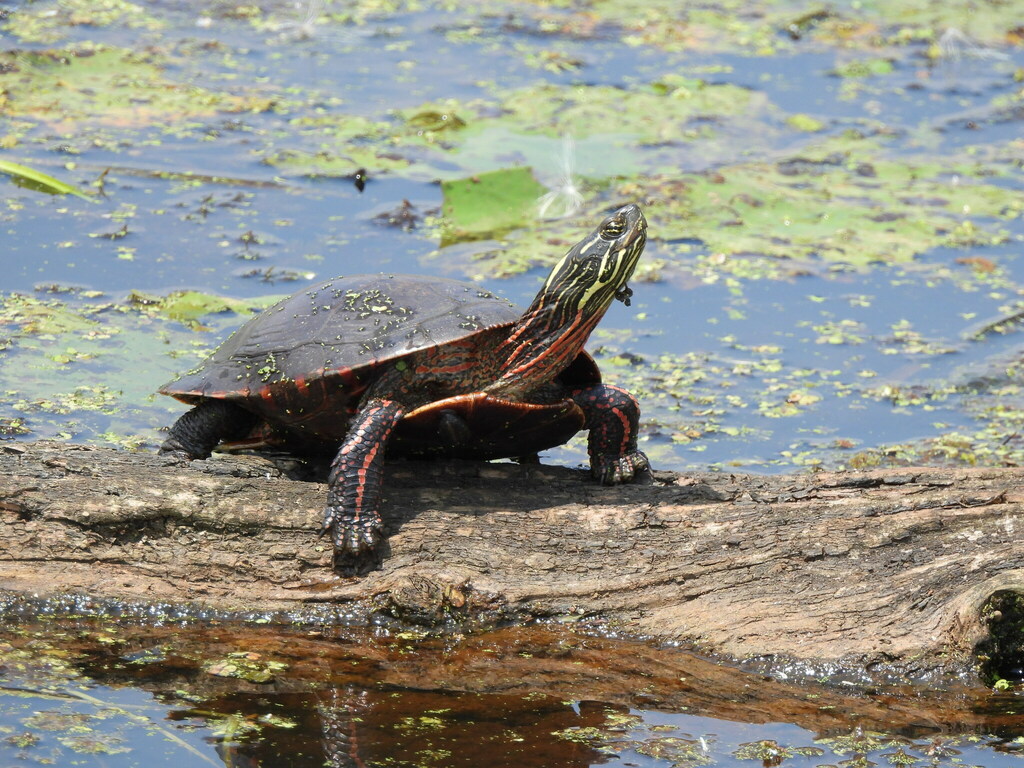
The painted turtle (Chrysemys picta) is the most widespread native turtle of North America.
- Kingdom
- Animalia
- Phylum
- Chordata
- Class
- Testudines
- Family
- Emydidae
- Genus
- Chrysemys
- Species
- Chrysemys picta
Description
The painted turtle (Chrysemys picta) is the most widespread native turtle of North America. This turtle is a member of the genus Chrysemys, which is part of the pond turtle family Emydidae. Fossils show that the painted turtle existed 15 million years ago. Three regionally based subspecies (the eastern, midland, and western) evolved during the last ice age. The southern painted turtle (C. dorsalis) is alternately considered the only other species in Chrysemys, or another subspecies of C. picta. It lives in relatively slow-moving fresh waters, from southern Canada to northern Mexico, and from the Atlantic to the Pacific. They have been shown to prefer large wetlands with long periods of inundation and emergent vegetation. The adult painted turtle is 13–25 cm (5.1–9.8 in) long; the male is smaller than the female. The turtle's top shell is dark and smooth, without a ridge. Its skin is olive to black with red, orange, or yellow stripes on its extremities. The subspecies can be distinguished by their shells: the eastern has straight-aligned top shell segments; the midland has a large gray mark on the bottom shell; the western has a red pattern on the bottom shell. The turtle eats aquatic vegetation, algae, and small water creatures including insects, crustaceans, and fish. Painted turtles primarily feed while in water and are able to locate and subdue prey even in heavily clouded conditions. Although they are frequently consumed as eggs or hatchlings by rodents, canines, and snakes, the adult turtles' hard shells protect them from most predators. However, they are still preyed on by animals such as foxes, raccoons, coyotes, and otters. Reliant on warmth from its surroundings, the painted turtle is active only during the day when it basks for hours on logs or rocks. During winter, the turtle brumates, usually in the mud at the bottom of water bodies. This species is one of the few that is specially adapted to tolerate freezing temperatures for extended periods of time due to an antifreeze-like substance in their blood that keeps their cells from freezing. The turtles mate in spring and autumn. Females dig nests on land and lay eggs between late spring and mid-summer. Hatched turtles grow until sexual maturity: 2–9 years for males, 6–16 for females. In the traditional tales of Algonquian tribes, the colorful turtle played the part of a trickster. In modern times, four U.S. states (Colorado, Illinois, Michigan, and Vermont) have named the painted turtle their official reptile. While habitat loss and road killings have reduced the turtle's population, its ability to live in human-disturbed settings has helped it remain the most abundant turtle in North America. Adults in the wild can live for more than 55 years.
Gallery
Ajouter des photos
Partagez vos photos de cette espèce (jusqu'à 20 à la fois) : elles sont vérifiées automatiquement, puis publiées.
Répartition
Occurrences observées (données GBIF). Les zones hors aire d'origine peuvent indiquer une présence introduite ou invasive.
Sources et crédits
Informations provenant de plusieurs sources vérifiées. Dernière mise à jour : .
Crédits photos (8)
- Photo : Daniel Lee (@daniel_lee28) · CC BY-NC 4.0 · via iNaturalist
- Photo : Sam Kieschnick (@sambiology) · CC BY 4.0 · via iNaturalist
- Photo : Joel Stave (@jstave) · CC BY-NC 4.0 · via iNaturalist
- Photo : Jared Gorrell (@wildlander) · CC BY-NC 4.0 · via iNaturalist
- Photo : @actaeon · CC BY-NC 4.0 · via iNaturalist
- Photo : @breanddave · CC BY-NC 4.0 · via iNaturalist
- Photo : Seema Sheth (@snsheth) · CC BY-NC 4.0 · via iNaturalist
- Photo : @fallriver22 · CC BY-NC 4.0 · via iNaturalist
Mentions de licence
Texte disponible sous licence CC BY-SA 4.0. Il adapte notamment Wikipedia (CC BY-SA) : Painted turtle (Wikipédia, auteurs dans l’historique de l’article).
- Taxonomie : GBIF Backbone Taxonomy (CC BY 4.0)
- Carte : occurrences GBIF, fond © contributeurs OpenStreetMap (ODbL)
- Statut de conservation : Liste rouge de l'UICN, via Wikidata (CC0)
Détail : Sources et licences.
Discussion (0)
Aucun message pour l’instant. Lancez la discussion sur cette fiche (sources, précisions, débats éditoriaux).
Connectez-vous pour participer à la discussion.