
Candoia aspera
Candoia aspera
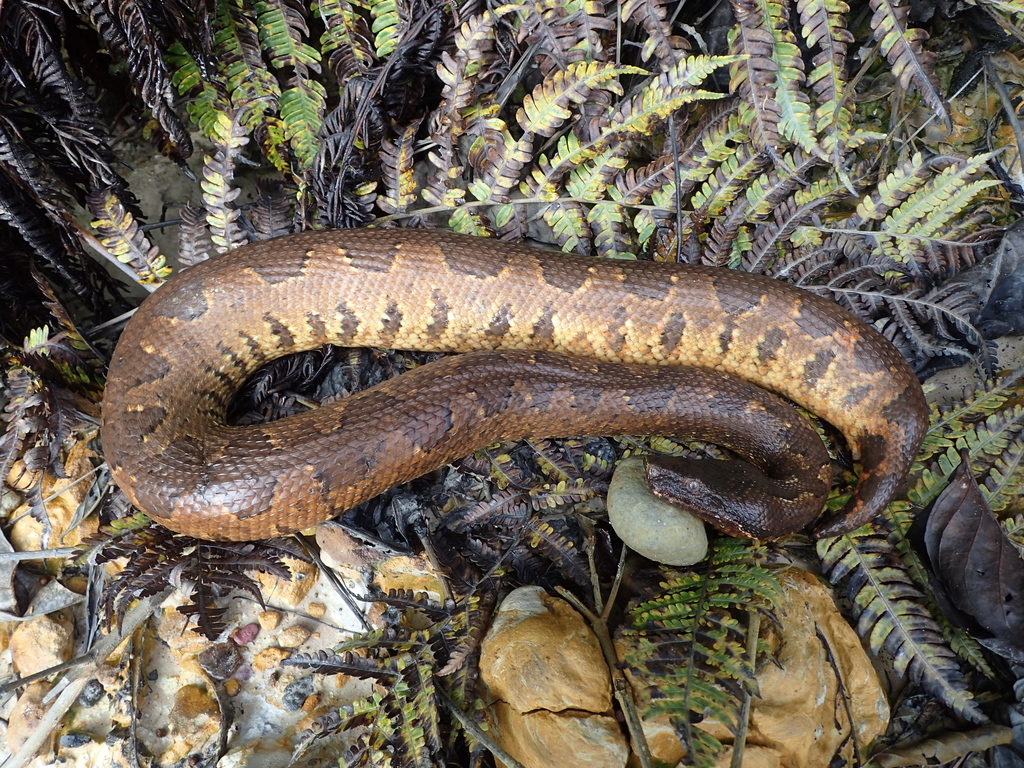
Candoia aspera, known commonly as the Papuan ground boa, New Guinea ground boa, or viper boa, is a species of snake in the family Boidae.
- Kingdom
- Animalia
- Phylum
- Chordata
- Class
- Squamata
- Family
- Boidae
- Genus
- Candoia
- Species
- Candoia aspera
Description
Candoia aspera, known commonly as the Papuan ground boa, New Guinea ground boa, or viper boa, is a species of snake in the family Boidae. As its common name suggests, it is found in New Guinea (in the Papua province of Indonesia and in Papua New Guinea). It is a terrestrial species, living in the undergrowth. It is smaller than some other members of the Boidae family. The Papuan ground boa grows to 2 to 3 feet (0.61 to 0.91 m) in length. It is known to be primarily nocturnal. The Papuan ground boa is known to be slightly more defensive than other Candoia species. In recent years, it has become increasingly scarce in the pet industry due to restrictions on import/export trading. Though it was more common in the past, there is still very little known about it, in particular its behaviour in the wild; for example, its lifespan is still undetermined. It got the nickname viper boa from its appearance. It looks extremely similar to the elapid species Acanthophis laevis, more commonly known as the "Papuan death adder." The Papuan death adder itself only resembles a viper, but is actually an elapid. However, because of the resemblance to the highly venomous Papuan death adder, many Papuan ground boas are killed out of fear, although the latter is harmless.
Gallery
Ajouter des photos
Partagez vos photos de cette espèce (jusqu'à 20 à la fois) : elles sont vérifiées automatiquement, puis publiées.
Répartition
Occurrences observées (données GBIF). Les zones hors aire d'origine peuvent indiquer une présence introduite ou invasive.
Sources et crédits
Informations provenant de plusieurs sources vérifiées. Dernière mise à jour : .
Crédits photos (8)
- Photo : Tom Kirschey (@tom-kirschey) · CC BY-NC 4.0 · via iNaturalist
- Photo : @brianchen8822 · CC BY-NC 4.0 · via iNaturalist
- Photo : @fajardarwis · CC BY-NC 4.0 · via iNaturalist
- Photo : Patrick (@patricklee0919) · CC BY-NC 4.0 · via iNaturalist
- Photo : Tom Kirschey (@tom-kirschey) · CC BY-NC 4.0 · via iNaturalist
- Photo : Eric N. Rittmeyer (@ritt) · CC BY-NC 4.0 · via iNaturalist
- Photo : Lisa_James (@lisa_james) · CC BY-NC 4.0 · via iNaturalist
- Photo : Кирилл (@kirill_petrov) · CC BY 4.0 · via iNaturalist
Mentions de licence
Texte disponible sous licence CC BY-SA 4.0. Il adapte notamment Wikipedia (CC BY-SA) : Candoia aspera (Wikipédia, auteurs dans l’historique de l’article).
- Taxonomie : GBIF Backbone Taxonomy (CC BY 4.0)
- Carte : occurrences GBIF, fond © contributeurs OpenStreetMap (ODbL)
- Statut de conservation : Liste rouge de l'UICN, via Wikidata (CC0)
Détail : Sources et licences.
Discussion (0)
Aucun message pour l’instant. Lancez la discussion sur cette fiche (sources, précisions, débats éditoriaux).
Connectez-vous pour participer à la discussion.