
Banded Houndshark
Triakis scyllium
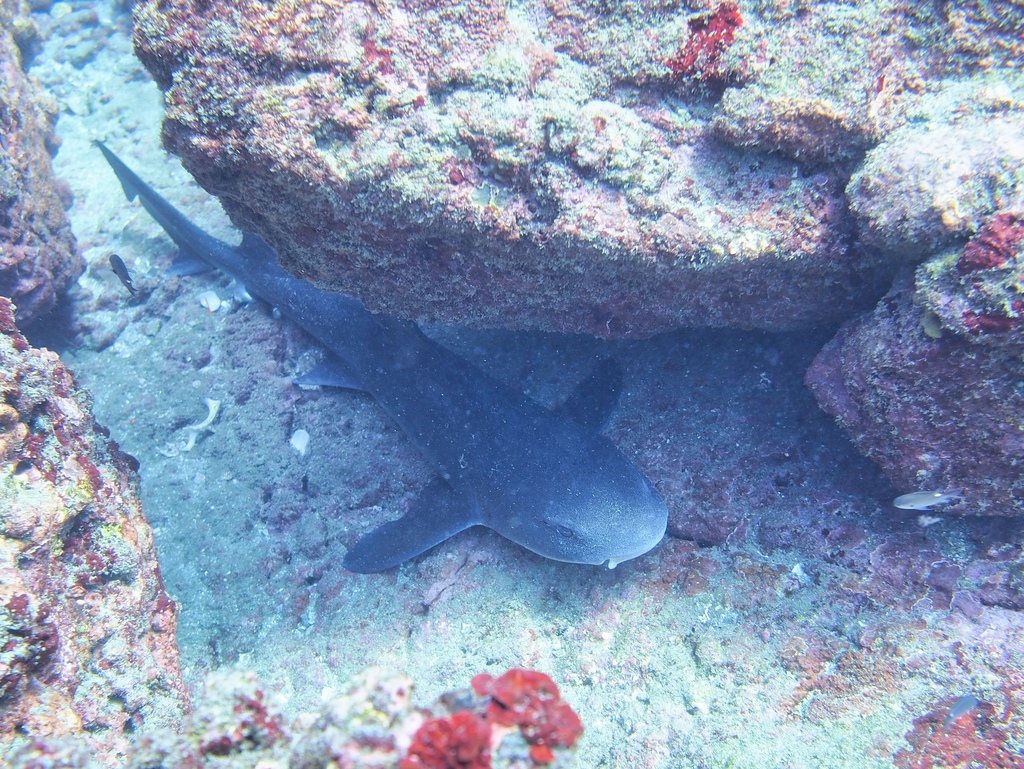
The banded houndshark (Triakis scyllium) is a species of houndshark in the family Triakidae, common in the northwestern Pacific Ocean from the southern Russian Far East to Taiwan.
- Kingdom
- Animalia
- Phylum
- Chordata
- Class
- Elasmobranchii
- Order
- Carcharhiniformes
- Family
- Triakidae
- Genus
- Triakis
- Species
- Triakis scyllium
Description
The banded houndshark (Triakis scyllium) is a species of houndshark in the family Triakidae, common in the northwestern Pacific Ocean from the southern Russian Far East to Taiwan. Found on or near the bottom, it favors shallow coastal habitats with sandy or vegetated bottoms, and also enters brackish water. This shark reaches 1.5 m (4.9 ft) in length. It has a short, rounded snout and mostly narrow fins; the pectoral fins are broad and triangular, and the trailing margin of the first dorsal fin is almost vertical. It is gray above and lighter below; younger sharks have darker saddles and dots, which fade with age. Nocturnal and largely solitary, the banded houndshark preys on benthic invertebrates and bony fishes. It is aplacental viviparous, with the developing embryos sustained by yolk. After mating during summer, females bear as many as 42 pups following a gestation period of 9–12 months. The banded houndshark poses no danger to humans and adapts well to captivity. It is caught as bycatch off Japan, Taiwan, and likely elsewhere in its range; it may be eaten but is not as well-regarded as related species. Because fishing does not appear to have diminished this shark's population, the International Union for Conservation of Nature has listed it under Endangered.
En aquarium
Espèce d'saumâtre et eau de mer évoluant plutôt près du fond. Sur le plan biologique, elle atteint jusqu'à 150 cm, son régime est piscivore.
Paramètres relevés dans le milieu naturel de l’espèce (données scientifiques FishBase). À adapter aux besoins précis de l’espèce en captivité.
Gallery
Ajouter des photos
Partagez vos photos de cette espèce (jusqu'à 20 à la fois) : elles sont vérifiées automatiquement, puis publiées.
Répartition
Occurrences observées (données GBIF). Les zones hors aire d'origine peuvent indiquer une présence introduite ou invasive.
Sources et crédits
Informations provenant de plusieurs sources vérifiées. Dernière mise à jour : .
Crédits photos (2)
- Photo : Keita Watanabe (@keitawatanabe) · CC BY-NC 4.0 · via iNaturalist
- Photo : Lily Yeung (@lily_yeung) · CC BY-NC 4.0 · via iNaturalist
Mentions de licence
Texte disponible sous licence CC BY-SA 4.0. Il adapte notamment Wikipedia (CC BY-SA) : Banded houndshark (Wikipédia, auteurs dans l’historique de l’article).
- Taxonomie : GBIF Backbone Taxonomy (CC BY 4.0)
- Carte : occurrences GBIF, fond © contributeurs OpenStreetMap (ODbL)
- Paramètres d'aquarium : FishBase (faits reformulés)
Détail : Sources et licences.
Discussion (0)
Aucun message pour l’instant. Lancez la discussion sur cette fiche (sources, précisions, débats éditoriaux).
Connectez-vous pour participer à la discussion.