
Japanese jack mackerel
Trachurus japonicus
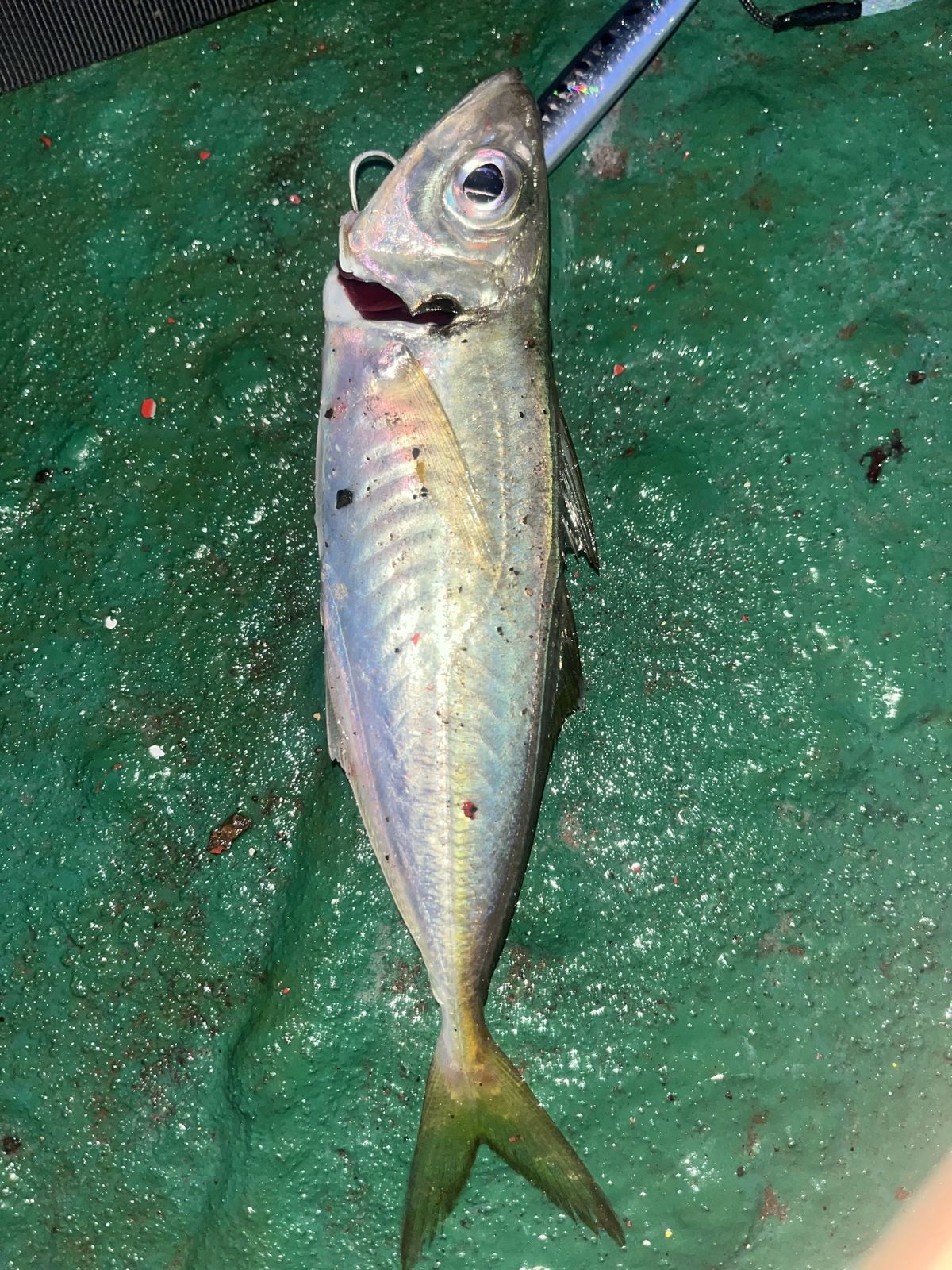
The Japanese jack mackerel (Trachurus japonicus), also known as the Japanese horse mackerel or Japanese scad, is a species named after its resemblance to mackerel but which is in the family Carangidae, the jacks, pompanos, trevallies…
- Kingdom
- Animalia
- Phylum
- Chordata
- Order
- Perciformes
- Family
- Carangidae
- Genus
- Trachurus
- Species
- Trachurus japonicus
Description
The Japanese jack mackerel (Trachurus japonicus), also known as the Japanese horse mackerel or Japanese scad, is a species named after its resemblance to mackerel but which is in the family Carangidae, the jacks, pompanos, trevallies and scads. Their maximum reported length is 50 cm (20 in) with a common length of 35 cm (14 in). They have a maximum reported weight of 0.66 kg (1.5 lb) and a maximum reported age of 12 years. They are found around the coast of Japan, except Okinawa Island, usually on sandy bottoms of 50–275 m (164–902 ft) deep. They feed mainly on small crustaceans such as copepods, as well as shrimp and small fish. They are similar to the yellowtail horse mackerel around New Zealand and Australia, apart from having more gill rakers and larger eyes. The Japanese name for the horse mackerel is aji (あじ) and by default generally implies the species Trachurus japonicus, which can be more specifically referred to as ma-aji (まあじ; lit. 'true aji'). The name is most commonly written in hiragana; although a kanji (鯵・鰺) does exist, it is not in common use. It is commonly deep fried or salt-grilled. In Korean cuisine, the fish is dubbed jeon-gaeng-i (전갱이) and is the default horse mackerel designated by this name. It is commonly grilled or fried as a jeon-gaeng-i gui (전갱이 구이). Among the specialties of Jeju cuisine is the soup gagjaegi-gug (각재기국), the name of which is derived from the name for the fish in the Jeju language.
En aquarium
Espèce d'eau de mer évoluant plutôt en pleine eau. Sur le plan biologique, elle atteint jusqu'à 50 cm, vit jusqu'à 12 ans, son régime est carnivore.
Paramètres relevés dans le milieu naturel de l’espèce (données scientifiques FishBase). À adapter aux besoins précis de l’espèce en captivité.
Gallery
Ajouter des photos
Partagez vos photos de cette espèce (jusqu'à 20 à la fois) : elles sont vérifiées automatiquement, puis publiées.
Répartition
Occurrences observées (données GBIF). Les zones hors aire d'origine peuvent indiquer une présence introduite ou invasive.
Sources et crédits
Informations provenant de plusieurs sources vérifiées. Dernière mise à jour : .
Crédits photos (10)
- Photo : jcowdog · CC BY-NC 4.0 · via GBIF
- Photo : qi_zhihao · CC BY-NC 4.0 · via GBIF
- Photo : jcowdog · CC BY-NC 4.0 · via GBIF
- Photo : Vince Golder · CC BY-NC 4.0 · via GBIF
- Photo : 鐦鍆錒/锎钔锕(Man Hoimoon) · CC BY-NC 4.0 · via GBIF
- Photo : crabini_ysk · CC BY-NC 4.0 · via GBIF
- Photo : Paul Ha · CC BY-NC 4.0 · via GBIF
- Photo : Paul Ha · CC BY-NC 4.0 · via GBIF
- Photo : indianaspeciesfishing · CC BY-NC 4.0 · via GBIF
- Photo : indianaspeciesfishing · CC BY-NC 4.0 · via GBIF
Mentions de licence
Texte disponible sous licence CC BY-SA 4.0. Il adapte notamment Wikipedia (CC BY-SA) : Japanese jack mackerel (Wikipédia, auteurs dans l’historique de l’article).
- Taxonomie : GBIF Backbone Taxonomy (CC BY 4.0)
- Carte : occurrences GBIF, fond © contributeurs OpenStreetMap (ODbL)
- Statut de conservation : Liste rouge de l'UICN, via Wikidata (CC0)
- Paramètres d'aquarium : FishBase (faits reformulés)
Détail : Sources et licences.
Discussion (0)
Aucun message pour l’instant. Lancez la discussion sur cette fiche (sources, précisions, débats éditoriaux).
Connectez-vous pour participer à la discussion.