
Albacore
Thunnus alalunga
The albacore (Thunnus alalunga), known also as the albicore or longfin tuna, is a species of tuna of the order Scombriformes.
- Kingdom
- Animalia
- Phylum
- Chordata
- Order
- Perciformes
- Family
- Scombridae
- Genus
- Thunnus
- Species
- Thunnus alalunga
Description
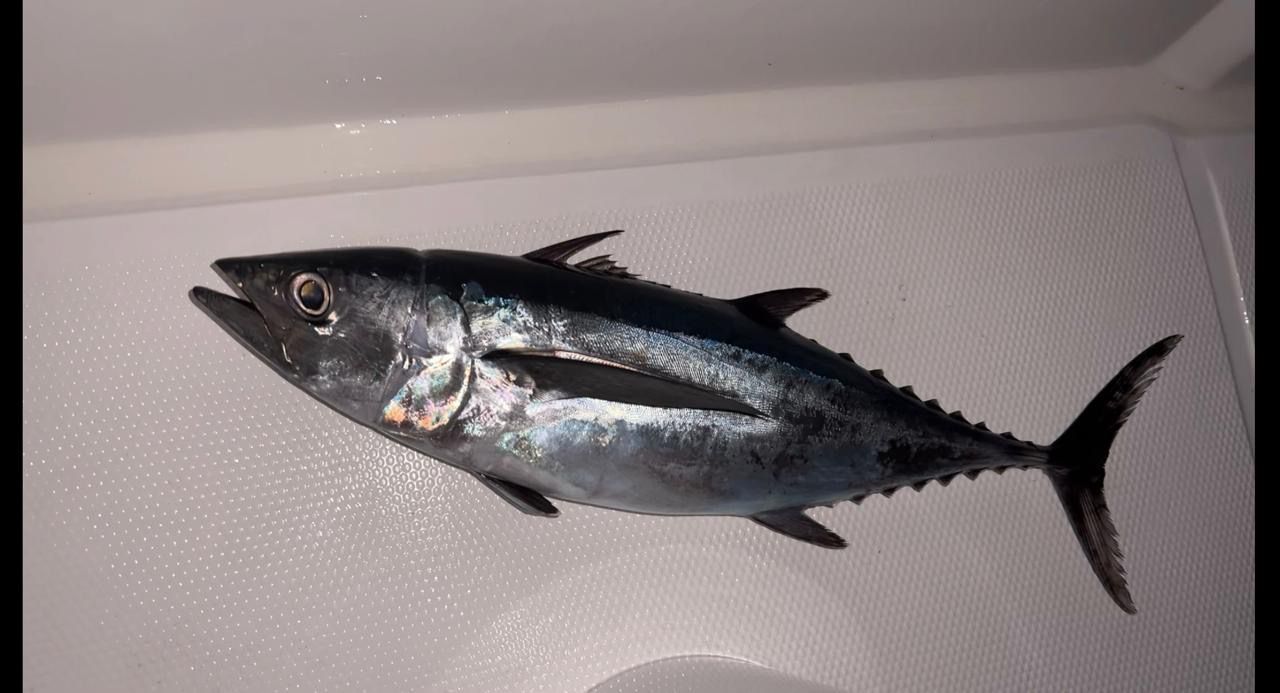
The albacore (Thunnus alalunga), known also as the albicore or longfin tuna, is a species of tuna of the order Scombriformes. It lives in temperate and tropical waters across the globe in the epipelagic and mesopelagic zones. There are six distinct stocks known globally in the Atlantic, Pacific, and Indian oceans, as well as in the Mediterranean Sea. The albacore has an elongate, fusiform body with a conical snout, large eyes, and remarkably long pectoral fins. Its body is a deep blue dorsally and shades of silvery white ventrally. Individuals can reach up to 1.4 m (4 ft 7 in) in length. Albacore are pelagic predators, eating a wide variety of foods, including fish, crustaceans, and cephalopods. They are unique among tuna in that their primary food-source is cephalopods, with fish making up a much smaller portion of their diet. Reproduction usually occurs from November to February and is oviparous. An adult female can release over two million eggs in a single cycle. Fry (juvenile fish) generally stay near where they were spawned for about a year before moving on. Albacore form schools based on their stage in the life cycle, but also combine with other tuna like the skipjack tuna, yellowfin tuna, and bluefin tuna. Schools of grown albacore are highly migratory. The albacore is a very economically important fish and is a target of commercial and recreational fisheries. It was originally the basis for the United States tuna canning industry and is no less important today, making up significant percentages of the gross domestic products of various Pacific nations. Previously listed as "Near Threatened" by the International Union for Conservation of Nature (IUCN) because of the threat of overfishing, the species moved to the category "Least Concern" in 2021. Several stocks were in significant decline but are now recovering thanks to the enforcement of regional fishing quotas.
En aquarium
Espèce d'eau de mer évoluant plutôt en pleine eau. Paramètres d'eau relevés dans son milieu : température de 9,5 à 25,2 °C. Sur le plan biologique, elle atteint jusqu'à 140 cm, vit jusqu'à 9 ans, son régime est piscivore.
Paramètres relevés dans le milieu naturel de l’espèce (données scientifiques FishBase). À adapter aux besoins précis de l’espèce en captivité.
Gallery
Ajouter des photos
Partagez vos photos de cette espèce (jusqu'à 20 à la fois) : elles sont vérifiées automatiquement, puis publiées.
Répartition
Occurrences observées (données GBIF). Les zones hors aire d'origine peuvent indiquer une présence introduite ou invasive.
Sources et crédits
Informations provenant de plusieurs sources vérifiées. Dernière mise à jour : .
Crédits photos (10)
- Photo : layla alnaqbi · CC BY-NC 4.0 · via GBIF
- Photo : Archer Lamason · CC BY-NC 4.0 · via GBIF
- Photo : Alison Kock · CC BY-NC 4.0 · via GBIF
- Photo : ocean_ecstasea · CC BY-NC 4.0 · via GBIF
- Photo : justine le bec · CC BY-NC 4.0 · via GBIF
- Photo : mushroomwatcher5000 · CC BY-NC 4.0 · via GBIF
- Photo : Connor Cochrane · CC BY-NC 4.0 · via GBIF
- Photo : Giampiero Giuliani · CC BY-NC 4.0 · via GBIF
- Photo : craigjhowe · CC BY-NC 4.0 · via GBIF
- Photo : Molly Cohn · CC BY-NC 4.0 · via GBIF
Mentions de licence
Texte disponible sous licence CC BY-SA 4.0. Il adapte notamment Wikipedia (CC BY-SA) : Albacore (Wikipédia, auteurs dans l’historique de l’article).
- Taxonomie : GBIF Backbone Taxonomy (CC BY 4.0)
- Carte : occurrences GBIF, fond © contributeurs OpenStreetMap (ODbL)
- Statut de conservation : Liste rouge de l'UICN, via Wikidata (CC0)
- Paramètres d'aquarium : FishBase (faits reformulés)
Détail : Sources et licences.
Discussion (0)
Aucun message pour l’instant. Lancez la discussion sur cette fiche (sources, précisions, débats éditoriaux).
Connectez-vous pour participer à la discussion.