
White cloud mountain minnow
Tanichthys albonubes
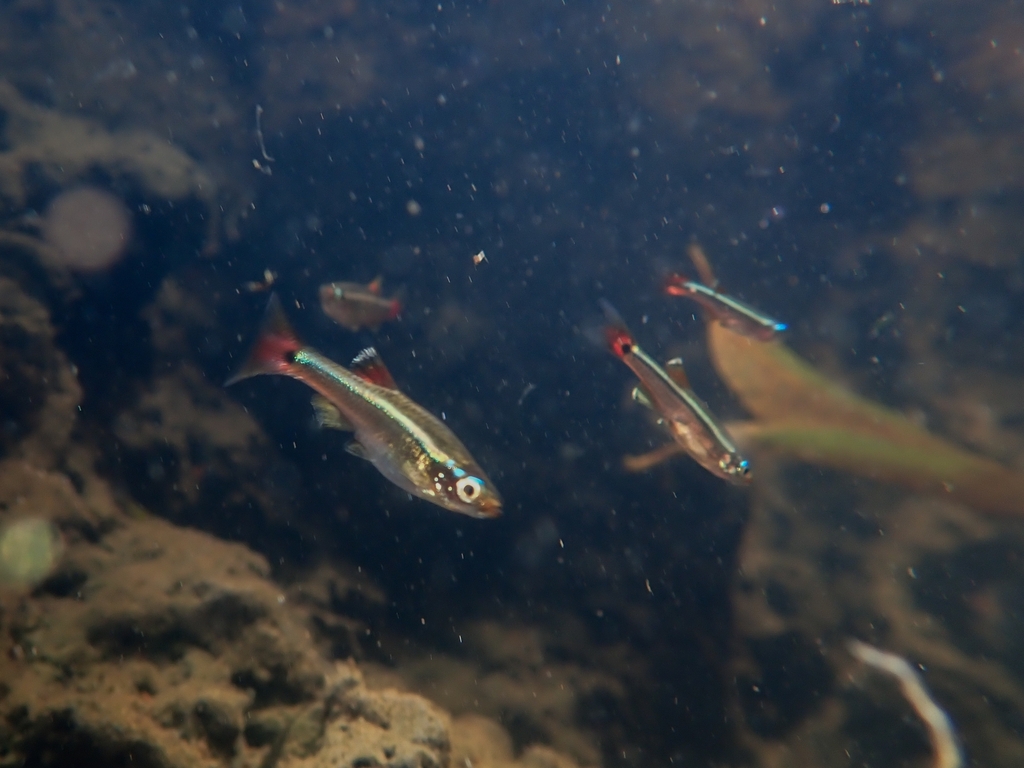
The White Cloud Mountain minnow (Tanichthys albonubes) is a hardy species of freshwater fish and coldwater fish often kept in an aquarium.
- Kingdom
- Animalia
- Phylum
- Chordata
- Order
- Cypriniformes
- Family
- Cyprinidae
- Genus
- Tanichthys
- Species
- Tanichthys albonubes
Description
The White Cloud Mountain minnow (Tanichthys albonubes) is a hardy species of freshwater fish and coldwater fish often kept in an aquarium. The species was considered to be a member of the carp family (family Cyprinidae) of the order Cypriniformes, although now it is placed in the family Tanichthyidae. This species is native to China. The White Cloud Mountain minnow is practically extinct in its native habitat, due to pollution and tourism. It was believed to be extinct for over 20 years in 1980, but an apparently native population of this fish was discovered on Hainan Island, well away from the White Cloud Mountain. They are bred in farms and are easily available through the aquarium trade. However, inbreeding in farms has led to genetically weak stock that is vulnerable to disease and prone to physical deformities. The species was discovered at White Cloud Mountain in the city of Guǎngzhōu in the province of Guǎngdōng around the 1930s by a Boy Scout leader called Tan Kam Fe, hence the generic name Tanichthys ("Tan's fish"). The specific name albonubes is from the Latin alba nubes (white cloud). The fish are sold in the aquarium trade under a variety of names, including White Cloud, White Cloud Mountain fish, White Cloud minnow, etc. The names Canton or China danio (although it is not a member of the genus Danio or a danionin) and cardinal fish are also encountered. In Chinese the fish is known as 唐魚 (táng yu), 廣東細鯽 (Guǎngdōng xìjì), or 潘氏細鯽 (pānshì xìjì). Aphyocypris pooni is an obsolete synonym for this species; it was coined to designate a color variety which is now known to be the same species as the White Cloud Mountain minnow.
En aquarium
Espèce d'eau douce évoluant plutôt près du fond. Paramètres d'eau relevés dans son milieu : température de 18 à 22 °C, pH de 6 à 8, dureté de 5 à 19 °dGH. Sur le plan biologique, elle atteint jusqu'à 4 cm, son régime est omnivore.
Paramètres relevés dans le milieu naturel de l’espèce (données scientifiques FishBase ; voir aussi la fiche Fishipedia). À adapter aux besoins précis de l’espèce en captivité.
Gallery
Ajouter des photos
Partagez vos photos de cette espèce (jusqu'à 20 à la fois) : elles sont vérifiées automatiquement, puis publiées.
Répartition
Occurrences observées (données GBIF). Les zones hors aire d'origine peuvent indiquer une présence introduite ou invasive.
Sources et crédits
Informations provenant de plusieurs sources vérifiées. Dernière mise à jour : .
Crédits photos (3)
- Photo : Guillaume Dupuy (@gdupuy) · CC BY-NC 4.0 · via iNaturalist
- Photo : ZenJay (@zenjay) · CC BY-NC 4.0 · via iNaturalist
- Photo : Pierre-Louis Stenger (@pl_stenger) · CC BY-NC 4.0 · via iNaturalist
Mentions de licence
Texte disponible sous licence CC BY-SA 4.0. Il adapte notamment Wikipedia (CC BY-SA) : White Cloud Mountain minnow (Wikipédia, auteurs dans l’historique de l’article).
- Taxonomie : GBIF Backbone Taxonomy (CC BY 4.0)
- Carte : occurrences GBIF, fond © contributeurs OpenStreetMap (ODbL)
- Statut de conservation : Liste rouge de l'UICN, via Wikidata (CC0)
- Paramètres d'aquarium : FishBase (faits reformulés)
Détail : Sources et licences.
Discussion (0)
Aucun message pour l’instant. Lancez la discussion sur cette fiche (sources, précisions, débats éditoriaux).
Connectez-vous pour participer à la discussion.