
Ocellated Wrasse
Symphodus ocellatus
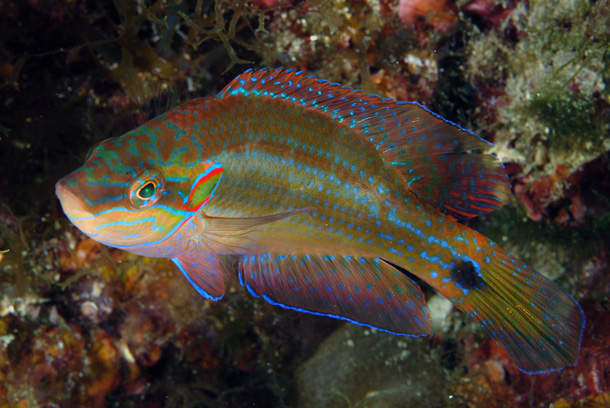
The ocellated wrasse (Symphodus ocellatus) is a species of wrasse native to the eastern Atlantic Ocean and throughout the Mediterranean Sea, the Black Sea, and the Sea of Azov.
- Kingdom
- Animalia
- Phylum
- Chordata
- Order
- Perciformes
- Family
- Labridae
- Genus
- Symphodus
- Species
- Symphodus ocellatus
Description
The ocellated wrasse (Symphodus ocellatus) is a species of wrasse native to the eastern Atlantic Ocean and throughout the Mediterranean Sea, the Black Sea, and the Sea of Azov. It inhabits areas with rocks and eelgrass at depths from 1 to 30 m (3.3 to 98.4 ft). It feeds on various marine invertebrates. This species can reach 12 cm (4.7 in) in standard length. It can also be found in the aquarium trade. These fish live about two to three years. There are three distinct male forms. There are nesting males, sneaker males, and satellite males. The nesting males are the largest of the three and the most brightly colored. The sneaker males are the smallest of the three types and the most dull in color, and actually closely resemble the female phenotype. Satellite males are an intermediate in size and color between the large nesting male and smaller sneaker male. Nesting males court females, build and guard nests, and provide parental care for the offspring. Nests are made of harvested algae. Sneaker males do not court females, do not provide parental care and they join in when a female and nesting male are mating in an attempt to fertilize the eggs before the nesting male. Satellite males assist in courting the females, they chase away sneaker males, but they do not provide parental care for the offspring. The male types are determined in early development. If a male fish grows quickly, it will be a satellite male in its first breeding season then will become a nesting male in its second. For the slower growing males, they will be a sneaker male in their first breeding season, then a satellite male in their second. Breeding season occurs from May to June.
En aquarium
Espèce d'eau de mer évoluant plutôt autour des récifs. Sur le plan biologique, elle atteint jusqu'à 18,5 cm, vit jusqu'à 5 ans, son régime est carnivore.
Paramètres relevés dans le milieu naturel de l’espèce (données scientifiques FishBase ; voir aussi la fiche Fishipedia). À adapter aux besoins précis de l’espèce en captivité.
Gallery
Ajouter des photos
Partagez vos photos de cette espèce (jusqu'à 20 à la fois) : elles sont vérifiées automatiquement, puis publiées.
Répartition
Occurrences observées (données GBIF). Les zones hors aire d'origine peuvent indiquer une présence introduite ou invasive.
Sources et crédits
Informations provenant de plusieurs sources vérifiées. Dernière mise à jour : .
Crédits photos (5)
- Photo : Etrusko25 · Domaine public
- Photo : Philippe Geniez (@philippe_geniez) · CC BY-NC 4.0 · via iNaturalist
- Photo : Gaëtan Jouvenez (@gaetan_jouvenez) · CC BY-NC 4.0 · via iNaturalist
- Photo : Krylenko VV (@krylenkosl) · CC BY-NC 4.0 · via iNaturalist
- Photo : Crebassa Jason (@crebassa) · CC0 (domaine public) · via iNaturalist
Mentions de licence
Texte disponible sous licence CC BY-SA 4.0. Il adapte notamment Wikipedia (CC BY-SA) : Ocellated wrasse (Wikipédia, auteurs dans l’historique de l’article).
- Taxonomie : GBIF Backbone Taxonomy (CC BY 4.0)
- Carte : occurrences GBIF, fond © contributeurs OpenStreetMap (ODbL)
- Statut de conservation : Liste rouge de l'UICN, via Wikidata (CC0)
- Paramètres d'aquarium : FishBase (faits reformulés)
Détail : Sources et licences.
Discussion (0)
Aucun message pour l’instant. Lancez la discussion sur cette fiche (sources, précisions, débats éditoriaux).
Connectez-vous pour participer à la discussion.