
Pacific Angelshark
Squatina californica
The Pacific angelshark (Squatina californica) is a species of angelshark, family Squatinidae, found in the eastern Pacific Ocean from Alaska to the Gulf of California, and from Ecuador to Chile, although those in the Gulf of California…
- Kingdom
- Animalia
- Phylum
- Chordata
- Class
- Elasmobranchii
- Order
- Squatiniformes
- Family
- Squatinidae
- Genus
- Squatina
- Species
- Squatina californica
Description
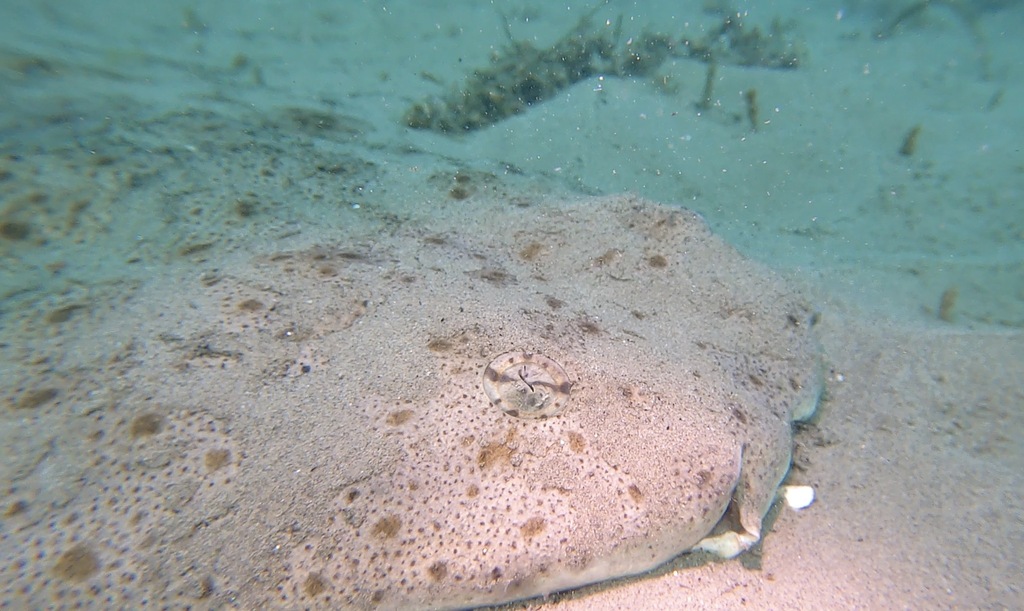
The Pacific angelshark (Squatina californica) is a species of angelshark, family Squatinidae, found in the eastern Pacific Ocean from Alaska to the Gulf of California, and from Ecuador to Chile, although those in the Gulf of California and southeastern Pacific may in fact be separate species. The Pacific angelshark inhabits shallow, coastal waters on sandy flats, usually near rocky reefs, kelp forests, or other underwater features. This species resembles other angel sharks in appearance, with a flattened body and greatly enlarged pectoral and pelvic fins. Characteristic features of this shark include a pair of cone-shaped barbels on its snout, angular pectoral fins, and a brown or gray dorsal coloration with many small dark markings. It attains a maximum length of 1.5 m (4.9 ft). An ambush predator, the Pacific angelshark conceals itself on the sea floor and waits for approaching prey, primarily bony fishes and squid. Prey are targeted visually and, with a quick upward thrust of the head, snatched in protrusible jaws. Individual sharks actively choose ideal ambush sites, where they stay for several days before moving on to a new one. This species is more active at night than during the day, when it stays buried in sediment and seldom moves. Reproduction is ovoviviparous, with the embryos hatching inside the mother's uterus and being sustained by a yolk sac until birth. Females give birth to an average of six young every spring. Pacific angelsharks are not dangerous to humans unless provoked, in which case their bite can cause a painful injury. They are valued for their meat and are captured by commercial and recreational fishers across their range. A targeted gillnet fishery for this species began off Santa Barbara, California in 1976 and ended in 1994, after overfishing and new regulations led to its near-collapse. This species is now mainly fished in Mexican waters. The International Union for Conservation of Nature (IUCN) has assessed this species as Near Threatened, as the Californian population is largely protected and recovering, while the impact of Mexican fisheries is unknown.
En aquarium
Espèce d'eau de mer évoluant plutôt près du fond. Sur le plan biologique, elle atteint jusqu'à 152 cm, vit jusqu'à 35 ans, son régime est piscivore.
Paramètres relevés dans le milieu naturel de l’espèce (données scientifiques FishBase). À adapter aux besoins précis de l’espèce en captivité.
Gallery
Ajouter des photos
Partagez vos photos de cette espèce (jusqu'à 20 à la fois) : elles sont vérifiées automatiquement, puis publiées.
Répartition
Occurrences observées (données GBIF). Les zones hors aire d'origine peuvent indiquer une présence introduite ou invasive.
Sources et crédits
Informations provenant de plusieurs sources vérifiées. Dernière mise à jour : .
Crédits photos (2)
- Photo : Ted Judah (@tedjudah) · CC BY-NC 4.0 · via iNaturalist
- Photo : Stefanie (@sflax) · CC BY-NC 4.0 · via iNaturalist
Mentions de licence
Texte disponible sous licence CC BY-SA 4.0. Il adapte notamment Wikipedia (CC BY-SA) : Pacific angelshark (Wikipédia, auteurs dans l’historique de l’article).
- Taxonomie : GBIF Backbone Taxonomy (CC BY 4.0)
- Carte : occurrences GBIF, fond © contributeurs OpenStreetMap (ODbL)
- Statut de conservation : Liste rouge de l'UICN, via Wikidata (CC0)
- Paramètres d'aquarium : FishBase (faits reformulés)
Détail : Sources et licences.
Discussion (0)
Aucun message pour l’instant. Lancez la discussion sur cette fiche (sources, précisions, débats éditoriaux).
Connectez-vous pour participer à la discussion.