
Amur catfish
Silurus asotus
The Amur catfish (Silurus asotus), also called the Japanese common catfish, Far Eastern catfish, and Chinese catfish, is a carnivorous catfish species belonging to the Siluridae family.
- Kingdom
- Animalia
- Phylum
- Chordata
- Order
- Siluriformes
- Family
- Siluridae
- Genus
- Silurus
- Species
- Silurus asotus
Description
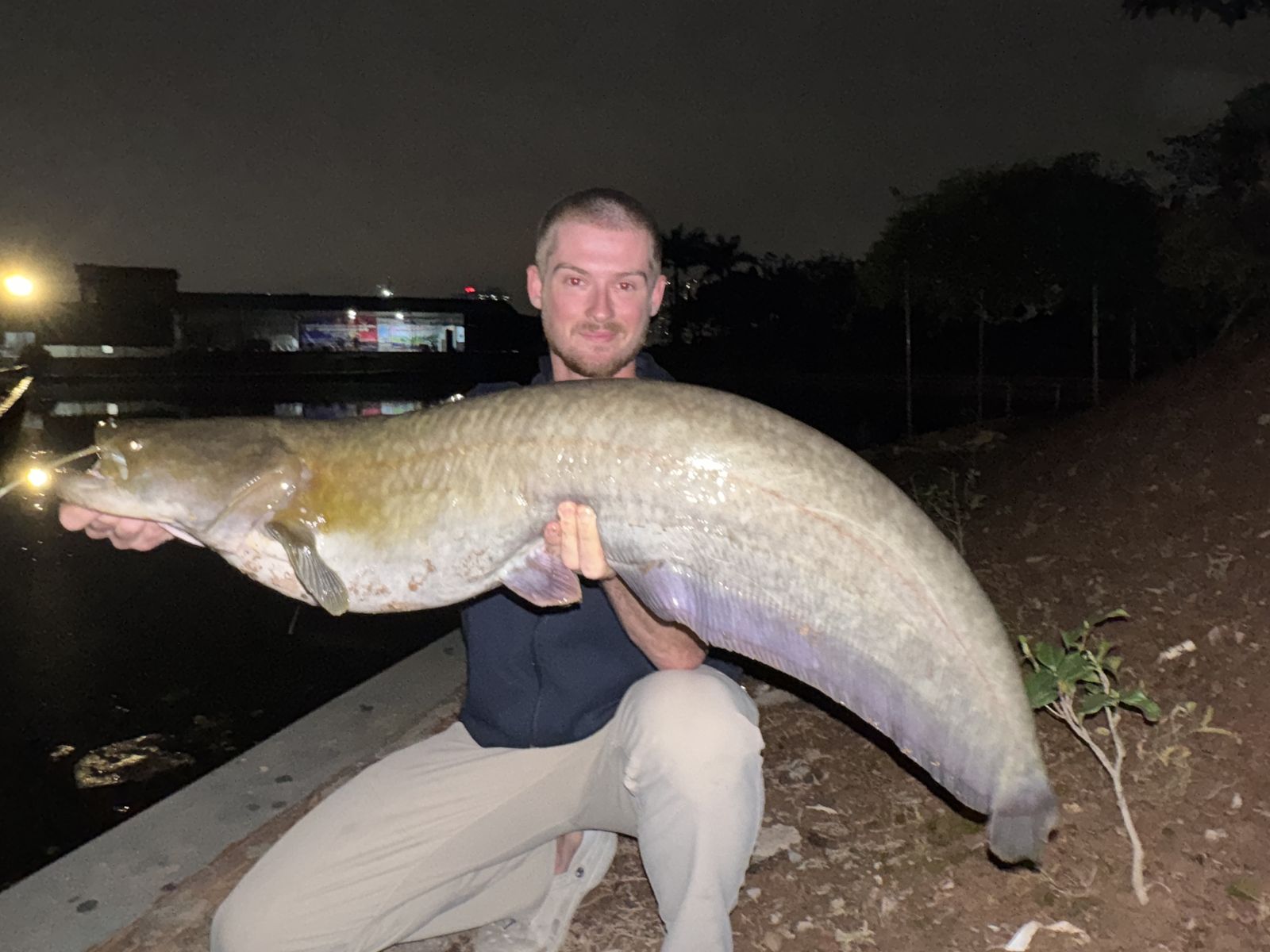
The Amur catfish (Silurus asotus), also called the Japanese common catfish, Far Eastern catfish, and Chinese catfish, is a carnivorous catfish species belonging to the Siluridae family. It lives in widespread distribution in freshwater habitats across East Asia and is subject to extensive aquaculture. As a freshwater species, it can be found only in the catchments of rivers, ponds, and lakes located in China, Japan, the Korean Peninsula, Taiwan, the Russian Amur Basin and northern Vietnam. S. asotus features are characteristic of a huge silurid catfish, featuring a white stomach and sporadic white spots on its sides. Fish have one pair of mandibular barbels and one pair of maxillary barbels, which are longer than the head, in both immature and adulthood. The young of this species have an additional pair of mandibular barbels. This species may reach a maximum length of 130 cm, although its typical length is between 30 and 60 cm, and its maximum weight is 30–40 kg.
En aquarium
Espèce d'eau douce évoluant plutôt près du fond. Paramètres d'eau relevés dans son milieu : température de 5 à 25 °C. Sur le plan biologique, elle atteint jusqu'à 130 cm, son régime est piscivore.
Paramètres relevés dans le milieu naturel de l’espèce (données scientifiques FishBase). À adapter aux besoins précis de l’espèce en captivité.
Gallery
Ajouter des photos
Partagez vos photos de cette espèce (jusqu'à 20 à la fois) : elles sont vérifiées automatiquement, puis publiées.
Répartition
Occurrences observées (données GBIF). Les zones hors aire d'origine peuvent indiquer une présence introduite ou invasive.
Sources et crédits
Informations provenant de plusieurs sources vérifiées. Dernière mise à jour : .
Crédits photos (10)
- Photo : tightontanago · CC BY-NC 4.0 · via GBIF
- Photo : Potamogeton sp.TOKYO · CC BY-NC 4.0 · via GBIF
- Photo : haru516 · CC BY-NC 4.0 · via GBIF
- Photo : ex16forlife · CC BY-NC 4.0 · via GBIF
- Photo : Chanwoo Kim · CC BY-NC 4.0 · via GBIF
- Photo : campbellfmh · CC BY-NC 4.0 · via GBIF
- Photo : Nick Tobler (Cowturtle) · CC BY 4.0 · via GBIF
- Photo : Yixuan Zhang · CC BY-NC 4.0 · via GBIF
- Photo : loginfortune · CC BY-NC 4.0 · via GBIF
- Photo : haru516 · CC BY-NC 4.0 · via GBIF
Mentions de licence
Texte disponible sous licence CC BY-SA 4.0. Il adapte notamment Wikipedia (CC BY-SA) : Amur catfish (Wikipédia, auteurs dans l’historique de l’article).
- Taxonomie : GBIF Backbone Taxonomy (CC BY 4.0)
- Carte : occurrences GBIF, fond © contributeurs OpenStreetMap (ODbL)
- Statut de conservation : Liste rouge de l'UICN, via Wikidata (CC0)
- Paramètres d'aquarium : FishBase (faits reformulés)
Détail : Sources et licences.
Discussion (0)
Aucun message pour l’instant. Lancez la discussion sur cette fiche (sources, précisions, débats éditoriaux).
Connectez-vous pour participer à la discussion.