
Roundhead Parrotfish
Scarus globiceps
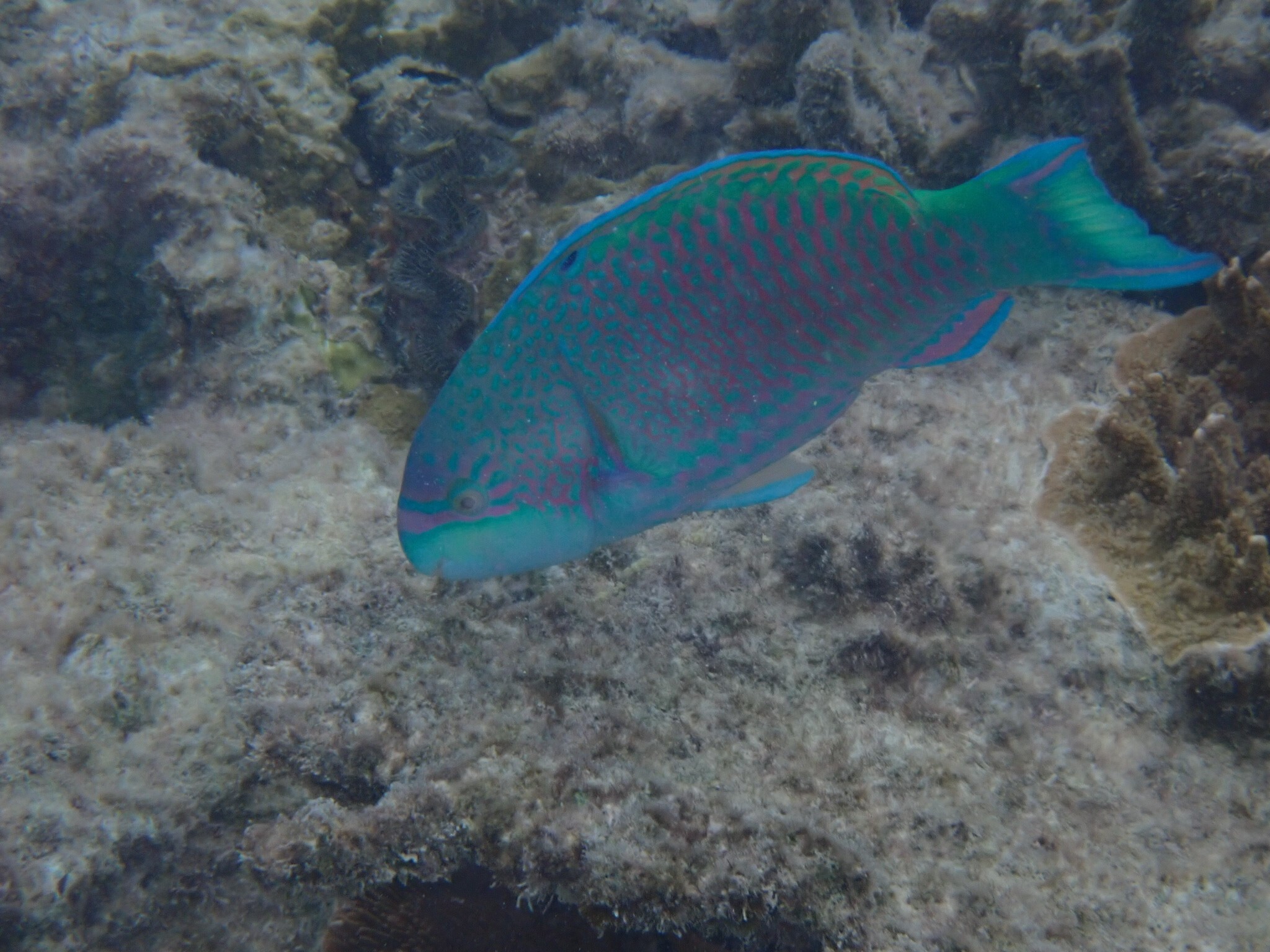
Scarus globiceps, commonly known as the globehead, violet-lined, speckled or roundhead parrotfish, is a marine fish native to the Indian and Pacific Oceans, where it lives in coral reefs.
- Kingdom
- Animalia
- Phylum
- Chordata
- Order
- Perciformes
- Family
- Scaridae
- Genus
- Scarus
- Species
- Scarus globiceps
Description
Scarus globiceps, commonly known as the globehead, violet-lined, speckled or roundhead parrotfish, is a marine fish native to the Indian and Pacific Oceans, where it lives in coral reefs. French naturalist Achille Valenciennes described the globehead parrotfish in 1840. The species was the first parrotfish collected by Charles Darwin-from the waters around Tahiti and then from the Cocos Islands; the former was described as a new species and given the name Scarus lepidus by Leonard Jenyns, while the latter was confirmed as the current species. In 1900, Henry Weed Fowler described a specimen from Caroline Island as Scarus pronus, which was later synonymised with this species. The globehead parrotfish can grow up to 45 cm (18 in) long and weigh up to 0.5 kg (1.1 lb). The adult male in terminal phase has a predominantly green body with its scales bordered with salmon pink. The tail fin is green with salmon-pink bands. It has a horizontal pink band bordered with green running from the snout through its eyes to the end of the opercle. It has 1 or 2 canine teeth on the upper and lower plates. Initial phase globehead parrotfish are grey-brown, their abdomens bearing three white bands. The range is from the Society and Line Islands in the Pacific west to the Ryukyu Islands in the north, the Great Barrier Reef in the south, and across the Indian Ocean to east Africa. It is found more commonly on outer reefs but can also inhabit lagoons, generally to a depth of around 12 metres (39 ft) and occasionally down to 30 metres (98 ft). Scarus globiceps is harvested for food in Guam.
En aquarium
Espèce d'eau de mer évoluant plutôt autour des récifs. Sur le plan biologique, elle atteint jusqu'à 45 cm, son régime est herbivore.
Paramètres relevés dans le milieu naturel de l’espèce (données scientifiques FishBase). À adapter aux besoins précis de l’espèce en captivité.
Gallery
Ajouter des photos
Partagez vos photos de cette espèce (jusqu'à 20 à la fois) : elles sont vérifiées automatiquement, puis publiées.
Répartition
Occurrences observées (données GBIF). Les zones hors aire d'origine peuvent indiquer une présence introduite ou invasive.
Sources et crédits
Informations provenant de plusieurs sources vérifiées. Dernière mise à jour : .
Crédits photos (6)
- Photo : erinwoodward · CC BY-NC 4.0 · via GBIF
- Photo : David R (@davidr) · CC BY-NC 4.0 · via iNaturalist
- Photo : Ryan McMinds (@rmcminds) · CC BY 4.0 · via iNaturalist
- Photo : @pangolino · CC BY-NC 4.0 · via iNaturalist
- Photo : 呂一起(Lyu yi-chi) (@pchi45) · CC BY 4.0 · via iNaturalist
- Photo : @kev-davies-ormeau · CC BY-NC 4.0 · via iNaturalist
Mentions de licence
Texte disponible sous licence CC BY-SA 4.0. Il adapte notamment Wikipedia (CC BY-SA) : Scarus globiceps (Wikipédia, auteurs dans l’historique de l’article).
- Taxonomie : GBIF Backbone Taxonomy (CC BY 4.0)
- Carte : occurrences GBIF, fond © contributeurs OpenStreetMap (ODbL)
- Statut de conservation : Liste rouge de l'UICN, via Wikidata (CC0)
- Paramètres d'aquarium : FishBase (faits reformulés)
Détail : Sources et licences.
Discussion (0)
Aucun message pour l’instant. Lancez la discussion sur cette fiche (sources, précisions, débats éditoriaux).
Connectez-vous pour participer à la discussion.