
Sauger
Sander canadensis
The sauger (Sander canadensis) is a freshwater perciform fish of the family Percidae that resembles its close relative, the walleye.
- Kingdom
- Animalia
- Phylum
- Chordata
- Order
- Perciformes
- Family
- Percidae
- Genus
- Sander
- Species
- Sander canadensis
Description
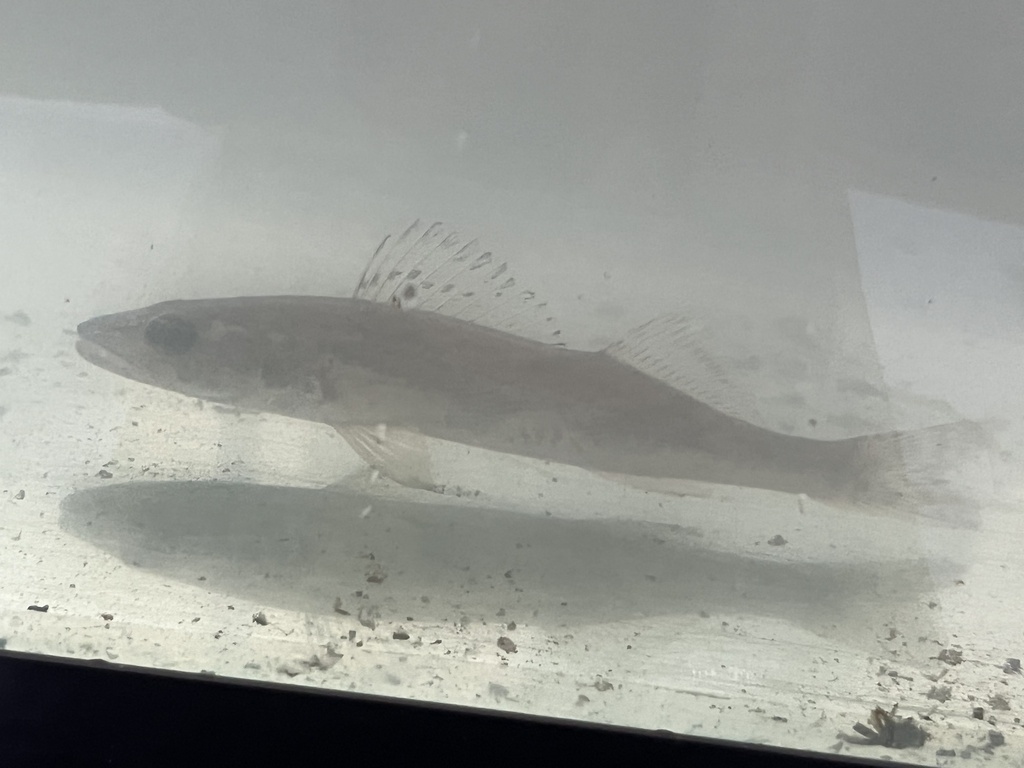
The sauger (Sander canadensis) is a freshwater perciform fish of the family Percidae that resembles its close relative, the walleye. The species is a member of the largest vertebrate order, the Perciformes. It is the most migratory percid species in North America. Saugers have two dorsal fins; the first is spiny and the posterior dorsal fin is soft-rayed. Their paired fins are in the thoracic position and their caudal fin is truncated, which means squared off at the corners, a characteristic of the family Percidae. Another physical characteristic of saugers is their ctenoid scales, which are common in advanced fishes. Saugers have a fusiform body structure, and as a result are well adapted predatory fishes and are capable of swimming into fast currents with minimal drag on their bodies. They may be distinguished from walleyes by the distinctly spotted dorsal fin, by the lack of a white splotch on the caudal fin, by the rough skin over their gills, and by their generally more brassy color, or darker (almost black) color in some regions. The typical sauger is 300 to 400 g (11 to 14 oz) in weight.
En aquarium
Espèce d'eau douce évoluant plutôt près du fond. Sur le plan biologique, elle atteint jusqu'à 76 cm, vit jusqu'à 18 ans, son régime est piscivore.
Paramètres relevés dans le milieu naturel de l’espèce (données scientifiques FishBase). À adapter aux besoins précis de l’espèce en captivité.
Ajouter des photos
Partagez vos photos de cette espèce (jusqu'à 20 à la fois) : elles sont vérifiées automatiquement, puis publiées.
Répartition
Occurrences observées (données GBIF). Les zones hors aire d'origine peuvent indiquer une présence introduite ou invasive.
Sources et crédits
Informations provenant de plusieurs sources vérifiées. Dernière mise à jour : .
Crédits photos (1)
- Photo : @jeanchristophel · CC BY-NC 4.0 · via iNaturalist
Mentions de licence
Texte disponible sous licence CC BY-SA 4.0. Il adapte notamment Wikipedia (CC BY-SA) : Sauger (Wikipédia, auteurs dans l’historique de l’article).
- Taxonomie : GBIF Backbone Taxonomy (CC BY 4.0)
- Carte : occurrences GBIF, fond © contributeurs OpenStreetMap (ODbL)
- Statut de conservation : Liste rouge de l'UICN, via Wikidata (CC0)
- Paramètres d'aquarium : FishBase (faits reformulés)
Détail : Sources et licences.
Discussion (0)
Aucun message pour l’instant. Lancez la discussion sur cette fiche (sources, précisions, débats éditoriaux).
Connectez-vous pour participer à la discussion.