
Basking shark
Cetorhinus maximus
The basking shark (Cetorhinus maximus) is the second-largest living shark and fish, after the whale shark.
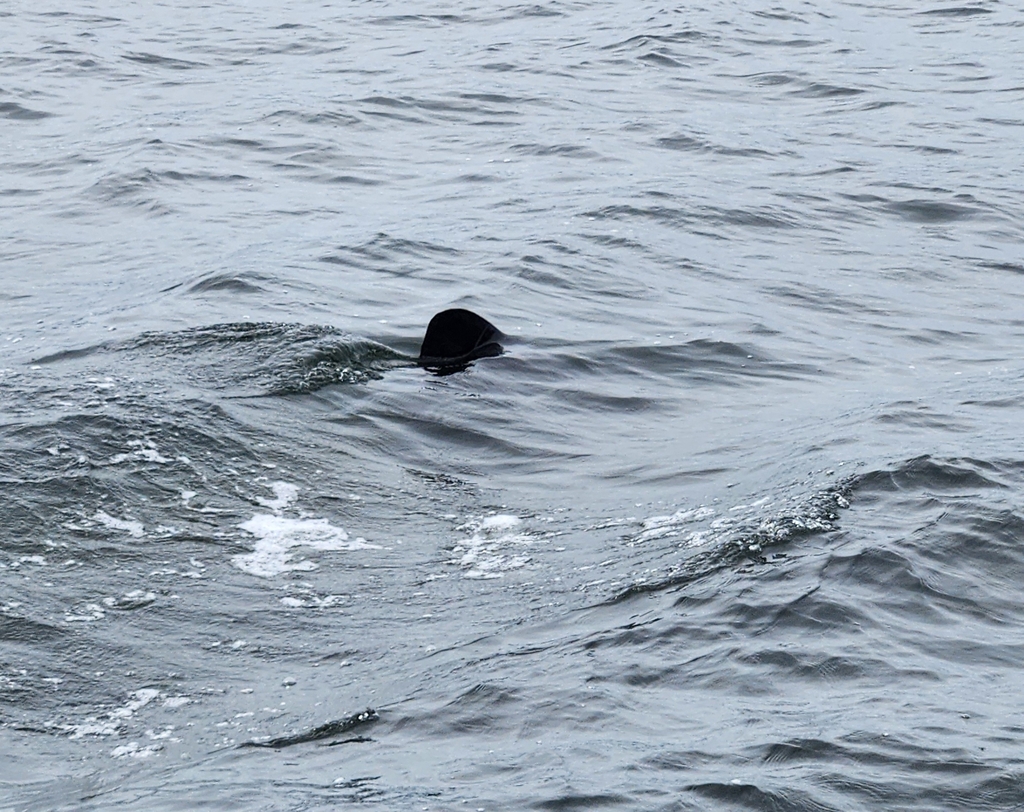
- Kingdom
- Animalia
- Phylum
- Chordata
- Class
- Elasmobranchii
- Order
- Lamniformes
- Family
- Cetorhinidae
- Genus
- Cetorhinus
- Species
- Cetorhinus maximus
Description
The basking shark (Cetorhinus maximus) is the second-largest living shark and fish, after the whale shark. It is one of three plankton-eating shark species, along with the whale shark and megamouth shark. Typically, basking sharks reach 7.9 m (26 ft) in length, but large individuals have been known to grow more than 10 m (33 ft) long. It is usually greyish-brown, with mottled skin, with the inside of the mouth being white in colour. The caudal fin has a strong lateral keel and a crescent shape. Other common names include bone shark, elephant shark, sailfish, and sunfish. The basking shark is a cosmopolitan migratory species found in all the world's temperate oceans. A slow-moving filter feeder, its common name derives from its habit of feeding at the surface, appearing to be basking in the warmer water there. It has anatomical adaptations for filter-feeding, such as a greatly enlarged mouth and highly developed gill rakers. Its snout is conical, and the gill slits extend around the top and bottom of its head. The gill rakers, dark and bristle-like, are used to catch plankton as water filters through the mouth and over the gills. The teeth are numerous, often numbering 100 per row. The teeth are very small, have a single conical cusp, are curved backwards, and are the same on both the upper and lower jaws. This species has the smallest weight-for-weight brain size of any shark, reflecting its relatively passive lifestyle. Basking sharks have been shown from satellite tracking to overwinter in both continental shelf (less than 200 m or 660 ft) and deeper waters. They may be found either in small shoals or alone. Despite their large size and threatening appearance, basking sharks are not aggressive and are harmless to humans. The basking shark has long been a commercially important fish as a source of food, shark fin, animal feed, and shark liver oil. Overexploitation has reduced its populations to the point where some have disappeared and others need protection.
En aquarium
Espèce d'eau de mer évoluant plutôt en pleine eau. Paramètres d'eau relevés dans son milieu : température de 6 à 24 °C. Sur le plan biologique, elle atteint jusqu'à 1520 cm, son régime est carnivore.
Paramètres relevés dans le milieu naturel de l’espèce (données scientifiques FishBase ; voir aussi la fiche Fishipedia). À adapter aux besoins précis de l’espèce en captivité.
Gallery
Ajouter des photos
Partagez vos photos de cette espèce (jusqu'à 20 à la fois) : elles sont vérifiées automatiquement, puis publiées.
Sources et crédits
Informations provenant de plusieurs sources vérifiées. Dernière mise à jour : .
Crédits photos (5)
- Photo : @ladesbordes · CC BY-NC 4.0 · via iNaturalist
- Photo : V Burdette (@vburdette) · CC BY-NC 4.0 · via iNaturalist
- Photo : Jeremy Barker (@jeremybarker) · CC BY-NC 4.0 · via iNaturalist
- Photo : Katie O'Neil (@moanamatrondesigns) · CC BY-NC 4.0 · via iNaturalist
- Photo : @bend2000 · CC BY-NC 4.0 · via iNaturalist
Mentions de licence
Texte disponible sous licence CC BY-SA 4.0. Il adapte notamment Requin pèlerin, Wikipedia (CC BY-SA) : Basking shark (Wikipédia, auteurs dans l’historique de l’article).
- Taxonomie : GBIF Backbone Taxonomy (CC BY 4.0)
- Statut de conservation : Liste rouge de l'UICN, via Wikidata (CC0)
- Paramètres d'aquarium : FishBase (faits reformulés)
Détail : Sources et licences.
Discussion (0)
Aucun message pour l’instant. Lancez la discussion sur cette fiche (sources, précisions, débats éditoriaux).
Connectez-vous pour participer à la discussion.