
Pelagic Stingray
Pteroplatytrygon violacea
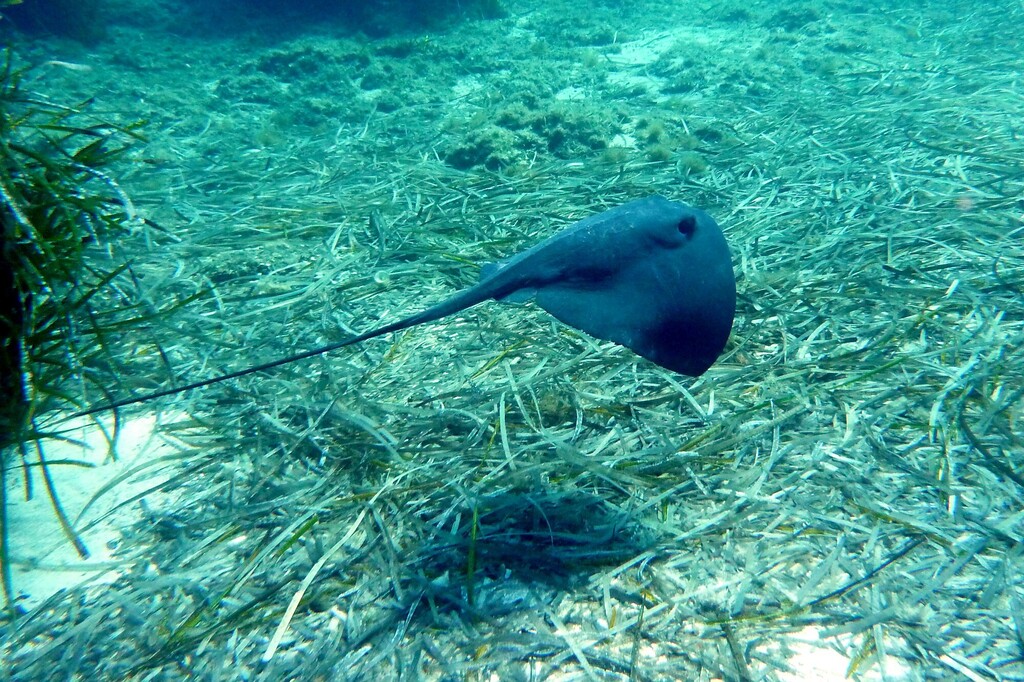
The pelagic stingray (Pteroplatytrygon violacea) is a species of stingray in the family Dasyatidae, and the sole member of its genus.
- Kingdom
- Animalia
- Phylum
- Chordata
- Class
- Elasmobranchii
- Order
- Myliobatiformes
- Family
- Dasyatidae
- Genus
- Pteroplatytrygon
- Species
- Pteroplatytrygon violacea
Description
The pelagic stingray (Pteroplatytrygon violacea) is a species of stingray in the family Dasyatidae, and the sole member of its genus. It is characterized by the wedge-like shape of its pectoral fin disc, which is much wider than long, as well as by the pointed teeth in both sexes, whip-like tail with extremely long tail spine, and uniform violet to blue-green coloration. It generally reaches 59 cm (23 in) in width. The pelagic stingray has a worldwide distribution in waters warmer than 19 °C (66 °F), and migrates seasonally to spend the summer closer to the continental shelf and at higher latitudes. The only stingray that almost exclusively inhabits the open ocean, this species is typically found in surface waters down to a depth of 100 m (330 ft). As a consequence of its midwater habits, its swimming style has evolved to feature more of a flapping motion of the pectoral fins, as opposed to the disc margin undulations used by other, bottom-dwelling stingrays. The diet of the pelagic stingray consists of free-swimming invertebrates and bony fishes. It is an active hunter, using its pectoral fins to trap and move food to its mouth, and has been known to take advantage of seasonal feeding opportunities such as spawning squid. Like other stingrays, it is aplacental viviparous, meaning that the embryos are sustained initially by yolk and later by histotroph ("uterine milk"). With a short gestation period of 2–4 months, females may bear two litters of 4–13 pups per year. Birthing generally occurs in warm water near the equator, with the exception of the Mediterranean, with the timing varying between regions. Rarely encountered except by fishery workers, the pelagic stingray can inflict a severe, even fatal wound with its tail spine. This species is caught as bycatch throughout its range; it is of little economic value and usually discarded, often with high mortality. However, there is evidence that its numbers are increasing, perhaps owing to the heavy fishing of its natural predators and competitors (e.g., sharks). Along with the pelagic stingray's global distribution and prolific life history, this has led the International Union for Conservation of Nature (IUCN) to assess it as of Least Concern.
En aquarium
Espèce d'eau de mer évoluant plutôt en pleine eau. Sur le plan biologique, elle atteint jusqu'à 96 cm, son régime est piscivore.
Paramètres relevés dans le milieu naturel de l’espèce (données scientifiques FishBase ; voir aussi la fiche Fishipedia). À adapter aux besoins précis de l’espèce en captivité.
Gallery
Ajouter des photos
Partagez vos photos de cette espèce (jusqu'à 20 à la fois) : elles sont vérifiées automatiquement, puis publiées.
Répartition
Occurrences observées (données GBIF). Les zones hors aire d'origine peuvent indiquer une présence introduite ou invasive.
Sources et crédits
Informations provenant de plusieurs sources vérifiées. Dernière mise à jour : .
Crédits photos (3)
- Photo : Daniel PAVON (@dpavon) · CC BY-NC 4.0 · via iNaturalist
- Photo : @alzzal · CC BY-NC 4.0 · via iNaturalist
- Photo : Valeria Huerta (@valeriehh) · CC BY-NC 4.0 · via iNaturalist
Mentions de licence
Texte disponible sous licence CC BY-SA 4.0. Il adapte notamment Wikipedia (CC BY-SA) : Pelagic stingray (Wikipédia, auteurs dans l’historique de l’article).
- Taxonomie : GBIF Backbone Taxonomy (CC BY 4.0)
- Carte : occurrences GBIF, fond © contributeurs OpenStreetMap (ODbL)
- Statut de conservation : Liste rouge de l'UICN, via Wikidata (CC0)
- Paramètres d'aquarium : FishBase (faits reformulés)
Détail : Sources et licences.
Discussion (0)
Aucun message pour l’instant. Lancez la discussion sur cette fiche (sources, précisions, débats éditoriaux).
Connectez-vous pour participer à la discussion.