
Pterophyllum scalare
Pterophyllum scalare
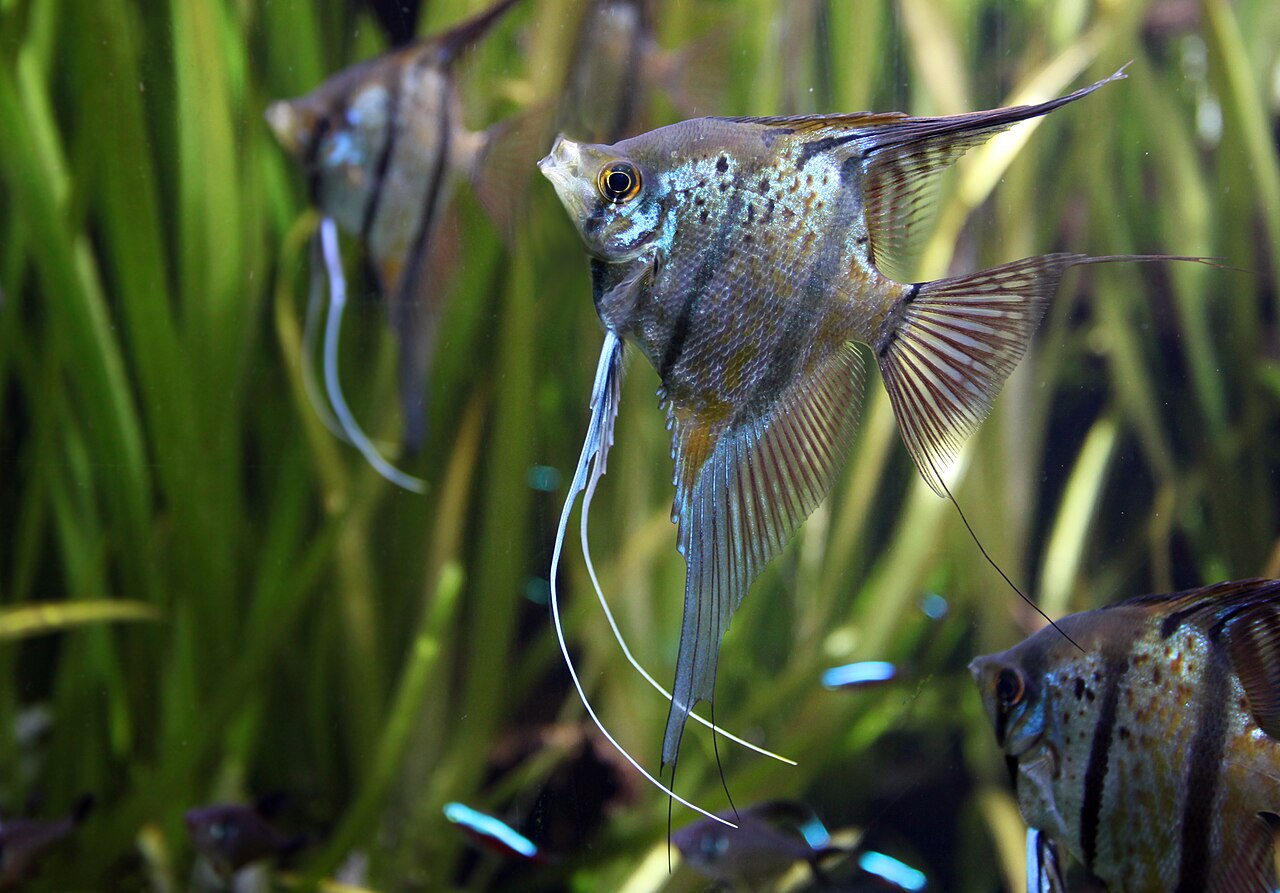
Pterophyllum scalare, most commonly referred to as angelfish or freshwater angelfish, is the most common species of Pterophyllum kept in captivity.
- Kingdom
- Animalia
- Phylum
- Chordata
- Order
- Perciformes
- Family
- Cichlidae
- Genus
- Pterophyllum
- Species
- Pterophyllum scalare
Description
Pterophyllum scalare, most commonly referred to as angelfish or freshwater angelfish, is the most common species of Pterophyllum kept in captivity. It is native to the Amazon Basin in Peru, Colombia, and Brazil. Particularly to the Ucayali river in Peru, the Oyapock River in French Guiana, the Essequibo River in Guyana, the Solimões, the Amapá, and the Amazon rivers in Brazil. It is found in swamps or flooded grounds where vegetation is dense and the water is either clear or silty. Its native waters range from a neutral pH of 7.0 down to near 6.0, with a general water hardness (gH) range of 3 to 10 °dH, and water temperature ranging from 26 to 30 °C (75 to 86 °F). This is the species of angelfish most frequently found in the aquarium trade. A similar (cross-breeding possible) P. scalare exists in the Rio Orinoco. They are of the same size and shape, the only difference being the stripes; the Orinoco P. scalare has thinner, but dual, stripes. The diet of Pterophyllum scalare consists of a wide spectrum of prey; they feed on tiny fish fry and younger, juvenile fishes, young and mature shrimps, crabs, prawns, various worms, mosquito larvae, and water bugs. Additionally, they will opportunistically catch any smaller-sized floating insects that have fallen onto the surface of the water. In captivity, these are not picky fish; They readily feed on different types of frozen, freeze-dried and live foods, such as tubifex worms, bean beetles (and larvae), bloodworms, brine shrimp, daphnia, flour beetles, krill, springtails, small or finely-chopped earthworms, black soldier fly larvae and cultured wingless fruit flies (Drosophila melanogaster). In particular, the tubifex worms and fruit flies are high in protein and nutrients, resulting in highly significant growth. A predominantly live food diet also provides nutrients for better reproductive performance. Ultimately, food variety is key, for health, but also for mimicking natural feeding habits. It was first described by Ferdinand Schultze in a catalog of specimens at the Zoological Museum of the Royal University of Berlin, published by Hinrich Lichtenstein in 1823. First import to Europe (Germany) by C.Ziggelkow, Hamburg in 1909 The genome of the angelfish was sequenced and assembled in 2022 by Indeever Madireddy, a high school student.
En aquarium
Espèce d'eau douce évoluant plutôt en pleine eau. Paramètres d'eau relevés dans son milieu : température de 24 à 29,5 °C, pH de 6 à 8, dureté de 5 à 13 °dGH. Sur le plan biologique, elle atteint jusqu'à 10,5 cm, son régime est carnivore.
Paramètres relevés dans le milieu naturel de l’espèce (données scientifiques FishBase ; voir aussi la fiche Fishipedia). À adapter aux besoins précis de l’espèce en captivité.
Gallery
Ajouter des photos
Partagez vos photos de cette espèce (jusqu'à 20 à la fois) : elles sont vérifiées automatiquement, puis publiées.
Répartition
Occurrences observées (données GBIF). Les zones hors aire d'origine peuvent indiquer une présence introduite ou invasive.
Sources et crédits
Informations provenant de plusieurs sources vérifiées. Dernière mise à jour : .
Crédits photos (2)
- Photo : This illustration was made by Citron You must credit this : Citron / CC-BY-SA-3.0 · CC BY-SA 3.0 · via Wikimedia Commons
- Photo : This illustration was made by Citron You must credit this : Citron / CC-BY-SA-3.0 · CC BY-SA 3.0 · via Wikimedia Commons
Mentions de licence
Texte disponible sous licence CC BY-SA 4.0. Il adapte notamment Wikipedia (CC BY-SA) : Pterophyllum scalare (Wikipédia, auteurs dans l’historique de l’article).
- Taxonomie : GBIF Backbone Taxonomy (CC BY 4.0)
- Carte : occurrences GBIF, fond © contributeurs OpenStreetMap (ODbL)
- Statut de conservation : Liste rouge de l'UICN, via Wikidata (CC0)
- Paramètres d'aquarium : FishBase (faits reformulés)
Détail : Sources et licences.
Discussion (0)
Aucun message pour l’instant. Lancez la discussion sur cette fiche (sources, précisions, débats éditoriaux).
Connectez-vous pour participer à la discussion.