
Pyjama shark
Poroderma africanum
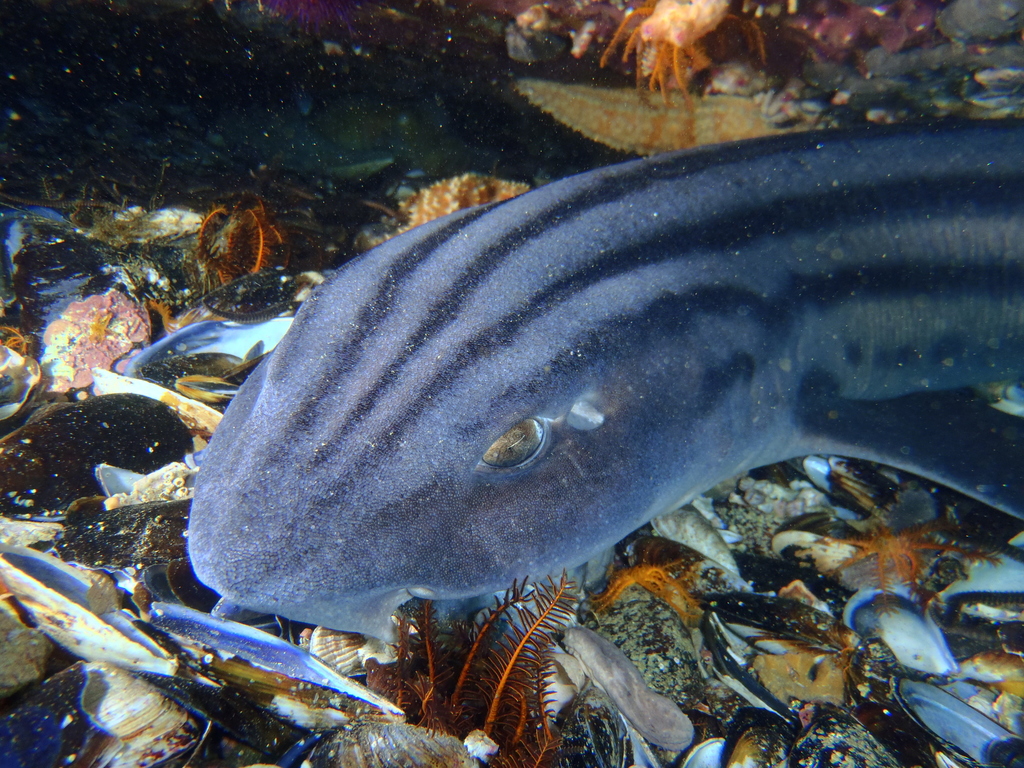
The pyjama shark or striped catshark (Poroderma africanum) is a species of catshark, and part of the family Scyliorhinidae, endemic to the coastal waters of South Africa.
- Kingdom
- Animalia
- Phylum
- Chordata
- Class
- Elasmobranchii
- Order
- Carcharhiniformes
- Family
- Scyliorhinidae
- Genus
- Poroderma
- Species
- Poroderma africanum
Description
The pyjama shark or striped catshark (Poroderma africanum) is a species of catshark, and part of the family Scyliorhinidae, endemic to the coastal waters of South Africa. This abundant, bottom-dwelling species can be found from the intertidal zone to a depth of around 100 m (330 ft), particularly over rocky reefs and kelp beds. With a series of thick, parallel, dark stripes running along its stout body, the pyjama shark has an unmistakable appearance. It is additionally characterized by a short head and snout with a pair of slender barbels that do not reach the mouth, and two dorsal fins that are placed far back on the body. It can grow up to a length of 1.1 m (3.6 ft) long. The pyjama shark is primarily nocturnal, spending most of the day lying motionless and hidden in a cave or crevice or among vegetation. It often forms groups, particularly during summer. This species is an opportunistic predator that feeds on a wide variety of fishes and invertebrates; it favors cephalopods and frequents the spawning grounds of the chokka squid (Loligo reynaudi). When threatened, it curls into a circle with its tail covering its head. Reproduction is oviparous, with females laying rectangular, dark brown egg cases two at a time year-round. This small and harmless shark adapts well to captivity and is commonly displayed in public aquariums. It is often caught as a bycatch of commercial and recreational fisheries. Many are killed by fishers who regard them as pests. However, there is no data suggesting its numbers have declined, so the International Union for Conservation of Nature (IUCN) has assessed the pyjama shark as least concern.
En aquarium
Espèce d'eau de mer évoluant plutôt près du fond. Sur le plan biologique, elle atteint jusqu'à 101 cm, son régime est carnivore.
Paramètres relevés dans le milieu naturel de l’espèce (données scientifiques FishBase ; voir aussi la fiche Fishipedia). À adapter aux besoins précis de l’espèce en captivité.
Gallery
Ajouter des photos
Partagez vos photos de cette espèce (jusqu'à 20 à la fois) : elles sont vérifiées automatiquement, puis publiées.
Répartition
Occurrences observées (données GBIF). Les zones hors aire d'origine peuvent indiquer une présence introduite ou invasive.
Sources et crédits
Informations provenant de plusieurs sources vérifiées. Dernière mise à jour : .
Crédits photos (4)
- Photo : Cape RADD (@caperadd) · CC BY-NC 4.0 · via iNaturalist
- Photo : Callum Evans (@callumevans) · CC BY-NC 4.0 · via iNaturalist
- Photo : Zander Labuschagne (@theescapist___) · CC BY-NC 4.0 · via iNaturalist
- Photo : Cape RADD (@caperadd) · CC BY-NC 4.0 · via iNaturalist
Mentions de licence
Texte disponible sous licence CC BY-SA 4.0. Il adapte notamment Wikipedia (CC BY-SA) : Pyjama shark (Wikipédia, auteurs dans l’historique de l’article).
- Taxonomie : GBIF Backbone Taxonomy (CC BY 4.0)
- Carte : occurrences GBIF, fond © contributeurs OpenStreetMap (ODbL)
- Statut de conservation : Liste rouge de l'UICN, via Wikidata (CC0)
- Paramètres d'aquarium : FishBase (faits reformulés)
Détail : Sources et licences.
Discussion (0)
Aucun message pour l’instant. Lancez la discussion sur cette fiche (sources, précisions, débats éditoriaux).
Connectez-vous pour participer à la discussion.