
Rainbow Trout
Oncorhynchus mykiss
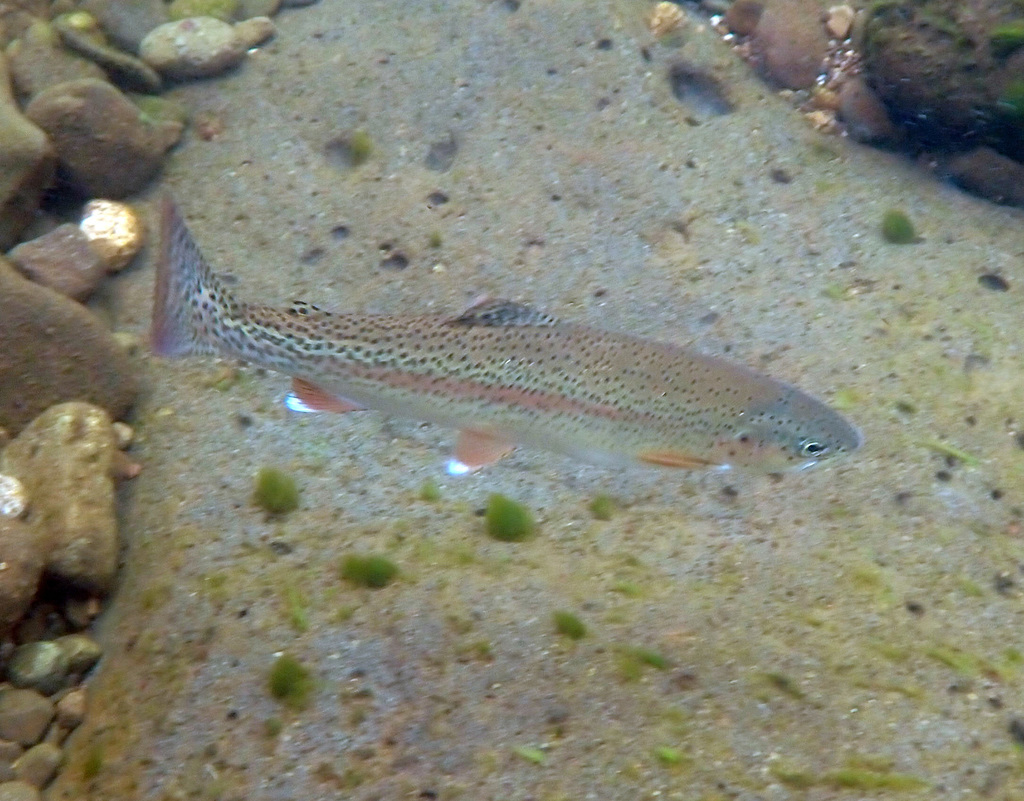
The rainbow trout (Oncorhynchus mykiss) is a species of trout native to cold-water tributaries of the Pacific Ocean in North America and Asia.
- Kingdom
- Animalia
- Phylum
- Chordata
- Order
- Salmoniformes
- Family
- Salmonidae
- Genus
- Oncorhynchus
- Species
- Oncorhynchus mykiss
Description
The rainbow trout (Oncorhynchus mykiss) is a species of trout native to cold-water tributaries of the Pacific Ocean in North America and Asia. The steelhead (sometimes called steelhead trout) is an anadromous (sea-run) form of the coastal rainbow trout (O. m. irideus) or Columbia River redband trout (O. m. gairdneri) that usually returns to freshwater to spawn after living two to three years in the ocean. Adult freshwater stream rainbow trout average between 0.5 and 2.5 kilograms (1 and 5 lb), while lake-dwelling and anadromous forms may reach 9 kg (20 lb). Coloration varies widely based on subspecies, forms, and habitat. Adult fish are distinguished by a broad reddish stripe along the lateral line, from gills to the tail, which is most vivid in breeding males. Wild-caught and hatchery-reared forms of the species have been transplanted and introduced for food or sport in at least 45 countries and every continent except Antarctica. Introductions to locations outside their native range in the United States, Southern Europe, Australia, New Zealand, and South America have damaged native fish species. Introduced populations may affect native species by preying on them, out-competing them, transmitting contagious diseases (such as whirling disease), or hybridizing with closely related species and subspecies. The rainbow trout is included in the list of the top 100 globally invasive species. Other introductions into waters previously devoid of fish or with severely depleted stocks of native fish have created sport fisheries, such as the Great Lakes and Wyoming's Firehole River. Some local populations of specific subspecies, or in the case of steelhead, distinct population segments, are listed as either threatened or endangered under the Endangered Species Act. The steelhead is the official state fish of Washington.
En aquarium
Espèce d'eau douce et saumâtre et eau de mer évoluant plutôt en pleine eau. Paramètres d'eau relevés dans son milieu : température de 10 à 24 °C. Sur le plan biologique, elle atteint jusqu'à 122 cm, vit jusqu'à 11 ans, son régime est piscivore.
Paramètres relevés dans le milieu naturel de l’espèce (données scientifiques FishBase ; voir aussi la fiche Fishipedia). À adapter aux besoins précis de l’espèce en captivité.
Gallery
Ajouter des photos
Partagez vos photos de cette espèce (jusqu'à 20 à la fois) : elles sont vérifiées automatiquement, puis publiées.
Répartition
Occurrences observées (données GBIF). Les zones hors aire d'origine peuvent indiquer une présence introduite ou invasive.
Sources et crédits
Informations provenant de plusieurs sources vérifiées. Dernière mise à jour : .
Crédits photos (2)
- Photo : Sue (@sue1001) · CC BY-NC 4.0 · via iNaturalist
- Photo : @rabbitfern · CC BY-NC 4.0 · via iNaturalist
Mentions de licence
Texte disponible sous licence CC BY-SA 4.0. Il adapte notamment Wikipedia (CC BY-SA) : Rainbow trout (Wikipédia, auteurs dans l’historique de l’article).
- Taxonomie : GBIF Backbone Taxonomy (CC BY 4.0)
- Carte : occurrences GBIF, fond © contributeurs OpenStreetMap (ODbL)
- Paramètres d'aquarium : FishBase (faits reformulés)
Détail : Sources et licences.
Discussion (0)
Aucun message pour l’instant. Lancez la discussion sur cette fiche (sources, précisions, débats éditoriaux).
Connectez-vous pour participer à la discussion.