
Chilean devil ray
Mobula tarapacana
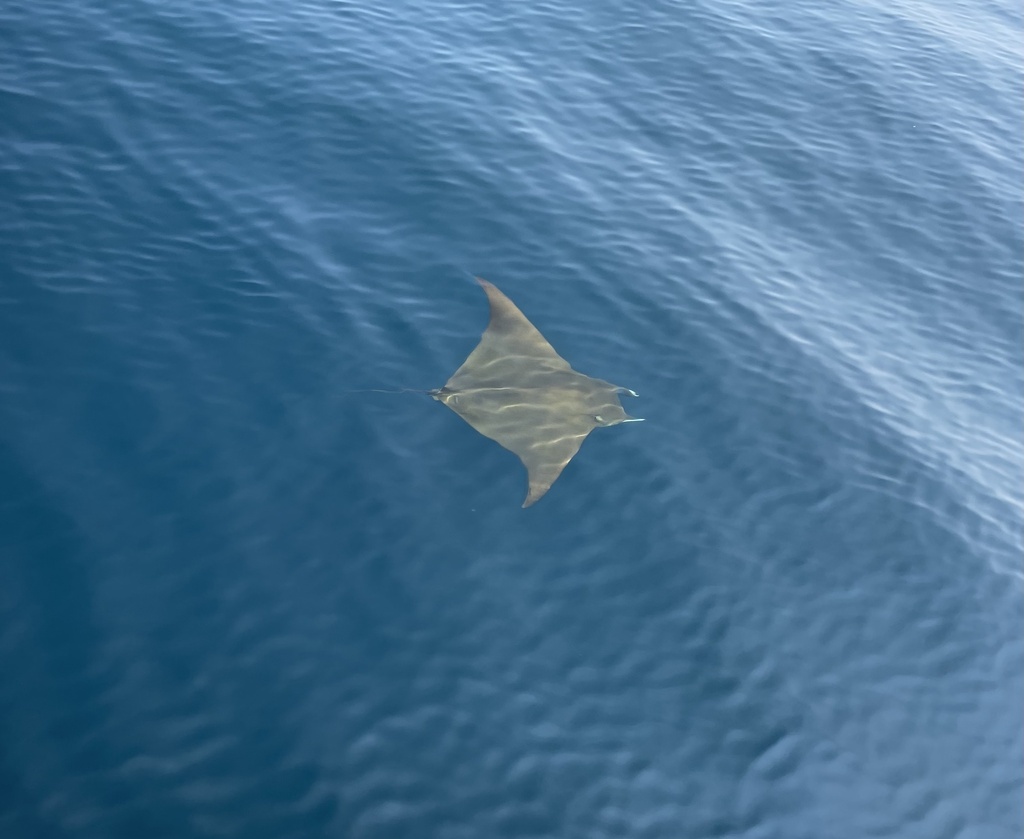
The Chilean devil ray (Mobula tarapacana), also known as the box ray, greater Guinean mobula, sicklefin devil ray or the spiny mobula, is a species of ray in the family Mobulidae.
- Kingdom
- Animalia
- Phylum
- Chordata
- Class
- Elasmobranchii
- Order
- Myliobatiformes
- Family
- Myliobatidae
- Genus
- Mobula
- Species
- Mobula tarapacana
Description
The Chilean devil ray (Mobula tarapacana), also known as the box ray, greater Guinean mobula, sicklefin devil ray or the spiny mobula, is a species of ray in the family Mobulidae. It is often observed worldwide, basking just below the surface in tropical, subtropical and warm temperate oceans, mainly offshore, and occasionally appearing near the coast. It can reach a disc width of up to 3.7 m (12 ft). Originally believed to be surface dwellers, Mobula tarapacana have been discovered to feed at depths of up to 1,896 metres (6,220 ft) during deep dives; they are among the deepest-diving ocean animals. Their dives often follow a stepwise pattern, in which the ray dives deeply, then works its way back up by repeatedly "levelling up" for a bit and then moving higher. Sonar observations suggest that rays level up where there are denser layers of prey, suggesting that this is a foraging behavior. Rays display two distinct deep-dive patterns. The stepwise dive pattern, which is usually only performed once every 24 hours, involves diving to the maximum depth and resurfacing after 60 to 90 minutes; a second pattern, which is less frequent, involves diving up to 1,000 meters for a maximum of 11 hours. The latter pattern may be associated with traveling rather than feeding. The ray's behavior may be linked to an organ called the retia mirabilia, which is found in rays and in deep-diving great white sharks. A veined structure of blood vessels warms the ray's brain at colder depths. Rays stay near warmer surface water for at least an hour both before and after deep diving, suggesting that they are soaking up heat to prepare for and recover from their descent into colder water.
En aquarium
Espèce d'eau de mer évoluant plutôt autour des récifs. Sur le plan biologique, elle atteint jusqu'à 328 cm, son régime est piscivore.
Paramètres relevés dans le milieu naturel de l’espèce (données scientifiques FishBase). À adapter aux besoins précis de l’espèce en captivité.
Gallery
Ajouter des photos
Partagez vos photos de cette espèce (jusqu'à 20 à la fois) : elles sont vérifiées automatiquement, puis publiées.
Répartition
Occurrences observées (données GBIF). Les zones hors aire d'origine peuvent indiquer une présence introduite ou invasive.
Sources et crédits
Informations provenant de plusieurs sources vérifiées. Dernière mise à jour : .
Crédits photos (4)
- Photo : @jamesbury · CC BY-NC 4.0 · via iNaturalist
- Photo : @milesleask · CC BY-NC 4.0 · via iNaturalist
- Photo : Alina Martin (@alinamartin) · CC BY 4.0 · via iNaturalist
- Photo : Stephen John Davies (@stephen220) · CC BY-NC 4.0 · via iNaturalist
Mentions de licence
Texte disponible sous licence CC BY-SA 4.0. Il adapte notamment Wikipedia (CC BY-SA) : Chilean devil ray (Wikipédia, auteurs dans l’historique de l’article).
- Taxonomie : GBIF Backbone Taxonomy (CC BY 4.0)
- Carte : occurrences GBIF, fond © contributeurs OpenStreetMap (ODbL)
- Statut de conservation : Liste rouge de l'UICN, via Wikidata (CC0)
- Paramètres d'aquarium : FishBase (faits reformulés)
Détail : Sources et licences.
Discussion (0)
Aucun message pour l’instant. Lancez la discussion sur cette fiche (sources, précisions, débats éditoriaux).
Connectez-vous pour participer à la discussion.