
Goblin Shark
Mitsukurina owstoni
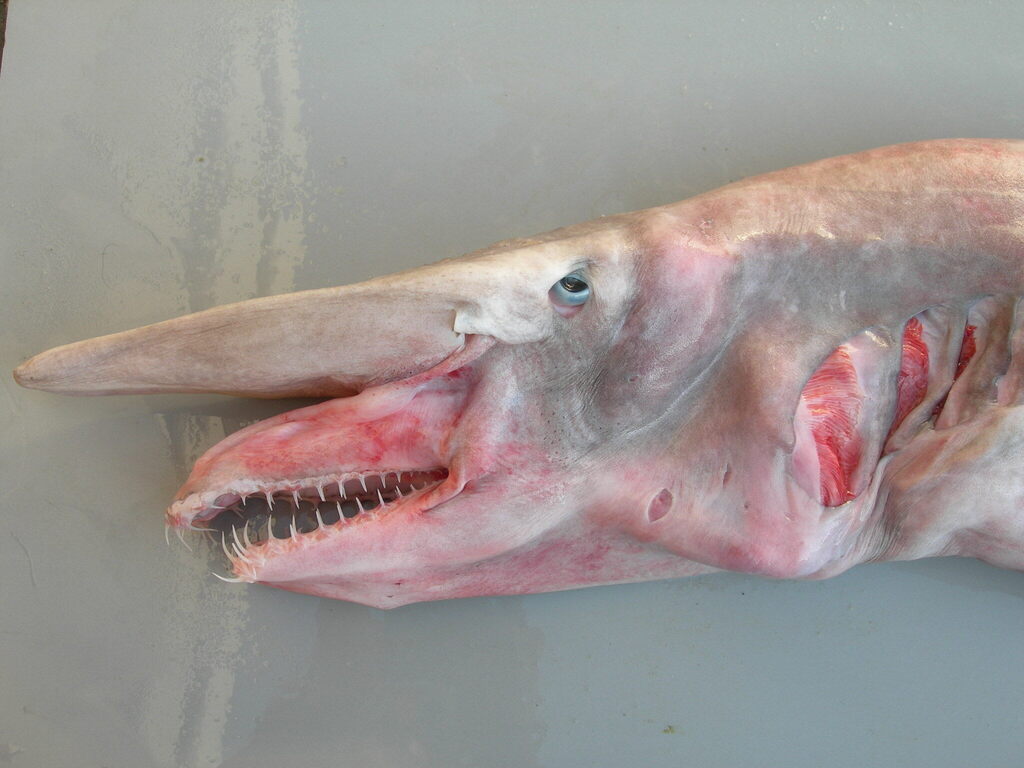
The goblin shark (Mitsukurina owstoni) is a rare species of deep-sea shark.
- Kingdom
- Animalia
- Phylum
- Chordata
- Class
- Elasmobranchii
- Order
- Lamniformes
- Family
- Mitsukurinidae
- Genus
- Mitsukurina
- Species
- Mitsukurina owstoni
Description
The goblin shark (Mitsukurina owstoni) is a rare species of deep-sea shark. Sometimes called a "living fossil", it is the only extant representative of the family Mitsukurinidae, a lineage some 125 million years old. This pink-skinned animal has a distinctive profile with an elongated, flat snout, and highly protrusible jaws containing prominent nail-like teeth. It typically reaches a length of 3 to 4 meters (10 to 13 feet) when fully grown, although it can grow significantly larger-such as one specimen captured in 2000, which was believed to measure around 6 meters (20 feet). Goblin sharks are benthopelagic creatures that inhabit upper continental slopes, submarine canyons, and seamounts throughout the world at depths greater than 100 m (330 ft), with adults found deeper than juveniles. Some researchers believed that these sharks could also dive to depths of up to 1,300 m (4,270 ft), for short periods; footage captured in 2024 suggests that their range could be deeper than previously thought, with a confirmed sighting of an adult swimming at 2,000 m (6,560 ft). Various anatomical features of the goblin shark, such as its flabby body and small fins, suggest that it is sluggish in nature. This species hunts for teleosts, cephalopods, and crustaceans near the sea floor and in the middle of the water column. Its long snout is covered with ampullae of Lorenzini that sense minute electric fields produced by nearby prey, which it snatches by rapidly extending its jaws. Small numbers of goblin sharks are unintentionally caught by deepwater fisheries. The International Union for Conservation of Nature (IUCN) has assessed it as Least Concern, despite its rarity, citing its wide distribution and low incidence of capture.
En aquarium
Espèce d'eau de mer évoluant plutôt en pleine eau. Sur le plan biologique, elle atteint jusqu'à 617 cm, son régime est piscivore.
Paramètres relevés dans le milieu naturel de l’espèce (données scientifiques FishBase). À adapter aux besoins précis de l’espèce en captivité.
Gallery
Ajouter des photos
Partagez vos photos de cette espèce (jusqu'à 20 à la fois) : elles sont vérifiées automatiquement, puis publiées.
Répartition
Occurrences observées (données GBIF). Les zones hors aire d'origine peuvent indiquer une présence introduite ou invasive.
Sources et crédits
Informations provenant de plusieurs sources vérifiées. Dernière mise à jour : .
Crédits photos (4)
- Photo : Gonzalo Mucientes Sandoval (@gmucientes) · CC BY-NC 4.0 · via iNaturalist
- Photo : Karen Scaife (@karen52603) · CC BY-NC 4.0 · via iNaturalist
- Photo : Andhika Prima Prasetyo (@andhika3010) · CC BY-NC 4.0 · via iNaturalist
- Photo : Ken Graham (@kengraham) · CC BY-NC 4.0 · via iNaturalist
Mentions de licence
Texte disponible sous licence CC BY-SA 4.0. Il adapte notamment Wikipedia (CC BY-SA) : Goblin shark (Wikipédia, auteurs dans l’historique de l’article).
- Taxonomie : GBIF Backbone Taxonomy (CC BY 4.0)
- Carte : occurrences GBIF, fond © contributeurs OpenStreetMap (ODbL)
- Statut de conservation : Liste rouge de l'UICN, via Wikidata (CC0)
- Paramètres d'aquarium : FishBase (faits reformulés)
Détail : Sources et licences.
Discussion (0)
Aucun message pour l’instant. Lancez la discussion sur cette fiche (sources, précisions, débats éditoriaux).
Connectez-vous pour participer à la discussion.