
Capelin
Mallotus villosus
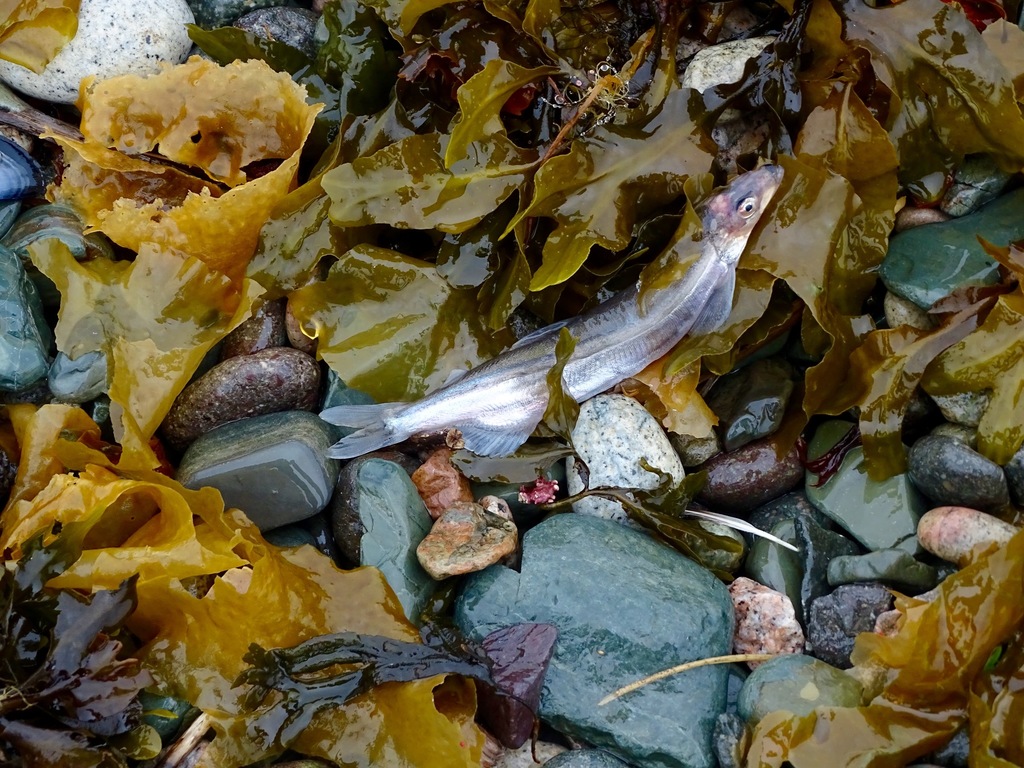
The capelin or caplin (Mallotus villosus) is a small forage fish of the smelt family found in the North Atlantic, North Pacific and Arctic oceans.
- Kingdom
- Animalia
- Phylum
- Chordata
- Order
- Osmeriformes
- Family
- Osmeridae
- Genus
- Mallotus
- Species
- Mallotus villosus
Description
The capelin or caplin (Mallotus villosus) is a small forage fish of the smelt family found in the North Atlantic, North Pacific and Arctic oceans. In summer, it grazes on dense swarms of plankton at the edge of the ice shelf. Larger capelin also eat a great deal of krill and other crustaceans. Among others, whales, seals, Atlantic cod, Atlantic mackerel, squid and seabirds prey on capelin, in particular during the spawning season while the capelin migrate south. Capelin spawn on sand and gravel bottoms or sandy beaches at the age of two to six years. When spawning on beaches, capelin have an extremely high post-spawning mortality rate which, for males, is close to 100%. Males reach 20 cm (8 in) in length, while females are up to 25.2 cm (10 in) long. They are olive-coloured dorsally, shading to silver on sides. Males have a translucent ridge on both sides of their bodies. The ventral aspects of the males iridesce reddish at the time of spawn. The closest relative of the capelin appears to have been the extinct fossil genus Enoplophthalmus, which inhabited Europe during the early Oligocene and early Miocene.
En aquarium
Espèce d'eau douce et saumâtre et eau de mer évoluant plutôt en pleine eau. Sur le plan biologique, elle atteint jusqu'à 20 cm, vit jusqu'à 10 ans, son régime est carnivore.
Paramètres relevés dans le milieu naturel de l’espèce (données scientifiques FishBase). À adapter aux besoins précis de l’espèce en captivité.
Ajouter des photos
Partagez vos photos de cette espèce (jusqu'à 20 à la fois) : elles sont vérifiées automatiquement, puis publiées.
Répartition
Occurrences observées (données GBIF). Les zones hors aire d'origine peuvent indiquer une présence introduite ou invasive.
Sources et crédits
Informations provenant de plusieurs sources vérifiées. Dernière mise à jour : .
Crédits photos (1)
- Photo : Carol McDougall (@salmonskyview) · CC BY-NC 4.0 · via iNaturalist
Mentions de licence
Texte disponible sous licence CC BY-SA 4.0. Il adapte notamment Wikipedia (CC BY-SA) : Capelin (Wikipédia, auteurs dans l’historique de l’article).
- Taxonomie : GBIF Backbone Taxonomy (CC BY 4.0)
- Carte : occurrences GBIF, fond © contributeurs OpenStreetMap (ODbL)
- Paramètres d'aquarium : FishBase (faits reformulés)
Détail : Sources et licences.
Discussion (0)
Aucun message pour l’instant. Lancez la discussion sur cette fiche (sources, précisions, débats éditoriaux).
Connectez-vous pour participer à la discussion.