
Bluegill
Lepomis macrochirus
The bluegill (Lepomis macrochirus), sometimes referred to as "bream", "brim", "sunny", or, in Texas, "copper nose", is a species of North American freshwater fish, native to and commonly found in streams, rivers, lakes, ponds and…
- Kingdom
- Animalia
- Phylum
- Chordata
- Order
- Perciformes
- Family
- Centrarchidae
- Genus
- Lepomis
- Species
- Lepomis macrochirus
Description
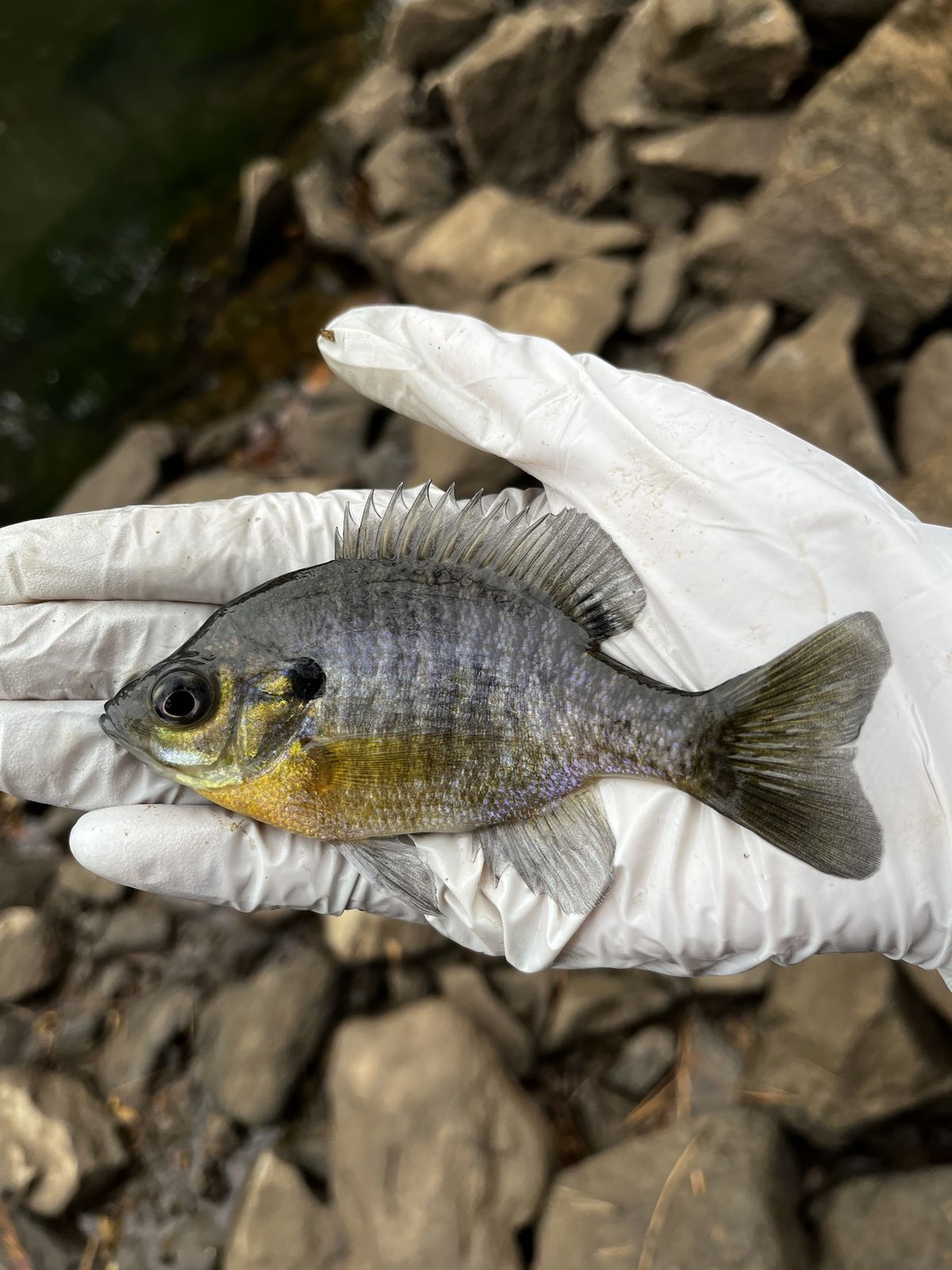
The bluegill (Lepomis macrochirus), sometimes referred to as "bream", "brim", "sunny", or, in Texas, "copper nose", is a species of North American freshwater fish, native to and commonly found in streams, rivers, lakes, ponds and wetlands east of the Rocky Mountains. It is from the family Centrarchidae (sunfishes, crappies and black basses) in the order Centrarchiformes. Bluegills can grow up to 16 in (41 cm) long and about 4+1⁄2 lb (2.0 kg). While their color can vary from population to population, they typically have a very distinctive coloring, with deep blue and purple on the face and gill cover, dark olive-colored bands down the side, and a fiery orange to yellow belly. They are omnivorous and will consume anything they can fit in their mouth, but mostly feed on small aquatic insects and baitfishes. The fish are important prey for bass, other larger sunfish, northern pike and muskellunge, walleye, trout, herons, kingfishers, snapping turtles and otters, and play a key role within the food chain of its freshwater ecosystem. A popular panfish among anglers, bluegill usually hide around and inside old tree stumps in swamps and other underwater structures (e.g. snags), and can live in either deep or very shallow water. Bluegills also like to find shelter among aquatic plants and in the shade of trees along banks, and will often move from one cover to another depending on the time of day or season.
En aquarium
Espèce d'eau douce évoluant plutôt en pleine eau. Paramètres d'eau relevés dans son milieu : température de 1 à 36 °C, pH de 7 à 7,5, dureté de 10 à 15 °dGH. Sur le plan biologique, elle atteint jusqu'à 41 cm, vit jusqu'à 10 ans, son régime est carnivore.
Paramètres relevés dans le milieu naturel de l’espèce (données scientifiques FishBase). À adapter aux besoins précis de l’espèce en captivité.
Gallery
Ajouter des photos
Partagez vos photos de cette espèce (jusqu'à 20 à la fois) : elles sont vérifiées automatiquement, puis publiées.
Répartition
Occurrences observées (données GBIF). Les zones hors aire d'origine peuvent indiquer une présence introduite ou invasive.
Sources et crédits
Informations provenant de plusieurs sources vérifiées. Dernière mise à jour : .
Crédits photos (10)
- Photo : lashale · CC BY-NC 4.0 · via GBIF
- Photo : Daniel Wieferich · CC BY-NC 4.0 · via GBIF
- Photo : David Wise V · CC BY-NC 4.0 · via GBIF
- Photo : gekko4470 · CC BY-NC 4.0 · via GBIF
- Photo : shmavin · CC BY-NC 4.0 · via GBIF
- Photo : Maria Krausmann · CC BY-NC 4.0 · via GBIF
- Photo : kary · CC BY-NC 4.0 · via GBIF
- Photo : lashale · CC BY-NC 4.0 · via GBIF
- Photo : lashale · CC BY-NC 4.0 · via GBIF
- Photo : Tony Doty · CC BY-NC 4.0 · via GBIF
Mentions de licence
Texte disponible sous licence CC BY-SA 4.0. Il adapte notamment Wikipedia (CC BY-SA) : Bluegill (Wikipédia, auteurs dans l’historique de l’article).
- Taxonomie : GBIF Backbone Taxonomy (CC BY 4.0)
- Carte : occurrences GBIF, fond © contributeurs OpenStreetMap (ODbL)
- Statut de conservation : Liste rouge de l'UICN, via Wikidata (CC0)
- Paramètres d'aquarium : FishBase (faits reformulés)
Détail : Sources et licences.
Discussion (0)
Aucun message pour l’instant. Lancez la discussion sur cette fiche (sources, précisions, débats éditoriaux).
Connectez-vous pour participer à la discussion.