
Longnose gar
Lepisosteus osseus
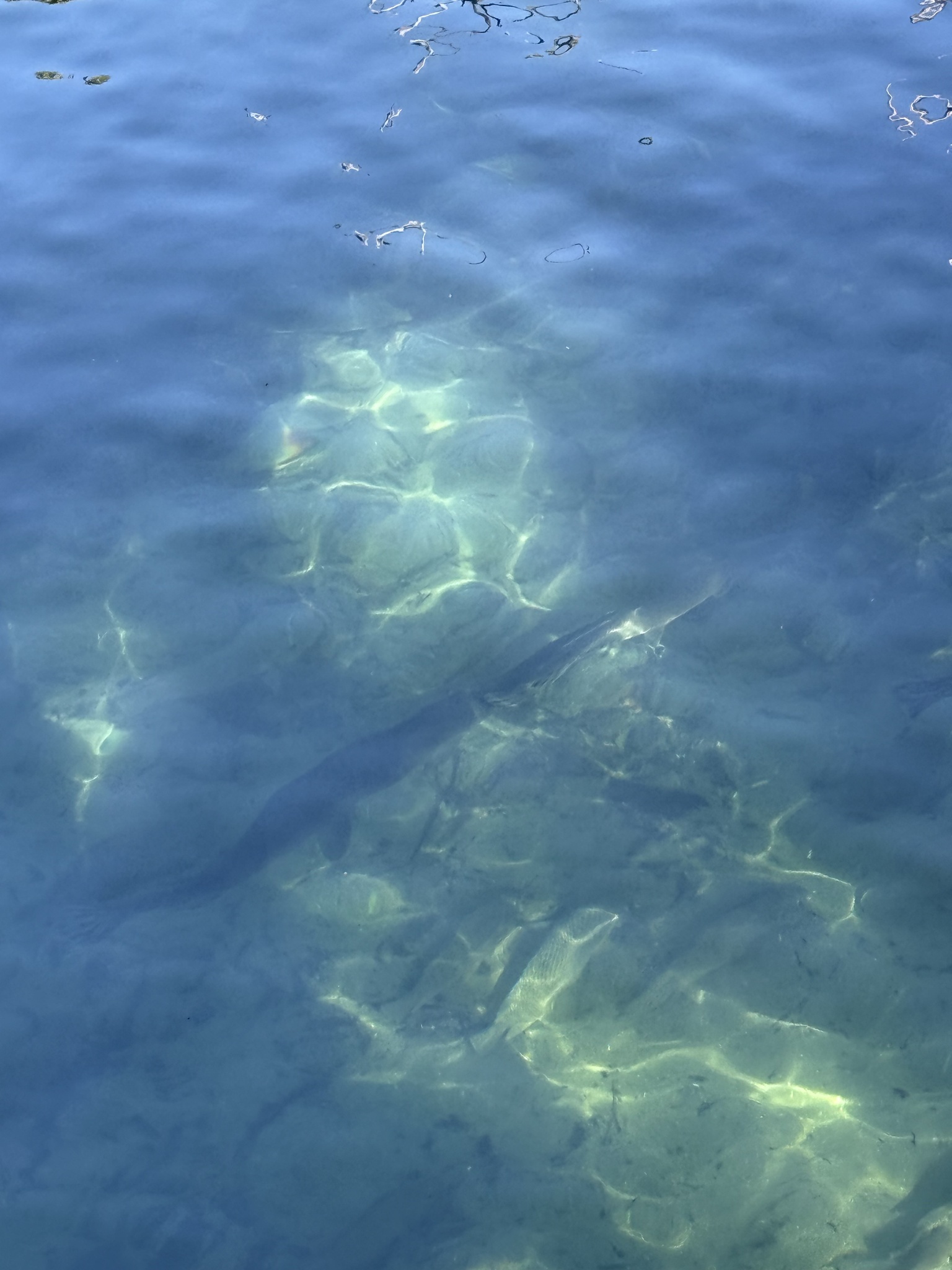
The longnose gar (Lepisosteus osseus), also known as longnose garpike or billy gar, is a ray-finned fish in the family Lepisosteidae.
- Kingdom
- Animalia
- Phylum
- Chordata
- Order
- Lepisosteiformes
- Family
- Lepisosteidae
- Genus
- Lepisosteus
- Species
- Lepisosteus osseus
Description
The longnose gar (Lepisosteus osseus), also known as longnose garpike or billy gar, is a ray-finned fish in the family Lepisosteidae. The genus may have been present in North America for about 100 million years. References are made to gars being a primitive group of bony fish because they have retained some primitive features, such as a spiral valve intestine, but they are not primitive in the sense of not being fully developed. They have an olive brown to green, torpedo-shaped body armored with ganoid scales, elongated jaws that form a needle-like snout nearly three times the length of its head, and a row of numerous sharp, cone-shaped teeth on each side of the upper jaw. They typically inhabit freshwater lakes, brackish water near coastal areas, swamps, and sluggish backwaters of rivers and streams. They can breathe both air and water, which allows them to inhabit aquatic environments that are low in oxygen. Longnose gar are found along the east coasts of North and Central America, and range as far west in the US as Kansas, Texas, and southern New Mexico. They are the only species of the family Lepisosteidae found in New Mexico. Their populations are stable and in some areas abundant in the interior portions of their range.
En aquarium
Espèce d'eau douce et saumâtre évoluant plutôt près du fond. Paramètres d'eau relevés dans son milieu : température de 12 à 20 °C, dureté de 10 à 15 °dGH. Sur le plan biologique, elle atteint jusqu'à 200 cm, vit jusqu'à 36 ans, son régime est piscivore.
Paramètres relevés dans le milieu naturel de l’espèce (données scientifiques FishBase). À adapter aux besoins précis de l’espèce en captivité.
Gallery
Ajouter des photos
Partagez vos photos de cette espèce (jusqu'à 20 à la fois) : elles sont vérifiées automatiquement, puis publiées.
Répartition
Occurrences observées (données GBIF). Les zones hors aire d'origine peuvent indiquer une présence introduite ou invasive.
Sources et crédits
Informations provenant de plusieurs sources vérifiées. Dernière mise à jour : .
Crédits photos (2)
- Photo : Alondra M. Caro Ruiz · CC BY-NC 4.0 · via GBIF
- Photo : Kaitlin Baughman (@kaitykait96) · CC BY-NC 4.0 · via iNaturalist
Mentions de licence
Texte disponible sous licence CC BY-SA 4.0. Il adapte notamment Wikipedia (CC BY-SA) : Longnose gar (Wikipédia, auteurs dans l’historique de l’article).
- Taxonomie : GBIF Backbone Taxonomy (CC BY 4.0)
- Carte : occurrences GBIF, fond © contributeurs OpenStreetMap (ODbL)
- Statut de conservation : Liste rouge de l'UICN, via Wikidata (CC0)
- Paramètres d'aquarium : FishBase (faits reformulés)
Détail : Sources et licences.
Discussion (0)
Aucun message pour l’instant. Lancez la discussion sur cette fiche (sources, précisions, débats éditoriaux).
Connectez-vous pour participer à la discussion.