
Orange roughy
Hoplostethus atlanticus
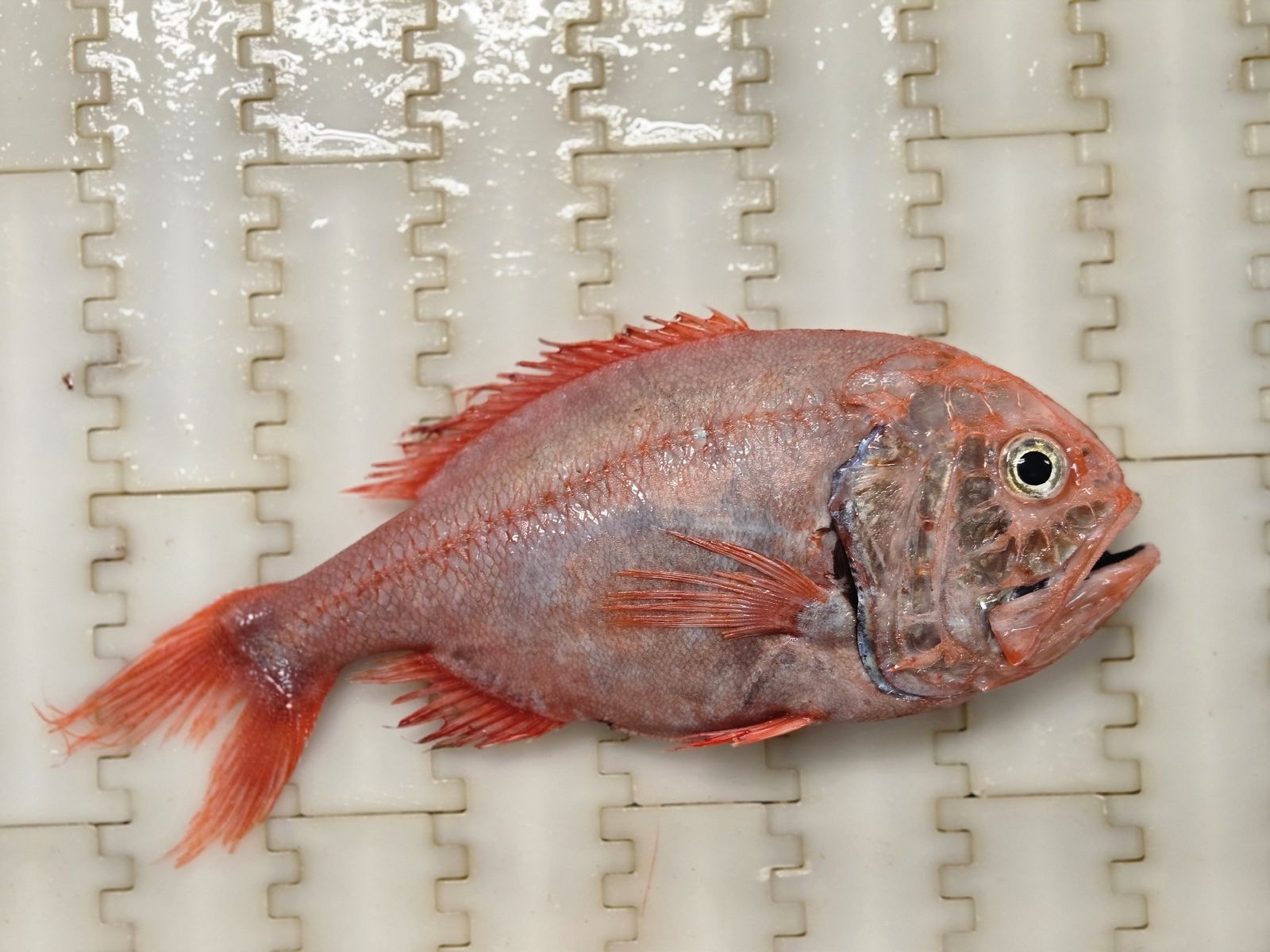
The orange roughy (Hoplostethus atlanticus), also known as the red roughy, slimehead and deep sea perch, is a relatively large deep-sea fish belonging to the slimehead family (Trachichthyidae).
- Kingdom
- Animalia
- Phylum
- Chordata
- Order
- Beryciformes
- Family
- Trachichthyidae
- Genus
- Hoplostethus
- Species
- Hoplostethus atlanticus
Description
The orange roughy (Hoplostethus atlanticus), also known as the red roughy, slimehead and deep sea perch, is a relatively large deep-sea fish belonging to the slimehead family (Trachichthyidae). It is bathypelagic, found in cold (3 to 9 °C or 37 to 48 °F), deep (180-to-1,800-metre or 590-to-5,910-foot) waters of the Western Pacific Ocean, eastern Atlantic Ocean (from Iceland to Morocco; and from Walvis Bay, Namibia, to off Durban, South Africa), Indo-Pacific (off New Zealand and Australia), and in the eastern Pacific off Chile. The orange roughy is notable for its extraordinary lifespan, attaining over 200 years. The fish has a bright, brick red color, fading to a yellowish-orange after death. Like other slimeheads, orange roughy is slow-growing and late to mature, resulting in a very low stock resilience, making them extremely susceptible to overfishing. Despite this, the species is important to commercial deep-trawl fisheries; many stocks (especially those off New Zealand and Australia, which were first exploited in the late 1970s) became severely depleted within 3–20 years, but several have subsequently recovered to levels that fisheries management believe are sustainable, although substantially below unfished populations. The UK Marine Conservation Society has categorized orange roughy as "vulnerable to exploitation".
En aquarium
Espèce d'eau de mer évoluant plutôt en pleine eau. Paramètres d'eau relevés dans son milieu : température de 3 à 9 °C. Sur le plan biologique, elle atteint jusqu'à 75 cm, vit jusqu'à 149 ans, son régime est piscivore.
Paramètres relevés dans le milieu naturel de l’espèce (données scientifiques FishBase). À adapter aux besoins précis de l’espèce en captivité.
Gallery
Ajouter des photos
Partagez vos photos de cette espèce (jusqu'à 20 à la fois) : elles sont vérifiées automatiquement, puis publiées.
Répartition
Occurrences observées (données GBIF). Les zones hors aire d'origine peuvent indiquer une présence introduite ou invasive.
Sources et crédits
Informations provenant de plusieurs sources vérifiées. Dernière mise à jour : .
Crédits photos (4)
- Photo : wolbaumc · CC BY-NC 4.0 · via GBIF
- Photo : Jean-François Rousseau · CC BY-NC 4.0 · via GBIF
- Photo : Gonzalo Mucientes Sandoval · CC BY-NC 4.0 · via GBIF
- Photo : Ken Graham · CC BY-NC 4.0 · via GBIF
Mentions de licence
Texte disponible sous licence CC BY-SA 4.0. Il adapte notamment Wikipedia (CC BY-SA) : Orange roughy (Wikipédia, auteurs dans l’historique de l’article).
- Taxonomie : GBIF Backbone Taxonomy (CC BY 4.0)
- Carte : occurrences GBIF, fond © contributeurs OpenStreetMap (ODbL)
- Paramètres d'aquarium : FishBase (faits reformulés)
Détail : Sources et licences.
Discussion (0)
Aucun message pour l’instant. Lancez la discussion sur cette fiche (sources, précisions, débats éditoriaux).
Connectez-vous pour participer à la discussion.