
Queen Angelfish
Holacanthus ciliaris
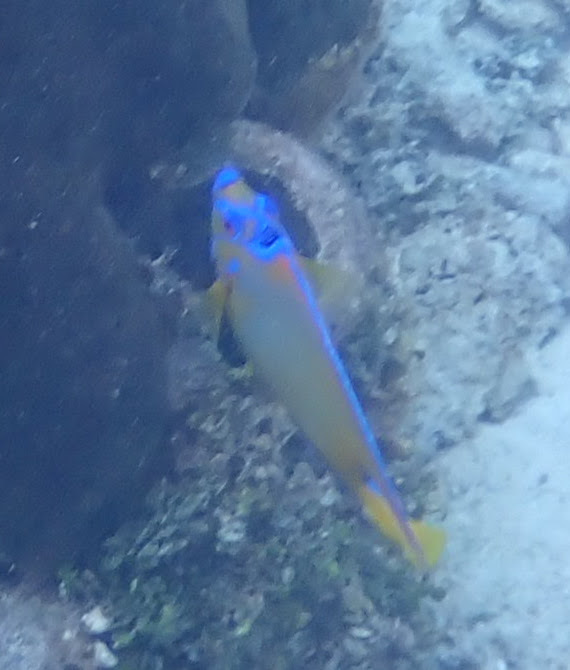
The queen angelfish (Holacanthus ciliaris), also known as the blue angelfish, golden angelfish, or yellow angelfish, is a species of marine angelfish found in the western Atlantic Ocean.
- Kingdom
- Animalia
- Phylum
- Chordata
- Order
- Perciformes
- Family
- Pomacanthidae
- Genus
- Holacanthus
- Species
- Holacanthus ciliaris
Description
The queen angelfish (Holacanthus ciliaris), also known as the blue angelfish, golden angelfish, or yellow angelfish, is a species of marine angelfish found in the western Atlantic Ocean. It is a benthic (ocean floor) warm-water species that lives in coral reefs. It is recognized by its blue and yellow coloration and a distinctive spot or "crown" on its forehead. This crown distinguishes it from the closely related and similar-looking Bermuda blue angelfish (Holacanthus bermudensis), with which it overlaps in range and can interbreed. Adult queen angelfish are selective feeders and primarily eat sponges. Their social structure consists of harems which include one male and up to four females. They live within a territory where the females forage separately and are tended to by the male. Breeding in the species occurs near a full moon. The transparent eggs float in the water until they hatch. Juveniles of the species have different coloration than adults and act as cleaner fish. The queen angelfish is popular in the aquarium trade and has been a particularly common exported species from Brazil. In 2010, the queen angelfish was assessed as least concern by the International Union for Conservation of Nature as the wild population appeared to be stable.
En aquarium
Espèce d'eau de mer évoluant plutôt autour des récifs. Sur le plan biologique, elle atteint jusqu'à 45 cm, son régime est carnivore.
Paramètres relevés dans le milieu naturel de l’espèce (données scientifiques FishBase ; voir aussi la fiche Fishipedia). À adapter aux besoins précis de l’espèce en captivité.
Gallery
Ajouter des photos
Partagez vos photos de cette espèce (jusqu'à 20 à la fois) : elles sont vérifiées automatiquement, puis publiées.
Répartition
Occurrences observées (données GBIF). Les zones hors aire d'origine peuvent indiquer une présence introduite ou invasive.
Sources et crédits
Informations provenant de plusieurs sources vérifiées. Dernière mise à jour : .
Crédits photos (6)
- Photo : Ben Zerante · CC BY-NC 4.0 · via GBIF
- Photo : Leigh Dyment (@leigh_dyment) · CC BY-NC 4.0 · via iNaturalist
- Photo : Jason Headley (@jasonheadley) · CC BY-NC 4.0 · via iNaturalist
- Photo : Floyd E. Hayes (@floydehayes) · CC BY-NC 4.0 · via iNaturalist
- Photo : Austin Bow (@adwodarkfly) · CC BY-NC 4.0 · via iNaturalist
- Photo : Al O'Donnell (@gampo) · CC BY-NC 4.0 · via iNaturalist
Mentions de licence
Texte disponible sous licence CC BY-SA 4.0. Il adapte notamment Wikipedia (CC BY-SA) : Queen angelfish (Wikipédia, auteurs dans l’historique de l’article).
- Taxonomie : GBIF Backbone Taxonomy (CC BY 4.0)
- Carte : occurrences GBIF, fond © contributeurs OpenStreetMap (ODbL)
- Statut de conservation : Liste rouge de l'UICN, via Wikidata (CC0)
- Paramètres d'aquarium : FishBase (faits reformulés)
Détail : Sources et licences.
Discussion (0)
Aucun message pour l’instant. Lancez la discussion sur cette fiche (sources, précisions, débats éditoriaux).
Connectez-vous pour participer à la discussion.