
Spotted Moray
Gymnothorax moringa
The spotted moray (Gymnothorax moringa) is a medium to large moray eel.
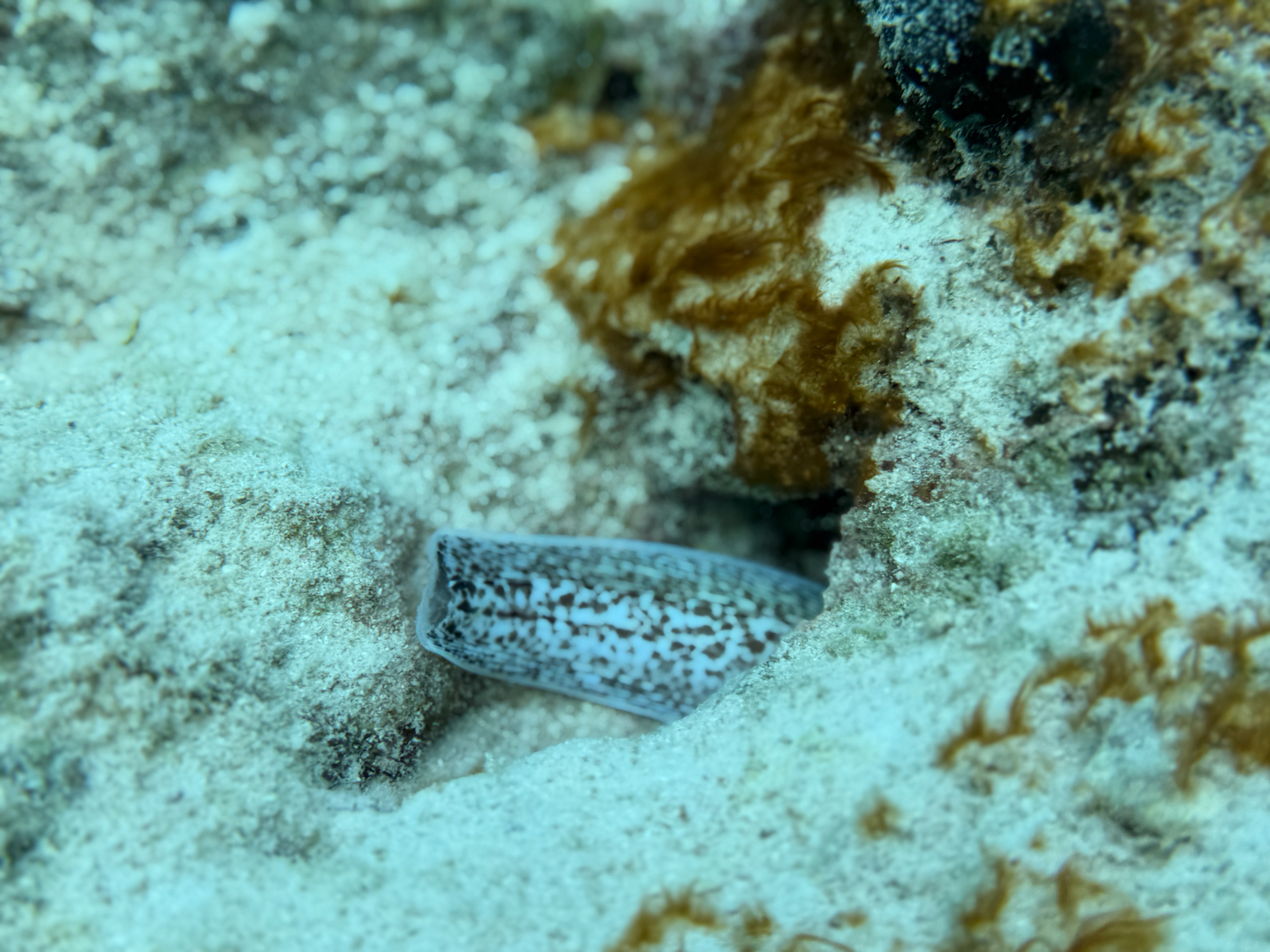
- Kingdom
- Animalia
- Phylum
- Chordata
- Order
- Anguilliformes
- Family
- Muraenidae
- Genus
- Gymnothorax
- Species
- Gymnothorax moringa
Description
The spotted moray (Gymnothorax moringa) is a medium to large moray eel. Other common names include conger, spotted eel, red moray, speckled moray, white cong, white jawed moray, white-chinned moray and white-jawed moray eel. Spotted eels have a long snake-like body, white or pale yellow in general with small overlapping reddish brown to dark-brown spots. They are commonly 60 cm (24 in) in length and can grow up to 2 m (6.6 ft), weighing 2.51 kg (5.5 lb). They inhabit the Western Atlantic Ocean from North Carolina and Bermuda to Brazil, including the Gulf of Mexico and the Caribbean. They are also found around the Mid- and Eastern Atlantic islands as far south as St Helena. They are typically found anywhere from the surface to a depth of 200 m (660 ft). Spotted morays are solitary animals, and usually hide in narrow crevices and holes in reef structures with only their heads peeking out. They are active during the day, feeding on crustaceans, molluscs and fish at or near the sea bottom. Their bite can be dangerous to humans due to damage caused by the pull-back effect of the bite itself, and potential toxins that may be released into the wound. There is a minor fishery for spotted eels, and they are also kept in aquariums until their size makes it impractical to do so.
En aquarium
Espèce d'eau de mer évoluant plutôt autour des récifs. Sur le plan biologique, elle atteint jusqu'à 200 cm, son régime est piscivore.
Paramètres relevés dans le milieu naturel de l’espèce (données scientifiques FishBase). À adapter aux besoins précis de l’espèce en captivité.
Gallery
Ajouter des photos
Partagez vos photos de cette espèce (jusqu'à 20 à la fois) : elles sont vérifiées automatiquement, puis publiées.
Répartition
Occurrences observées (données GBIF). Les zones hors aire d'origine peuvent indiquer une présence introduite ou invasive.
Sources et crédits
Informations provenant de plusieurs sources vérifiées. Dernière mise à jour : .
Crédits photos (5)
- Photo : Taylor Justason · CC BY-NC 4.0 · via GBIF
- Photo : Garrett (@gparks) · CC BY-NC 4.0 · via iNaturalist
- Photo : patrick van thull (@pvanthull) · CC BY-NC 4.0 · via iNaturalist
- Photo : Xochitl Castaño (@laxoch) · CC BY 4.0 · via iNaturalist
- Photo : SiphonophoreSlinger (@siphonophoreslinger) · CC BY 4.0 · via iNaturalist
Mentions de licence
Texte disponible sous licence CC BY-SA 4.0. Il adapte notamment Wikipedia (CC BY-SA) : Spotted moray (Wikipédia, auteurs dans l’historique de l’article).
- Taxonomie : GBIF Backbone Taxonomy (CC BY 4.0)
- Carte : occurrences GBIF, fond © contributeurs OpenStreetMap (ODbL)
- Statut de conservation : Liste rouge de l'UICN, via Wikidata (CC0)
- Paramètres d'aquarium : FishBase (faits reformulés)
Détail : Sources et licences.
Discussion (0)
Aucun message pour l’instant. Lancez la discussion sur cette fiche (sources, précisions, débats éditoriaux).
Connectez-vous pour participer à la discussion.