
Aba
Gymnarchus niloticus
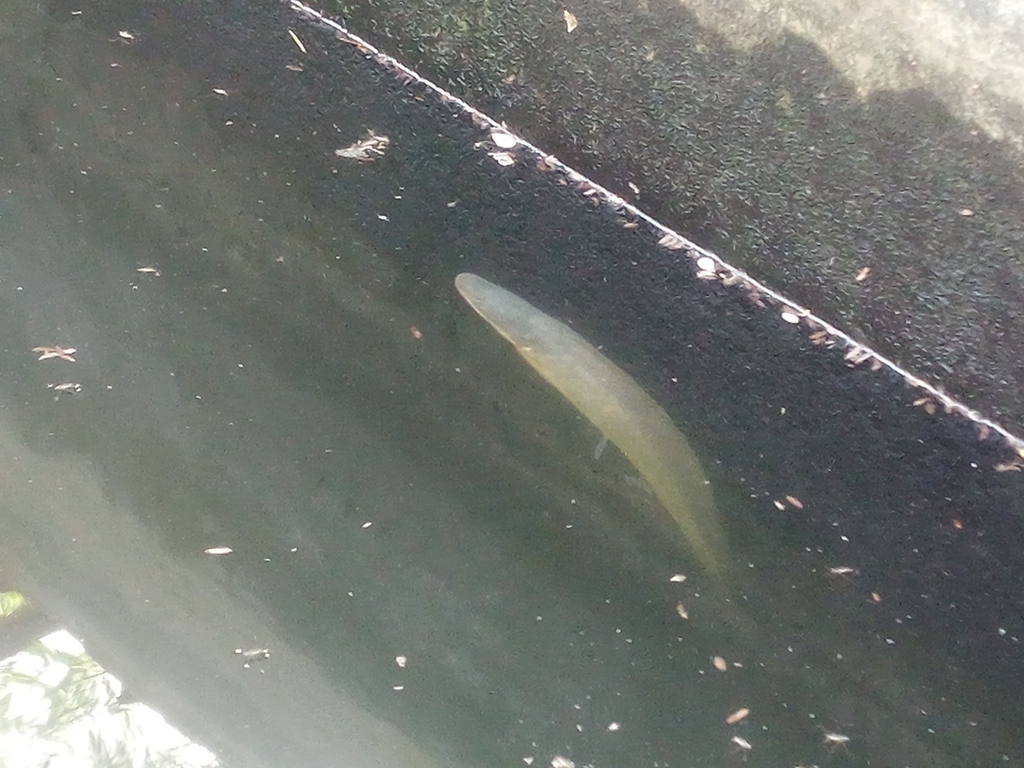
Gymnarchus niloticus – the aba, aba aba or frankfish – is an electric fish, living at the bottoms of rivers and lakes.
- Kingdom
- Animalia
- Phylum
- Chordata
- Order
- Osteoglossiformes
- Family
- Gymnarchidae
- Genus
- Gymnarchus
- Species
- Gymnarchus niloticus
Description
Gymnarchus niloticus – the aba, aba aba or frankfish – is an electric fish, living at the bottoms of rivers and lakes. It is the only species in the genus Gymnarchus and the family Gymnarchidae, within the order Osteoglossiformes. It is a long slender fish with no pelvic or anal fins, and a tail fin shaped like a rat's tail. It swims using its elongated dorsal fin, allowing it to keep its body straight while it moves. This in turn enables it to produce a steady but weak electric field, which it uses to locate its prey. It is large for a river fish; adults can reach 1.6 m (5.2 ft) in length and 19 kg (42 lb) in weight. In 1950, Hans Lissmann noticed that the fish could swim equally well forwards or backwards, clearly relying on a sense other than vision. He demonstrated that it could locate prey by electroreception, making it the first fish known to have this ability. The fish is considered good to eat in West Africa, where it has a wide but scattered distribution. It is important culturally, as it is given as a gift in community celebrations and marriages. Globally, its conservation status is 'least concern' but it faces local threats in West Africa from human activities including overfishing and pollution.
En aquarium
Espèce d'eau douce évoluant plutôt près du fond. Paramètres d'eau relevés dans son milieu : température de 23 à 28 °C, pH de 6,5 à 8, dureté de 10 à 25 °dGH. Sur le plan biologique, elle atteint jusqu'à 167 cm, son régime est piscivore.
Paramètres relevés dans le milieu naturel de l’espèce (données scientifiques FishBase). À adapter aux besoins précis de l’espèce en captivité.
Ajouter des photos
Partagez vos photos de cette espèce (jusqu'à 20 à la fois) : elles sont vérifiées automatiquement, puis publiées.
Répartition
Occurrences observées (données GBIF). Les zones hors aire d'origine peuvent indiquer une présence introduite ou invasive.
Sources et crédits
Informations provenant de plusieurs sources vérifiées. Dernière mise à jour : .
Crédits photos (1)
- Photo : AMADOU BAHLEMAN FARID (@bahleman) · CC BY-NC 4.0 · via iNaturalist
Mentions de licence
Texte disponible sous licence CC BY-SA 4.0. Il adapte notamment Wikipedia (CC BY-SA) : Gymnarchus niloticus (Wikipédia, auteurs dans l’historique de l’article).
- Taxonomie : GBIF Backbone Taxonomy (CC BY 4.0)
- Carte : occurrences GBIF, fond © contributeurs OpenStreetMap (ODbL)
- Statut de conservation : Liste rouge de l'UICN, via Wikidata (CC0)
- Paramètres d'aquarium : FishBase (faits reformulés)
Détail : Sources et licences.
Discussion (0)
Aucun message pour l’instant. Lancez la discussion sur cette fiche (sources, précisions, débats éditoriaux).
Connectez-vous pour participer à la discussion.