
Western Mosquitofish
Gambusia affinis
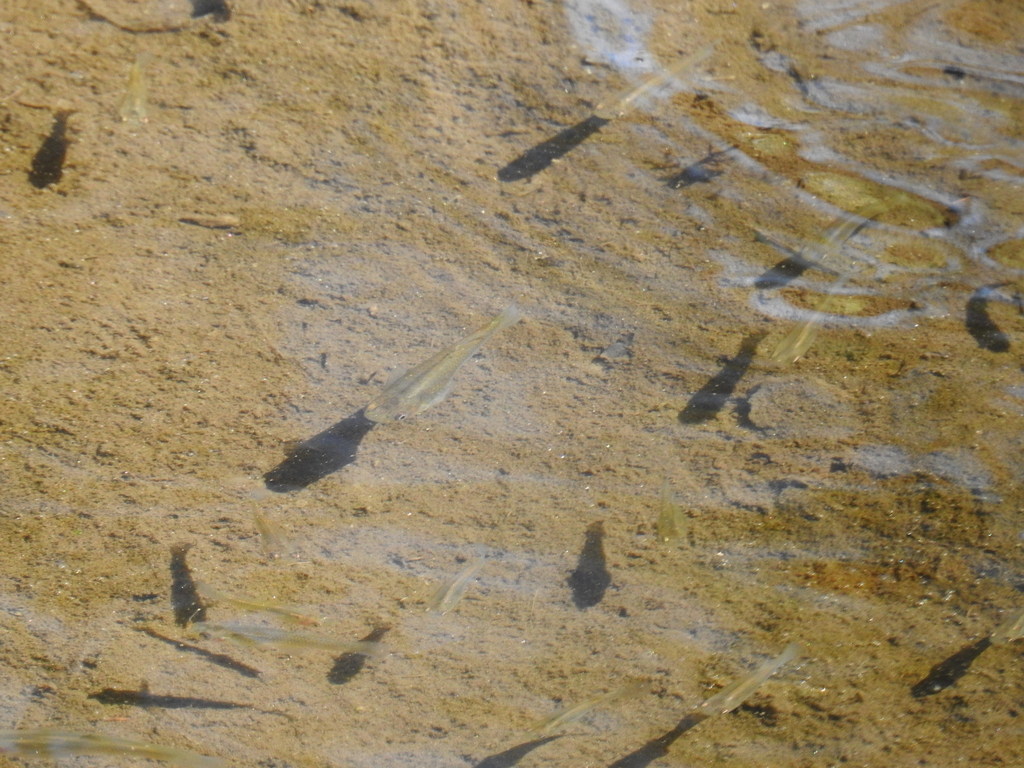
The western mosquitofish (Gambusia affinis) is a North American freshwater poeciliid fish, also known commonly, if ambiguously, as simply mosquitofish or by its generic name, Gambusia, or by the common name gambezi.
- Kingdom
- Animalia
- Phylum
- Chordata
- Order
- Cyprinodontiformes
- Family
- Poeciliidae
- Genus
- Gambusia
- Species
- Gambusia affinis
Description
The western mosquitofish (Gambusia affinis) is a North American freshwater poeciliid fish, also known commonly, if ambiguously, as simply mosquitofish or by its generic name, Gambusia, or by the common name gambezi. Its sister species, the eastern mosquitofish (Gambusia holbrooki) is also referred to by these names. Mosquitofish are small in comparison to many other freshwater fish, with females reaching a maximum length of 7 cm (2.8 in) and males a maximum length of 4 cm (1.6 in). The female can be distinguished from the male by her larger size and a gravid spot at the posterior of her abdomen. The name "mosquitofish" was given because the fish eats mosquito larvae, and has been used more than any other fishes for the biological control of mosquitoes. Gambusia typically eat zooplankton, beetles, mayflies, caddisflies, mites, and other invertebrates; mosquito larvae make up only a small portion of their diet. Mosquitofish were introduced directly into ecosystems in many parts of the world as a biocontrol to lower mosquito populations which in turn negatively affected many other species in each distinct bioregion. Mosquitofish in Australia are classified as a noxious pest and may have exacerbated the mosquito problem in many areas by outcompeting native invertebrate predators of mosquito larvae. Several counties in California distribute mosquitofish at no charge to residents with human-made fish ponds and pools as part of their mosquito abatement programs. The fish are made available to residents only and are intended to be used solely on their own property, not introduced into natural habitat. On 24 February 2014, Chennai Corporation in India introduced western mosquitofish in 660 ponds to control the mosquito population in freshwater bodies. Fertilization is internal; the male secretes milt into the genital aperture of the female through his gonopodium. Within 16 to 28 days after mating, the female gives birth to about 60 young. The males reach sexual maturity within 43 to 62 days. The females, if born early in the reproductive season, reach sexual maturity within 21 to 28 days; females born later in the season reach sexual maturity the next season, in six to seven months.
En aquarium
Espèce d'eau douce et saumâtre évoluant plutôt en pleine eau. Paramètres d'eau relevés dans son milieu : température de 12 à 29 °C, pH de 6 à 8, dureté de 5 à 19 °dGH. Sur le plan biologique, elle atteint jusqu'à 5,1 cm, vit jusqu'à 3 ans, son régime est carnivore.
Paramètres relevés dans le milieu naturel de l’espèce (données scientifiques FishBase). À adapter aux besoins précis de l’espèce en captivité.
Gallery
Ajouter des photos
Partagez vos photos de cette espèce (jusqu'à 20 à la fois) : elles sont vérifiées automatiquement, puis publiées.
Répartition
Occurrences observées (données GBIF). Les zones hors aire d'origine peuvent indiquer une présence introduite ou invasive.
Sources et crédits
Informations provenant de plusieurs sources vérifiées. Dernière mise à jour : .
Crédits photos (2)
- Photo : Rachel Stringham (@restringham) · CC BY 4.0 · via iNaturalist
- Photo : @uuuuuuuuuuuuuuu · CC BY-NC 4.0 · via iNaturalist
Mentions de licence
Texte disponible sous licence CC BY-SA 4.0. Il adapte notamment Wikipedia (CC BY-SA) : Mosquitofish (Wikipédia, auteurs dans l’historique de l’article).
- Taxonomie : GBIF Backbone Taxonomy (CC BY 4.0)
- Carte : occurrences GBIF, fond © contributeurs OpenStreetMap (ODbL)
- Statut de conservation : Liste rouge de l'UICN, via Wikidata (CC0)
- Paramètres d'aquarium : FishBase (faits reformulés)
Détail : Sources et licences.
Discussion (0)
Aucun message pour l’instant. Lancez la discussion sur cette fiche (sources, précisions, débats éditoriaux).
Connectez-vous pour participer à la discussion.