
Frilled shark
Chlamydoselachus anguineus
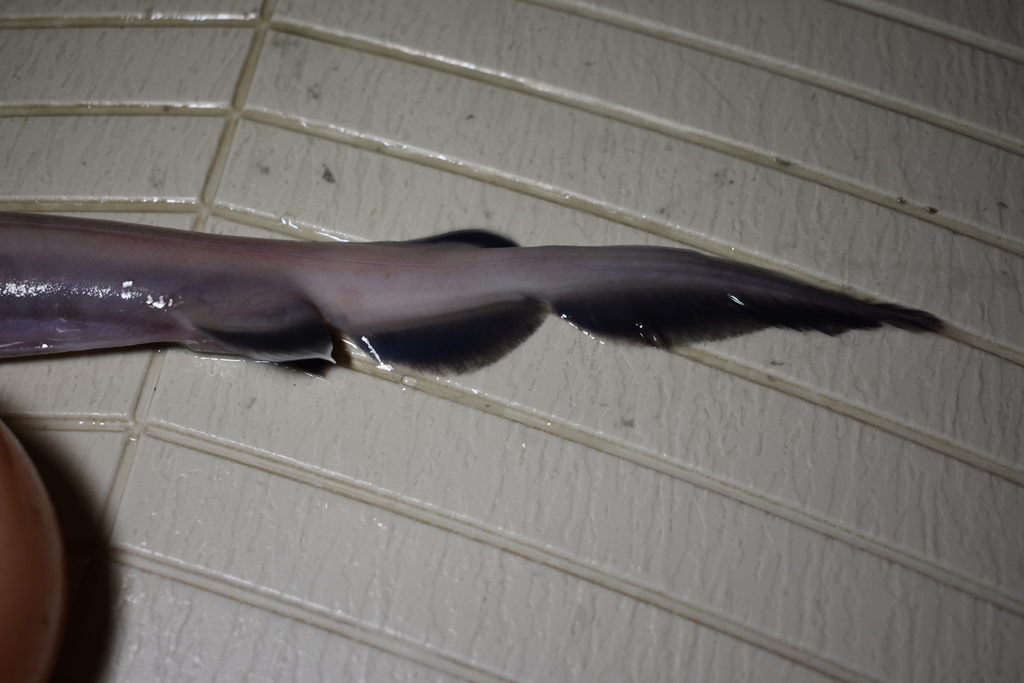
The frilled shark (Chlamydoselachus anguineus), also known as the lizard shark, is one of the two extant species of shark in the family Chlamydoselachidae (the other is the southern African frilled shark, Chlamydoselachus africana).
- Kingdom
- Animalia
- Phylum
- Chordata
- Class
- Elasmobranchii
- Order
- Hexanchiformes
- Family
- Chlamydoselachidae
- Genus
- Chlamydoselachus
- Species
- Chlamydoselachus anguineus
Description
The frilled shark (Chlamydoselachus anguineus), also known as the lizard shark, is one of the two extant species of shark in the family Chlamydoselachidae (the other is the southern African frilled shark, Chlamydoselachus africana). The frilled shark is considered a living fossil, because of its primitive, anguilliform (eel-like) physical traits, such as a dark-brown color, amphistyly (the articulation of the jaws to the cranium), and a 2.0 m (6.6 ft)–long body, which has dorsal, pelvic, and anal fins located towards the tail. The common name, frilled shark, derives from the fringed appearance of the six pairs of gill slits at the shark's throat. The two species of frilled shark are distributed throughout regions of the Atlantic and the Pacific oceans, usually in the waters of the outer continental shelf and of the upper continental slope, where the sharks usually live near the ocean floor, near biologically productive areas of the ecosystem. To live on a diet of cephalopods, smaller sharks, and bony fish, the frilled shark practices diel vertical migration to feed at night at the surface of the ocean. When hunting food, the frilled shark curls its tail against a rock and moves like an eel, bending and lunging to capture and swallow whole prey with its long and flexible jaws, which are equipped with 300 recurved, needle-like teeth. Reproductively, the two species of frilled shark, C. anguineus and C. africana, are aplacental viviparous animals, born of an egg, without a placenta to the mother shark. Contained within egg capsules, the shark embryos develop in the body of the mother shark; at birth, the infant sharks emerge from their egg capsules in the uterus, where they feed on yolk. Although it has no distinct breeding season, the gestation period of the frilled shark can be up to 3.5 years long, to produce a litter of 2–15 shark pups. Usually caught as bycatch in commercial fishing, the frilled shark has some economic value as a meat and as fishmeal; and has been caught from depths of 1,570 m (5,150 ft), although its occurrence is uncommon below 1,200 m (3,900 ft); whereas in Suruga Bay, Japan, the frilled shark commonly occurs at depths of 50–200 m (160–660 ft).
En aquarium
Espèce d'eau de mer évoluant plutôt en pleine eau. Sur le plan biologique, elle atteint jusqu'à 200 cm, son régime est piscivore.
Paramètres relevés dans le milieu naturel de l’espèce (données scientifiques FishBase). À adapter aux besoins précis de l’espèce en captivité.
Ajouter des photos
Partagez vos photos de cette espèce (jusqu'à 20 à la fois) : elles sont vérifiées automatiquement, puis publiées.
Répartition
Occurrences observées (données GBIF). Les zones hors aire d'origine peuvent indiquer une présence introduite ou invasive.
Sources et crédits
Informations provenant de plusieurs sources vérifiées. Dernière mise à jour : .
Crédits photos (1)
- Photo : ゆり魔王 (@yurimaoh) · CC BY-NC 4.0 · via iNaturalist
Mentions de licence
Texte disponible sous licence CC BY-SA 4.0. Il adapte notamment Wikipedia (CC BY-SA) : Frilled shark (Wikipédia, auteurs dans l’historique de l’article).
- Taxonomie : GBIF Backbone Taxonomy (CC BY 4.0)
- Carte : occurrences GBIF, fond © contributeurs OpenStreetMap (ODbL)
- Statut de conservation : Liste rouge de l'UICN, via Wikidata (CC0)
- Paramètres d'aquarium : FishBase (faits reformulés)
Détail : Sources et licences.
Discussion (0)
Aucun message pour l’instant. Lancez la discussion sur cette fiche (sources, précisions, débats éditoriaux).
Connectez-vous pour participer à la discussion.