
Portuguese Dogfish
Centroscymnus coelolepis
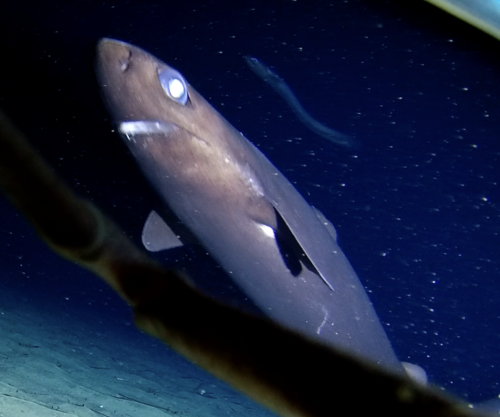
The Portuguese dogfish (Centroscymnus coelolepis) or Portuguese shark, is a species of sleeper shark of the family Somniosidae.
- Kingdom
- Animalia
- Phylum
- Chordata
- Class
- Elasmobranchii
- Order
- Squaliformes
- Family
- Somniosidae
- Genus
- Centroscymnus
- Species
- Centroscymnus coelolepis
Description
The Portuguese dogfish (Centroscymnus coelolepis) or Portuguese shark, is a species of sleeper shark of the family Somniosidae. This globally distributed species has been reported down to a depth of 3,675 m (12,057 ft), making it the deepest-living shark known. It inhabits lower continental slopes and abyssal plains, usually staying near the bottom. Stocky and dark brown in color, the Portuguese dogfish can be distinguished from similar-looking species (such as the kitefin shark, Dalatias licha) by the small spines in front of its dorsal fins. Its dermal denticles are also unusual, resembling the scales of a bony fish. This species typically reaches 0.9–1 m (3.0–3.3 ft) in length; sharks in the Mediterranean Sea are much smaller and have distinct depth and food preferences. Relatively common, the Portuguese dogfish is an active hunter capable of tackling fast, large prey. It feeds mainly on cephalopods and fishes, though it also consumes invertebrates and cetacean carrion. This shark has acute vision optimized for detecting the bioluminescence of its prey, as sunlight does not reach the depths at which it lives. The Portuguese dogfish is aplacental viviparous, with the young provisioned by yolk and perhaps uterine fluid. The females give birth to up to 29 young after a gestation period of over one year. Valued for its liver oil and to a lesser extent meat, Portuguese dogfish are important to deepwater commercial fisheries operating off Portugal, the British Isles, Japan, and Australia. These fishing pressures and the low reproductive rate of this species have led the International Union for Conservation of Nature (IUCN) to assess it as Near Threatened.
En aquarium
Espèce d'eau de mer évoluant plutôt en pleine eau. Paramètres d'eau relevés dans son milieu : température de 5 à 13 °C. Sur le plan biologique, elle atteint jusqu'à 121 cm, son régime est piscivore.
Paramètres relevés dans le milieu naturel de l’espèce (données scientifiques FishBase). À adapter aux besoins précis de l’espèce en captivité.
Gallery
Ajouter des photos
Partagez vos photos de cette espèce (jusqu'à 20 à la fois) : elles sont vérifiées automatiquement, puis publiées.
Répartition
Occurrences observées (données GBIF). Les zones hors aire d'origine peuvent indiquer une présence introduite ou invasive.
Sources et crédits
Informations provenant de plusieurs sources vérifiées. Dernière mise à jour : .
Crédits photos (2)
- Photo : (c) jgrimshaw, some rights reserved (CC BY-NC) · CC BY-NC 4.0 · via iNaturalist
- Photo : @jgrimshaw · CC BY-NC 4.0 · via iNaturalist
Mentions de licence
Texte disponible sous licence CC BY-SA 4.0. Il adapte notamment Wikipedia (CC BY-SA) : Portuguese dogfish (Wikipédia, auteurs dans l’historique de l’article).
- Taxonomie : GBIF Backbone Taxonomy (CC BY 4.0)
- Carte : occurrences GBIF, fond © contributeurs OpenStreetMap (ODbL)
- Statut de conservation : Liste rouge de l'UICN, via Wikidata (CC0)
- Paramètres d'aquarium : FishBase (faits reformulés)
Détail : Sources et licences.
Discussion (0)
Aucun message pour l’instant. Lancez la discussion sur cette fiche (sources, précisions, débats éditoriaux).
Connectez-vous pour participer à la discussion.