
Great White Shark
Carcharodon carcharias
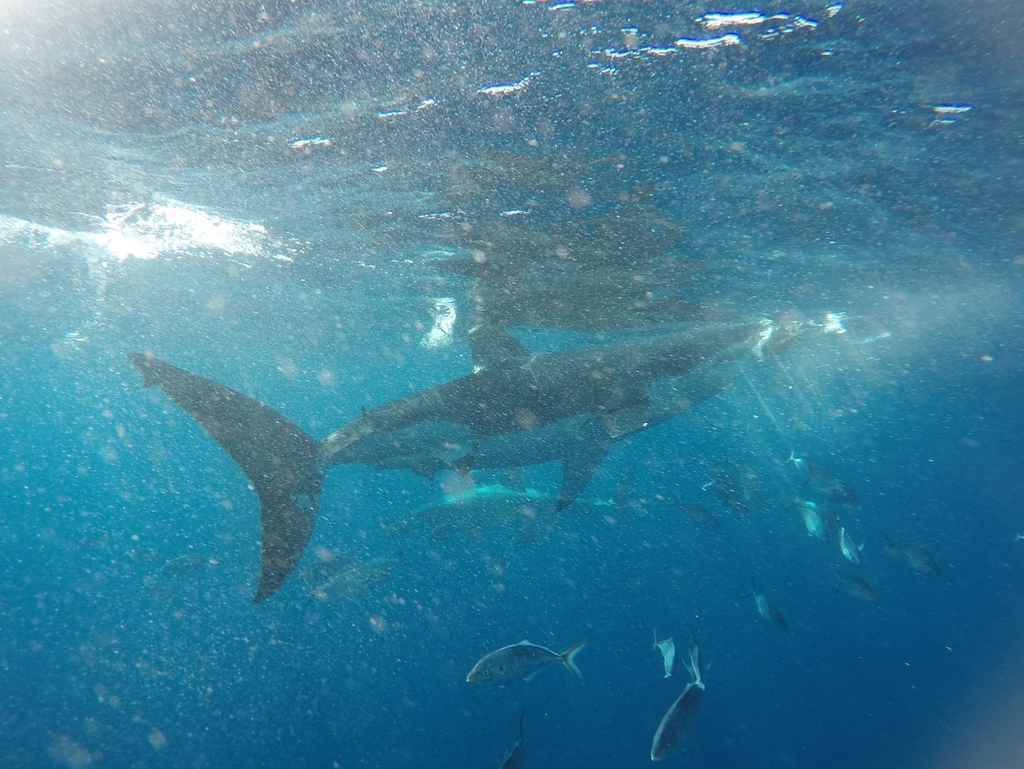
The great white shark (Carcharodon carcharias), also known as the white shark, white pointer, or great white, is a large shark.
- Kingdom
- Animalia
- Phylum
- Chordata
- Class
- Elasmobranchii
- Order
- Lamniformes
- Family
- Lamnidae
- Genus
- Carcharodon
- Species
- Carcharodon carcharias
Description
The great white shark (Carcharodon carcharias), also known as the white shark, white pointer, or great white, is a large shark. It is closely related to the mako sharks, the porbeagle, and the salmon shark. It is a robustly built species with a grayish upperside and a white underside. The white shark is one of the largest living shark and fish species, though it is still smaller than the whale shark and basking shark. It has about 300 triangular, serrated teeth that are continuously replaced. Its massive, fatty liver can reach over a quarter of its body weight, providing buoyancy and storing energy. The species is partially warm-blooded, an adaptation that allows it to remain active in colder waters. White sharks inhabit tropical and temperate ocean waters around the world and can be found both near coasts and in the open ocean. Populations are most concentrated at the Pacific and Atlantic of North America and in the waters of southern Africa and Oceania. They are a highly migratory species, traveling between the coast and the open ocean and even between continents. The white shark preys on marine mammals such as seals and dolphins, as well as squid and fish, including other sharks. It also scavenges whale carcasses. Though normally an apex predator, the species is sometimes preyed on by orcas. White sharks are generally solitary, but may gather in aggregations, particularly at feeding sites. They may communicate and establish dominance hierarchies with body language. The species reproduces with pups hatching from eggs inside the female before being born live. Juvenile white sharks typically inhabit shallower water and are limited to feeding on smaller prey. The white shark has a fearsome reputation among the public. It is featured in the 1974 novel Jaws and its 1975 film adaptation, both of which portray it as a ferocious man-eater. In reality, white sharks normally do not prey on humans, and the majority of bites are due to curiosity or possibly mistaken identity. Many attempts have been made to keep the species in captivity, but specimens either ended up dying or being released. White shark aggregations have attracted tourists who may view them from boats or from inside shark cages. The International Union for Conservation of Nature lists the white shark as a vulnerable species globally and critically endangered regionally in European and Mediterranean waters. Major threats have included accidental catching by commercial fisheries, recreational fishing, and entanglement in protective nets near beaches. Several governments have enacted protections for the species, including bans on catching and killing it.
En aquarium
Espèce d'saumâtre et eau de mer évoluant plutôt en pleine eau. Sur le plan biologique, elle atteint jusqu'à 640 cm, vit jusqu'à 36 ans, son régime est piscivore.
Paramètres relevés dans le milieu naturel de l’espèce (données scientifiques FishBase ; voir aussi la fiche Fishipedia). À adapter aux besoins précis de l’espèce en captivité.
Gallery
Ajouter des photos
Partagez vos photos de cette espèce (jusqu'à 20 à la fois) : elles sont vérifiées automatiquement, puis publiées.
Répartition
Occurrences observées (données GBIF). Les zones hors aire d'origine peuvent indiquer une présence introduite ou invasive.
Sources et crédits
Informations provenant de plusieurs sources vérifiées. Dernière mise à jour : .
Crédits photos (4)
- Photo : Justin Walker (@birdpackingadventures) · CC BY-NC 4.0 · via iNaturalist
- Photo : Joshua F (@quill_ocean) · CC BY-NC 4.0 · via iNaturalist
- Photo : Andrew Harmer (@noiselessowl) · CC BY-NC 4.0 · via iNaturalist
- Photo : James Maughn (@jmaughn) · CC BY-NC 4.0 · via iNaturalist
Mentions de licence
Texte disponible sous licence CC BY-SA 4.0. Il adapte notamment Wikipedia (CC BY-SA) : Great white shark (Wikipédia, auteurs dans l’historique de l’article).
- Taxonomie : GBIF Backbone Taxonomy (CC BY 4.0)
- Carte : occurrences GBIF, fond © contributeurs OpenStreetMap (ODbL)
- Statut de conservation : Liste rouge de l'UICN, via Wikidata (CC0)
- Paramètres d'aquarium : FishBase (faits reformulés)
Détail : Sources et licences.
Discussion (0)
Aucun message pour l’instant. Lancez la discussion sur cette fiche (sources, précisions, débats éditoriaux).
Connectez-vous pour participer à la discussion.