
Sand tiger shark
Carcharias taurus
The sand tiger shark (Carcharias taurus), also commonly known as the spotted ragged-tooth shark in South Africa, grey nurse shark in Australia, or blue-nurse sand tiger in India, is a species of shark that inhabits subtropical and…
- Kingdom
- Animalia
- Phylum
- Chordata
- Class
- Elasmobranchii
- Order
- Lamniformes
- Family
- Odontaspididae
- Genus
- Carcharias
- Species
- Carcharias taurus
Description
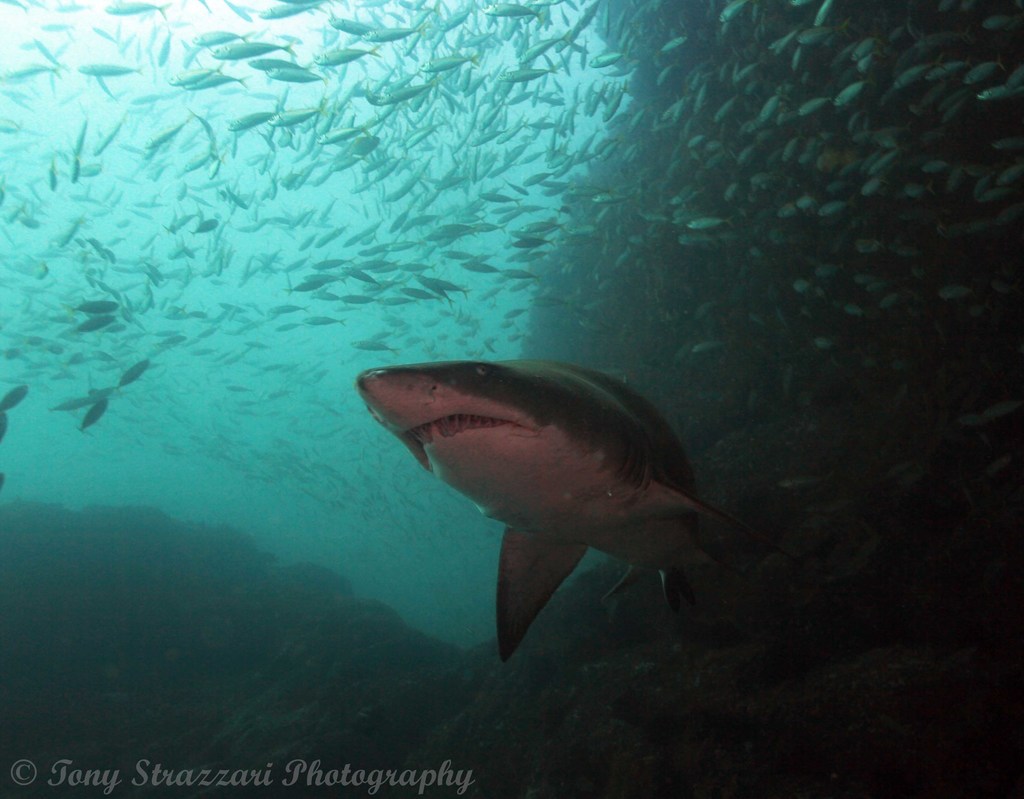
The sand tiger shark (Carcharias taurus), also commonly known as the spotted ragged-tooth shark in South Africa, grey nurse shark in Australia, or blue-nurse sand tiger in India, is a species of shark that inhabits subtropical and temperate waters worldwide. It inhabits the continental shelf, from sandy shorelines (hence the name sand tiger shark) and submerged reefs to a depth of around 191 m (627 ft). They dwell in the waters of Japan, Australia, South Africa, and the east coasts of North and South America. The sand tiger shark also inhabited the Mediterranean; however, it was last seen there in 2003 and is presumed extirpated. Despite its common names, it is not closely related to either the tiger shark (Galeocerdo cuvier) or the nurse shark (Ginglymostoma cirratum). Despite its fearsome appearance and strong swimming ability, it is a relatively placid and slow-moving shark with no confirmed human fatalities. This species has a sharp, pointy head, and a bulky body. The sand tiger's length can reach 3.2 m (10.5 ft) but is normally 2.2–2.5 m in length. They are grey with reddish-brown spots on their backs. Shivers (groups) have been observed to hunt large schools of fish. Their diet consists of bony fish, crustaceans, squid, skates and other sharks. Unlike other sharks, the sand tiger can gulp air from the surface, allowing it to be suspended in the water column with minimal effort. During pregnancy, the most developed embryo will feed on its siblings, a reproductive strategy known as intrauterine cannibalism i.e. "embryophagy" or, more colorfully, adelphophagy-literally "eating one's brother". The sand tiger is categorized as critically endangered on the International Union for Conservation of Nature Red List. It is the most widely kept large shark in public aquariums owing to its tolerance for captivity.
En aquarium
Espèce d'eau de mer évoluant plutôt autour des récifs. Sur le plan biologique, elle atteint jusqu'à 330 cm, son régime est piscivore.
Paramètres relevés dans le milieu naturel de l’espèce (données scientifiques FishBase ; voir aussi la fiche Fishipedia). À adapter aux besoins précis de l’espèce en captivité.
Gallery
Ajouter des photos
Partagez vos photos de cette espèce (jusqu'à 20 à la fois) : elles sont vérifiées automatiquement, puis publiées.
Répartition
Occurrences observées (données GBIF). Les zones hors aire d'origine peuvent indiquer une présence introduite ou invasive.
Sources et crédits
Informations provenant de plusieurs sources vérifiées. Dernière mise à jour : .
Crédits photos (6)
- Photo : Tony Strazzari (@tonydiver) · CC BY-NC 4.0 · via iNaturalist
- Photo : Robin Laws-Wall (@rlawswall) · CC BY-NC 4.0 · via iNaturalist
- Photo : Michal (@biniek-io) · CC BY-NC 4.0 · via iNaturalist
- Photo : @katewolny · CC BY-NC 4.0 · via iNaturalist
- Photo : @jutgr · CC BY-NC 4.0 · via iNaturalist
- Photo : Rafi Amar (@rafi1) · CC BY-NC 4.0 · via iNaturalist
Mentions de licence
Texte disponible sous licence CC BY-SA 4.0. Il adapte notamment Wikipedia (CC BY-SA) : Sand tiger shark (Wikipédia, auteurs dans l’historique de l’article).
- Taxonomie : GBIF Backbone Taxonomy (CC BY 4.0)
- Carte : occurrences GBIF, fond © contributeurs OpenStreetMap (ODbL)
- Statut de conservation : Liste rouge de l'UICN, via Wikidata (CC0)
- Paramètres d'aquarium : FishBase (faits reformulés)
Détail : Sources et licences.
Discussion (0)
Aucun message pour l’instant. Lancez la discussion sur cette fiche (sources, précisions, débats éditoriaux).
Connectez-vous pour participer à la discussion.