
Bull Shark
Carcharhinus leucas
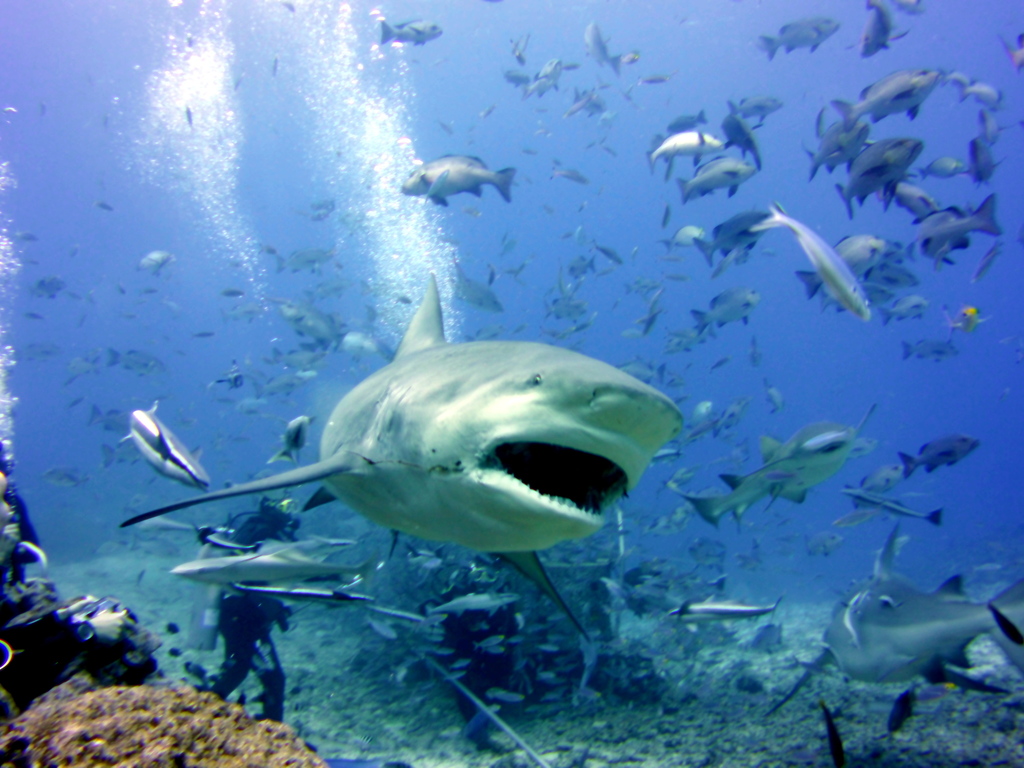
The bull shark (Carcharhinus leucas), also known as the Zambezi shark (informally zambi) in Africa and Lake Nicaragua shark in Nicaragua, is a species of requiem shark commonly found worldwide in warm, shallow waters along coasts and in…
- Kingdom
- Animalia
- Phylum
- Chordata
- Class
- Elasmobranchii
- Order
- Carcharhiniformes
- Family
- Carcharhinidae
- Genus
- Carcharhinus
- Species
- Carcharhinus leucas
Description
The bull shark (Carcharhinus leucas), also known as the Zambezi shark (informally zambi) in Africa and Lake Nicaragua shark in Nicaragua, is a species of requiem shark commonly found worldwide in warm, shallow waters along coasts and in rivers. It is known for its aggressive nature, and presence mainly in warm, shallow brackish and freshwater systems including estuaries and (usually) lower reaches of rivers. Their aggressive nature has led to ongoing shark-culling efforts near beaches to protect beachgoers, which is one of the causes of bull shark populations continuing to decrease. Bull sharks are listed as vulnerable on the IUCN Red List. Bull sharks are euryhaline and can thrive in both salt and fresh water. They are known to travel far up rivers, and have been known to travel up the Mississippi River as far as Alton, Illinois, about 1,100 kilometres (700 mi) from the ocean, but few freshwater interactions with humans have been recorded. Larger-sized bull sharks are responsible for a large part of nearshore shark attacks, and may be responsible for many attacks involving unidentified species. Unlike the river sharks of the genus Glyphis, bull sharks are not true freshwater sharks, despite their ability to survive in freshwater habitats. This shark appears in the image of the 2000 colones banknote from Costa Rica.
En aquarium
Espèce d'eau douce et saumâtre et eau de mer évoluant plutôt autour des récifs. Sur le plan biologique, elle atteint jusqu'à 360 cm, vit jusqu'à 32 ans, son régime est piscivore.
Paramètres relevés dans le milieu naturel de l’espèce (données scientifiques FishBase ; voir aussi la fiche Fishipedia). À adapter aux besoins précis de l’espèce en captivité.
Gallery
Ajouter des photos
Partagez vos photos de cette espèce (jusqu'à 20 à la fois) : elles sont vérifiées automatiquement, puis publiées.
Répartition
Occurrences observées (données GBIF). Les zones hors aire d'origine peuvent indiquer une présence introduite ou invasive.
Sources et crédits
Informations provenant de plusieurs sources vérifiées. Dernière mise à jour : .
Crédits photos (4)
- Photo : Jack Crosbie (@ecosse28) · CC BY-NC 4.0 · via iNaturalist
- Photo : Samuel Taylor (@dinofish99) · CC BY-NC 4.0 · via iNaturalist
- Photo : Bill Levine (@blevine) · CC BY 4.0 · via iNaturalist
- Photo : Bridgette Gower (@bridgetteaussiemacro) · CC BY-NC 4.0 · via iNaturalist
Mentions de licence
Texte disponible sous licence CC BY-SA 4.0. Il adapte notamment Wikipedia (CC BY-SA) : Bull shark (Wikipédia, auteurs dans l’historique de l’article).
- Taxonomie : GBIF Backbone Taxonomy (CC BY 4.0)
- Carte : occurrences GBIF, fond © contributeurs OpenStreetMap (ODbL)
- Statut de conservation : Liste rouge de l'UICN, via Wikidata (CC0)
- Paramètres d'aquarium : FishBase (faits reformulés)
Détail : Sources et licences.
Discussion (0)
Aucun message pour l’instant. Lancez la discussion sur cette fiche (sources, précisions, débats éditoriaux).
Connectez-vous pour participer à la discussion.