
Bluefin trevally
Caranx melampygus
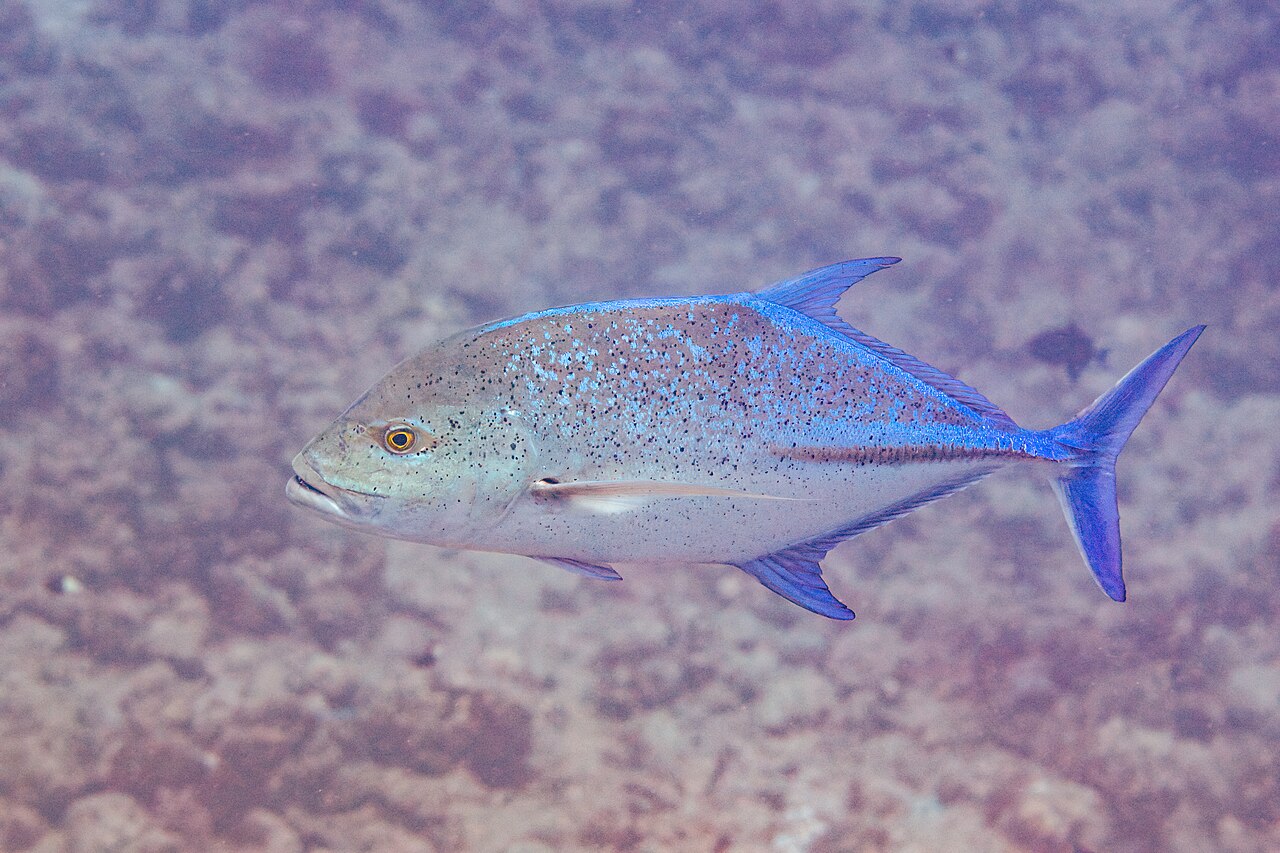
The bluefin trevally (Caranx melampygus), also known as the bluefin jack, bluefin kingfish, bluefinned crevalle, blue ulua, omilu, and spotted trevally, is a species of large, widely distributed marine fish classified in the jack…
- Kingdom
- Animalia
- Phylum
- Chordata
- Order
- Perciformes
- Family
- Carangidae
- Genus
- Caranx
- Species
- Caranx melampygus
Description
The bluefin trevally (Caranx melampygus), also known as the bluefin jack, bluefin kingfish, bluefinned crevalle, blue ulua, omilu, and spotted trevally, is a species of large, widely distributed marine fish classified in the jack family, Carangidae. The bluefin trevally is distributed throughout the tropical waters of the Indian and Pacific Oceans, ranging from Eastern Africa in the west to Central America in the east, including Japan in the north and Australia in the south. The species grows to a maximum known length of 117 centimetres (46 in) and a weight of 43.5 kilograms (96 lb), however is rare above 80 centimetres (31 in). Bluefin trevally are easily recognised by their electric blue fins, tapered snout and numerous blue and black spots on their sides. Juveniles lack these obvious colours, and must be identified by more detailed anatomical features such as fin ray and scute counts. The bluefin trevally inhabits both inshore environments such as bays, lagoons and shallow reefs, as well as deeper offshore reefs, atolls and bomboras. Juveniles prefer shallower, protected waters, even entering estuaries for short periods in some locations. The bluefin trevally is a strong predatory fish, with a diet dominated by fish and supplemented by cephalopods and crustaceans as an adult. Juveniles consume a higher amount of small crustaceans, but transfer to a more fish based diet as they grow. The species displays a wide array of hunting techniques ranging from aggressive midwater attacks, reef ambushes and foraging interactions with other larger species, snapping up any prey items missed by the larger animal. The bluefin trevally reproduces at different periods throughout its range, and reaches sexual maturity at 30–40 cm in length and around 2 years of age. It is a multiple spawner, capable of reproducing up to 8 times per year, releasing up to 6 million eggs per year in captivity. Growth is well studied, with the fish reaching 194 mm in its first year, 340 mm in the second and 456 mm in the third year. The bluefin trevally is a popular target for both commercial and recreational fishermen. Commercial fisheries record up to 50 tonnes of the species taken per year in the west Indian Ocean, and around 700 lbs per year in Hawaii. The rapid decimation of the Hawaiian population due to overfishing has led to increased research in the aquaculture potential of the species, with spawning achieved in captivity. Despite its popularity as a table fish, many cases of ciguatera poisoning have been reported from the species.
En aquarium
Espèce d'saumâtre et eau de mer évoluant plutôt autour des récifs. Sur le plan biologique, elle atteint jusqu'à 117 cm, son régime est piscivore.
Paramètres relevés dans le milieu naturel de l’espèce (données scientifiques FishBase). À adapter aux besoins précis de l’espèce en captivité.
Gallery
Ajouter des photos
Partagez vos photos de cette espèce (jusqu'à 20 à la fois) : elles sont vérifiées automatiquement, puis publiées.
Répartition
Occurrences observées (données GBIF). Les zones hors aire d'origine peuvent indiquer une présence introduite ou invasive.
Sources et crédits
Informations provenant de plusieurs sources vérifiées. Dernière mise à jour : .
Crédits photos (5)
- Photo : Diego Delso · CC BY-SA 4.0
- Photo : Dubravka Skalamera (@duka_skalamera) · CC BY-NC 4.0 · via iNaturalist
- Photo : @keesgroenendijk · CC BY 4.0 · via iNaturalist
- Photo : Brittany Brockett (@brittbrockers) · CC BY-NC 4.0 · via iNaturalist
- Photo : ethan currens (@ethanec) · CC BY-NC 4.0 · via iNaturalist
Mentions de licence
Texte disponible sous licence CC BY-SA 4.0. Il adapte notamment Wikipedia (CC BY-SA) : Bluefin trevally (Wikipédia, auteurs dans l’historique de l’article).
- Taxonomie : GBIF Backbone Taxonomy (CC BY 4.0)
- Carte : occurrences GBIF, fond © contributeurs OpenStreetMap (ODbL)
- Statut de conservation : Liste rouge de l'UICN, via Wikidata (CC0)
- Paramètres d'aquarium : FishBase (faits reformulés)
Détail : Sources et licences.
Discussion (0)
Aucun message pour l’instant. Lancez la discussion sur cette fiche (sources, précisions, débats éditoriaux).
Connectez-vous pour participer à la discussion.