
Giant trevally
Caranx ignobilis
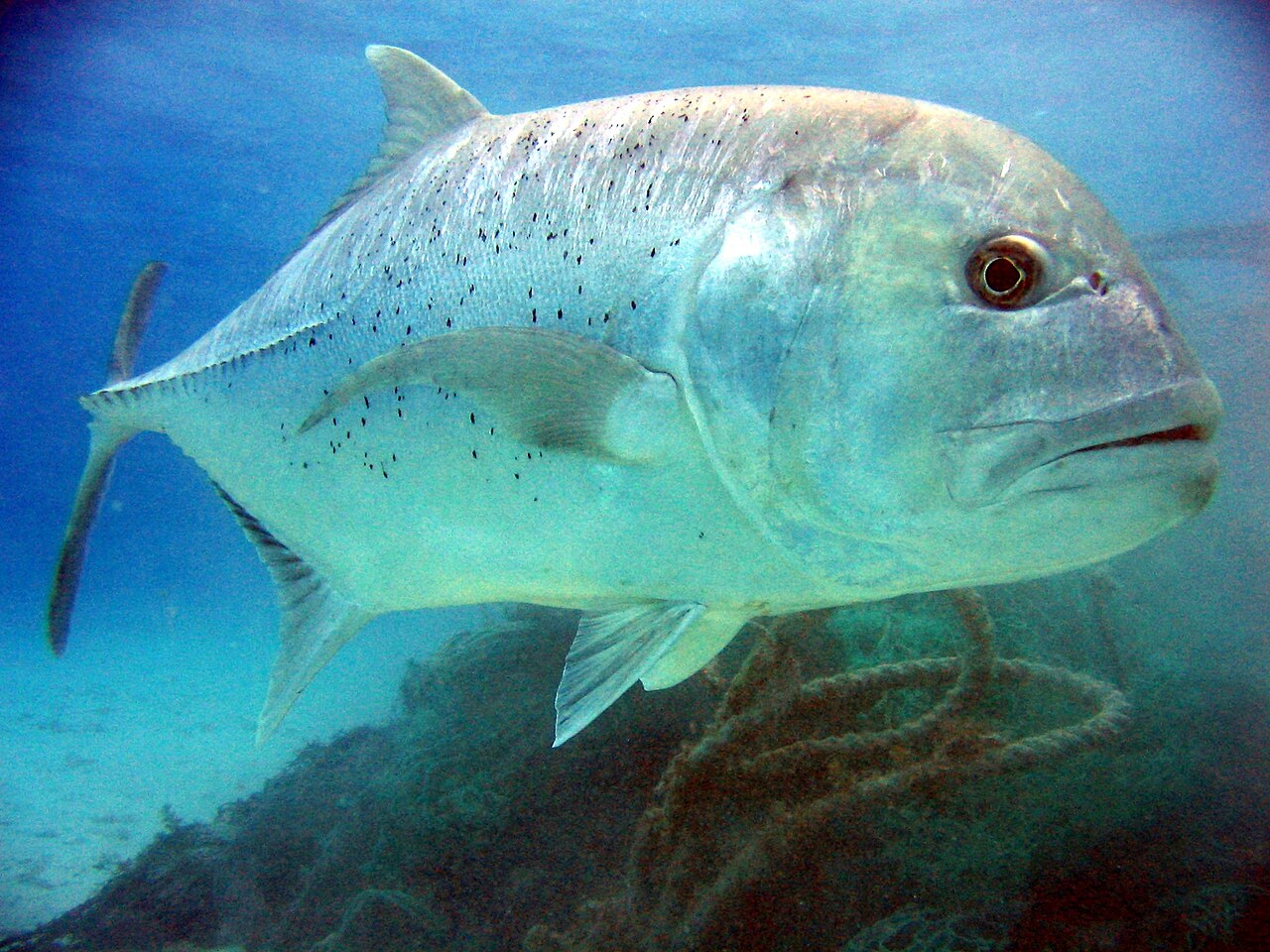
The giant trevally (Caranx ignobilis), also known as the lowly trevally, barrier trevally, giant kingfish, or ulua, is a species of large marine fish classified in the jack family, Carangidae.
- Kingdom
- Animalia
- Phylum
- Chordata
- Order
- Perciformes
- Family
- Carangidae
- Genus
- Caranx
- Species
- Caranx ignobilis
Description
The giant trevally (Caranx ignobilis), also known as the lowly trevally, barrier trevally, giant kingfish, or ulua, is a species of large marine fish classified in the jack family, Carangidae. The giant trevally is distributed throughout the tropical waters of the Indo-Pacific region, with a range stretching from South Africa to Hawaii, including Japan in the north and Australia in the south. The giant trevally is distinguished by its steep head profile, strong tail scutes, and a variety of other more detailed anatomical features. It is normally a silvery colour with occasional dark spots, but males may be black once they mature. It is the largest fish in the genus Caranx, growing to a maximum known size of 170 cm (67 in) and a weight of 80 kg (176 lb). The giant trevally inhabits a wide range of marine environments, from estuaries, shallow bays, and lagoons as a juvenile to deeper reefs, offshore atolls, and large embayments as an adult. Juveniles of the species are known to live in waters of very low salinity such as coastal lakes and upper reaches of rivers, and tend to prefer turbid waters. The giant trevally is an apex predator in most of its habitats, and is known to hunt individually and in schools. The species predominantly takes various fish as prey, although crustaceans, cephalopods, and molluscs make up a considerable part of their diets in some regions. Their novel hunting strategies include shadowing monk seals to pick off escaping prey, using sharks to ambush prey, and leaping to catch birds. The giant trevally reproduces in the warmer months, with peaks differing by region. Spawning occurs at specific stages of the lunar cycle, when large schools congregate to spawn over reefs and bays, with reproductive behaviour observed in the wild. The fish grow relatively fast, reaching sexual maturity at a length around 60 cm at three years of age. The giant trevally is both an important species to commercial fisheries and a recognised gamefish, with the species taken by nets and lines by professionals and by bait and lures by anglers. Catch statistics in the Asian region show hauls of 4,000–10,000 tonnes, while around 10,000 lb of the species are taken in Hawaii each year. The species is considered poor to excellent table fare by different authors, although ciguatera poisoning is common from eating the fish. Dwindling numbers around the main Hawaiian Islands have also led to several proposals to reduce the catch of fish in this region.
En aquarium
Espèce d'saumâtre et eau de mer évoluant plutôt autour des récifs. Paramètres d'eau relevés dans son milieu : température de 26 à 29 °C. Sur le plan biologique, elle atteint jusqu'à 170 cm, son régime est piscivore.
Paramètres relevés dans le milieu naturel de l’espèce (données scientifiques FishBase ; voir aussi la fiche Fishipedia). À adapter aux besoins précis de l’espèce en captivité.
Gallery
Ajouter des photos
Partagez vos photos de cette espèce (jusqu'à 20 à la fois) : elles sont vérifiées automatiquement, puis publiées.
Répartition
Occurrences observées (données GBIF). Les zones hors aire d'origine peuvent indiquer une présence introduite ou invasive.
Sources et crédits
Informations provenant de plusieurs sources vérifiées. Dernière mise à jour : .
Crédits photos (3)
- Photo : Dr. Dwayne Meadows, NOAA/NMFS/OPR · Domaine public
- Photo : @decolover · CC BY-NC 4.0 · via iNaturalist
- Photo : Alastair Freeman (@alastairfreeman) · CC BY-NC 4.0 · via iNaturalist
Mentions de licence
Texte disponible sous licence CC BY-SA 4.0. Il adapte notamment Wikipedia (CC BY-SA) : Giant trevally (Wikipédia, auteurs dans l’historique de l’article).
- Taxonomie : GBIF Backbone Taxonomy (CC BY 4.0)
- Carte : occurrences GBIF, fond © contributeurs OpenStreetMap (ODbL)
- Statut de conservation : Liste rouge de l'UICN, via Wikidata (CC0)
- Paramètres d'aquarium : FishBase (faits reformulés)
Détail : Sources et licences.
Discussion (0)
Aucun message pour l’instant. Lancez la discussion sur cette fiche (sources, précisions, débats éditoriaux).
Connectez-vous pour participer à la discussion.