
Sailfin Dragonet
Callionymus pusillus
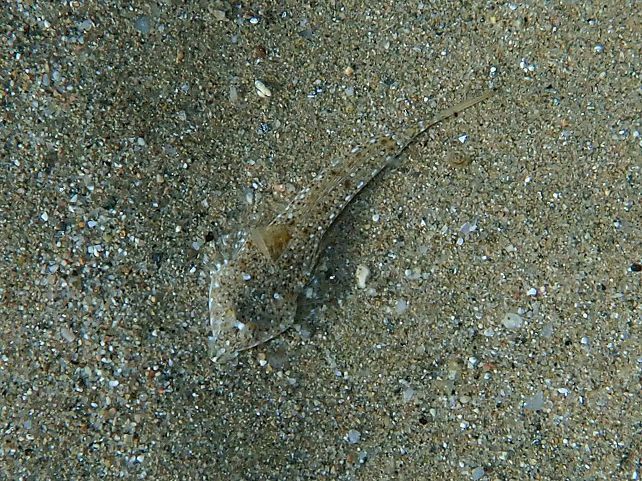
The sailfin dragonet (Callionymus pusillus) is a species of dragonet common in the Eastern Atlantic, where it occurs on the Portuguese coast to as far north as Lisbon and south to Morocco, and also in the northern Mediterranean…
- Kingdom
- Animalia
- Phylum
- Chordata
- Order
- Perciformes
- Family
- Callionymidae
- Genus
- Callionymus
- Species
- Callionymus pusillus
Description
The sailfin dragonet (Callionymus pusillus) is a species of dragonet common in the Eastern Atlantic, where it occurs on the Portuguese coast to as far north as Lisbon and south to Morocco, and also in the northern Mediterranean including the Adriatic, Aegean and Black seas as well as the coasts of Lebanon and Israel. It occurs on the southern Mediterranean shore as far east as Tunisia. Males of this species grow to a length of 14 centimetres (5.5 in) TL while females reach a length of 10 centimetres (3.9 in) TL. In the areas of the Mediterranean where it occurs it is one of the most common dragonet species, as it is the only species that has been recorded within many protected areas. It is a benthic species which occurs in shallow waters and prefers sandy bottoms down to 100 metres (330 ft). The males are territorial, aggressively defend their territories from other males and like other dragonets this species undergoes complex breeding behaviour which has 4 phases. This starts with courtship, the male and female then form a pair before ascending to the surface where they release eggs and milt. The spawning season runs from May to August in the Mediterranean and the eggs and larvae are pelagic. This species feeds mainly on small benthic invertebrates such as worms and small crustaceans. The sailfin dragonet has three upwardly directed spines on the preoperculum and differs from other species of dragonet by having a first dorsal fin which is lower than the second dorsal fin. The second dorsal fin has long rays which extend into long filaments. These filaments extend beyond the caudal fin. The male is brightly coloured with 14 to 16 silvery transverse lines fringed with black on its body and with blue streaks on the fins. The female is beige with small whitish spots.
En aquarium
Espèce d'eau de mer évoluant plutôt près du fond. Sur le plan biologique, elle atteint jusqu'à 14 cm, son régime est carnivore.
Paramètres relevés dans le milieu naturel de l’espèce (données scientifiques FishBase ; voir aussi la fiche Fishipedia). À adapter aux besoins précis de l’espèce en captivité.
Gallery
Ajouter des photos
Partagez vos photos de cette espèce (jusqu'à 20 à la fois) : elles sont vérifiées automatiquement, puis publiées.
Répartition
Occurrences observées (données GBIF). Les zones hors aire d'origine peuvent indiquer une présence introduite ou invasive.
Sources et crédits
Informations provenant de plusieurs sources vérifiées. Dernière mise à jour : .
Crédits photos (5)
- Photo : manelor · CC BY-NC-ND 4.0 · via GBIF
- Photo : Denis Makhnovsky (@denis_m) · CC BY-NC 4.0 · via iNaturalist
- Photo : Merav Vonshak (@merav) · CC BY-NC 4.0 · via iNaturalist
- Photo : @indi84 · CC BY-NC 4.0 · via iNaturalist
- Photo : Frédéric ANDRE (@frederic-andre) · CC BY-NC 4.0 · via iNaturalist
Mentions de licence
Texte disponible sous licence CC BY-SA 4.0. Il adapte notamment Wikipedia (CC BY-SA) : Sailfin dragonet (Wikipédia, auteurs dans l’historique de l’article).
- Taxonomie : GBIF Backbone Taxonomy (CC BY 4.0)
- Carte : occurrences GBIF, fond © contributeurs OpenStreetMap (ODbL)
- Statut de conservation : Liste rouge de l'UICN, via Wikidata (CC0)
- Paramètres d'aquarium : FishBase (faits reformulés)
Détail : Sources et licences.
Discussion (0)
Aucun message pour l’instant. Lancez la discussion sur cette fiche (sources, précisions, débats éditoriaux).
Connectez-vous pour participer à la discussion.